Stablecoins in DeFi: How They Power Lending and Trading
Stablecoins give DeFi a steady unit of value for lending, trading and saving. Learn where they sit in a protocol and what can go wrong.
On this page
Short answer
Stablecoins in DeFi are crypto tokens designed to hold a steady value, usually one dollar, that people use as the stable unit inside lending pools, trading pairs and savings products. They let users borrow, lend and trade without moving money back to a bank.
What are stablecoins in DeFi?
Stablecoins in DeFi are crypto tokens designed to hold a steady value, usually one dollar, that serve as the stable unit of account inside decentralised finance protocols. Instead of pricing a loan or a trade in a token that can move 10% in a day, users price it in a stablecoin.
A stablecoin is a token on a blockchain whose value is tied to something stable, most often a fiat currency such as the US dollar. In DeFi, stablecoins are the cash of the system: they are what you deposit as collateral, what you borrow, what you swap into when you want to stop holding a risky asset, and what you earn as interest.
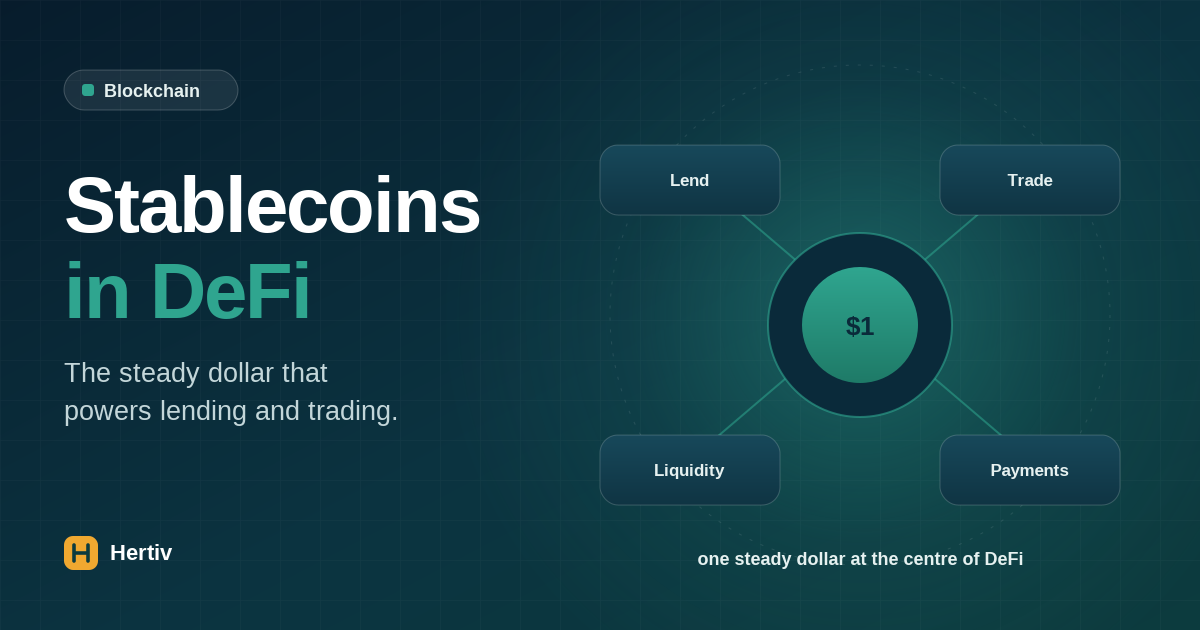
They appear in four main roles:
| Role | What the stablecoin does | Example |
|---|---|---|
| Unit of account | Prices loans, trades and fees in dollars | A loan quoted as 5,000 stablecoins |
| Collateral | Backs a loan without price swings | Deposit stablecoins to borrow crypto |
| Liquidity | Fills one side of a trading pair | A pool holding ether and stablecoins |
| Payments | Settles a transfer at a known value | Paying a supplier in stablecoins |
Without a stable unit, every DeFi position would carry two risks at once: the risk of the product itself and the risk of the currency it is priced in. Stablecoins remove the second risk, which is why they sit at the centre of most DeFi activity. For a plain definition of the tokens themselves, see what a stablecoin is.
Why does DeFi need a stable unit?
DeFi needs a stable unit because crypto prices move far more than the prices of the things people actually want to buy, borrow or earn. A loan priced in ether is a different loan every day, even if the interest rate never changes.
Consider a borrower who takes a loan worth 10,000 dollars in ether and plans to repay it in three months. If ether falls by a third, the borrower still owes the same amount of ether, which is now worth far less in dollars, while the lender receives less value back. If ether rises, the borrower repays more in dollar terms than planned. Either way, the price move drowns out the interest rate.
A stablecoin fixes the unit. Both sides agree the loan is 10,000 stablecoins, worth about 10,000 dollars at the start and at the end. The interest rate then means what it says, and the borrower can plan around it.
The same logic applies to trading. A trader who sells a token wants to know what the sale is worth in dollars, not in another token that may move before the trade settles. Stablecoins give traders a parking place between trades, so they can step out of a position without leaving the blockchain. That is one reason stablecoin trading pairs are among the most active in DeFi.
Where do stablecoins sit in a DeFi protocol?
Stablecoins sit in three places inside a DeFi protocol: in lending pools, in trading pools, and as the collateral that backs other positions. Each use has its own mechanics and its own risks.
In a lending pool, users deposit stablecoins and earn interest from borrowers. The pool lends them out to borrowers who post collateral, and the interest rate moves with supply and demand. When many people want to borrow and few want to lend, the rate rises; when the pool is full of idle stablecoins, the rate falls.
In a trading pool, a stablecoin usually forms one half of the pair. A pool holding ether and a stablecoin lets anyone swap between the two at a price set by the ratio of the two tokens in the pool. People who add both tokens to the pool earn a share of the trading fees.
As collateral, stablecoins back positions that need a steady base. A user might deposit stablecoins and borrow a volatile token, or mint a new token against stablecoin collateral. Because the collateral does not swing in price, the position is less likely to be liquidated by a sudden market move.
Some protocols also use stablecoins for their own treasuries and for paying contributors, so the stablecoin becomes the working currency of the whole project. If you are building in this space, DeFi development covers the lending, staking and yield products these tokens plug into.
What are the main types of stablecoin used in DeFi?
The main types of stablecoin used in DeFi are fiat-backed, crypto-backed and algorithmic, and they differ in what holds their price steady and who you must trust.
Fiat-backed stablecoins are backed by dollars or other assets held in bank accounts or short-term government debt by the issuing company. Each token is meant to be redeemable for one dollar. They are the most widely used in DeFi because their backing is simple to understand, but they rely on the issuer holding the reserves and honouring redemptions.
Crypto-backed stablecoins are backed by crypto assets locked in a smart contract, usually with more collateral than the stablecoins issued. A user might lock 150 dollars of ether to mint 100 stablecoins. The extra collateral absorbs price falls, and if the collateral value drops too far, the position is sold off automatically.
Algorithmic stablecoins try to hold their price with rules in code rather than with reserves, expanding or contracting supply as the price moves above or below one dollar. They have no reserves to fall back on, so a loss of confidence can break the peg quickly. Several high-profile algorithmic stablecoins have failed, which is why most DeFi protocols now treat them with caution.
Before choosing a stablecoin for a product, check how it is backed, whether its reserves are audited, and whether it can be redeemed. A stablecoin is only as steady as its backing and its redemption path.
How does a stablecoin loan work, step by step?
A stablecoin loan works by locking collateral in a lending protocol, borrowing stablecoins against it, and repaying them with interest. The steps are the same across most protocols.
- Deposit collateral. You send crypto, often ether or another token, into the lending protocol. The protocol values it at the current market price.
- Check the borrowing limit. The protocol lets you borrow only a share of your collateral value, often 60 to 80 percent, so a price fall does not leave the loan under-collateralised.
- Borrow stablecoins. You draw the loan in stablecoins, which arrive in your wallet and can be spent, traded or used elsewhere.
- Watch the health of the loan. If your collateral falls in value, your loan gets closer to liquidation. You can add collateral or repay part of the loan to stay safe.
- Repay with interest. You return the stablecoins plus the interest that has built up, and the protocol releases your collateral.
Interest on stablecoin loans is usually variable, moving with supply and demand in the pool. Borrowing when a pool is heavily used costs more, and the rate can change while your loan is open, so check whether the protocol offers a fixed-rate option before borrowing a large amount. The team behind a token should also understand how to launch a stablecoin before building products around one.
Example: a first stablecoin loan in DeFi
Example (hypothetical): a small trading firm holds 20,000 dollars of ether and wants 10,000 dollars in cash for a supplier payment, without selling the ether.
The firm deposits the ether into a lending protocol and borrows 10,000 stablecoins. The loan is half the collateral value, so the collateral ratio is 200 percent: 20,000 divided by 10,000. That gives the position room to absorb a price fall before liquidation.
The loan carries a variable rate of 5 percent a year. Over three months, the interest is 10,000 times 5 percent times one quarter, which is 125 dollars. The firm converts the stablecoins to dollars, pays the supplier, and three months later repays 10,125 stablecoins to release its ether.
If ether had fallen by 40 percent during those three months, the collateral would be worth 12,000 dollars against a 10,000 dollar loan, a ratio of 120 percent. The position would still be open, but close to the liquidation line, and the firm would need to add collateral or repay part of the loan. That is the trade-off of borrowing against a volatile asset.
What are the common mistakes?
The most common stablecoin mistakes in DeFi are treating all stablecoins as equally safe, borrowing to the maximum, and ignoring the peg.
- Assuming every stablecoin is worth one dollar. A stablecoin can trade below its peg if its backing is doubted or redemptions stall. Check the backing and the redemption path, not just the name.
- Borrowing to the limit. A loan at 80 percent of collateral leaves almost no room for a price fall. Borrowing less costs little in extra capital and avoids liquidation.
- Ignoring the variable rate. A rate of 3 percent can become 12 percent when a pool gets busy. A borrower who cannot afford the higher rate should use a fixed-rate product or borrow less.
- Holding a single stablecoin everywhere. If that stablecoin loses its peg, every position suffers at once. Spreading holdings across two or three well-backed stablecoins reduces that risk.
- Forgetting smart contract risk. The protocol holding your collateral can have a bug or be attacked. A stablecoin does not make the protocol around it safe.
Key takeaways
- Stablecoins give DeFi a steady unit of value, so loans and trades can be priced in dollars
- Fiat-backed, crypto-backed and algorithmic stablecoins differ in what holds the peg and who you must trust
- Stablecoins sit in lending pools, trading pools and as collateral inside DeFi protocols
- A stablecoin loan locks collateral, borrows a share of its value, and must be watched for liquidation
- Check the backing, the redemption path and the interest rate before using a stablecoin in DeFi
Frequently asked questions
Is a stablecoin the same as a dollar?
No. A stablecoin is a token designed to track one dollar, but its value depends on its backing and on whether holders can redeem it. Most of the time it trades at or near one dollar, but it can trade below its peg if confidence in the backing falls.
Which stablecoin is safest for DeFi?
There is no single safest choice. Fiat-backed stablecoins with published reserves and working redemptions are the most widely used, while crypto-backed stablecoins rely on over-collateralisation and automatic liquidation. Compare the backing, the audits and the redemption path before choosing.
Can I earn interest on stablecoins in DeFi?
Yes. You can deposit stablecoins into a lending pool and earn the interest borrowers pay, or add them to a trading pool and earn a share of trading fees. The return moves with supply and demand, and the protocol holding your deposit carries smart contract risk.
What happens if a stablecoin loses its peg?
Its price falls below one dollar, so loans, collateral and savings priced in it lose value. Lending protocols may liquidate positions, and trading pools reprice. This is why spreading holdings across more than one well-backed stablecoin is a common precaution.
Do stablecoins need a bank account?
Fiat-backed stablecoins rely on the issuer holding dollars or short-term government debt, so the issuer needs banking relationships. Crypto-backed stablecoins do not, since their backing is locked in a smart contract. Users of either type need no bank account to hold the token.
Are stablecoins in DeFi regulated?
Rules differ by country and are changing. Some regions now require stablecoin issuers to hold reserves and register, and businesses using stablecoins for payments should check local rules before launch. The regulatory picture is still developing, so treat any plan as subject to change.


