Stablecoins in Customer Service: Refunds and Payouts
Stablecoins in customer service speed up refunds, payouts and rewards for online shops. Here is how they work, where they help most, and the risks to manage.
On this page
Short answer
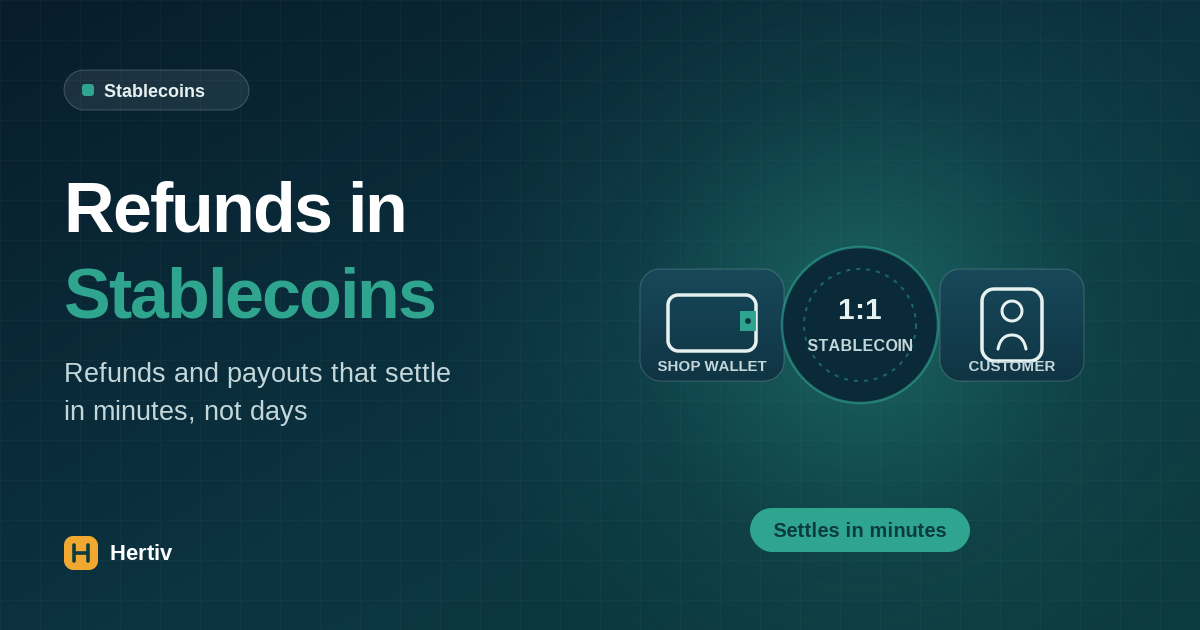
Stablecoins in customer service are dollar-pegged tokens a business uses to send refunds, payouts and rewards directly to a customer's wallet, instead of routing the money through cards or banks. They work best for cross-border customers and always-on shops, because the payment settles in minutes and runs outside banking hours.
What are stablecoins in customer service?
Stablecoins in customer service are dollar-pegged tokens that a business sends directly to a customer's crypto wallet to settle a refund, a payout or a reward. The token is designed to hold a steady value against a currency such as the dollar, so the amount the customer receives matches the amount the business intended to send.
The idea is simple: instead of a refund travelling through a card network and a bank over several days, the business sends tokens to the wallet address the customer provides. The customer can hold the tokens, spend them where they are accepted, or convert them to local currency.
| Use | What happens | Why it helps |
|---|---|---|
| Refund | Tokens sent to the customer's wallet | Settles in minutes, not days |
| Payout | Creators and sellers paid in tokens | One rail for many countries |
| Reward | Loyalty credit issued as tokens | Customer can use or convert it |
| Cross-border support | Customers outside card networks paid | Works where cards do not reach |
| Goodwill credit | Small credit after a bad experience | Fast apology with real value |
| Dispute settlement | Agreed amount sent with a record | Transfer is recorded on-chain |
Stablecoins do not replace card refunds for every customer. They are an extra option, offered where the customer already has a wallet and the business can handle the compliance checks that come with crypto payments.
How do stablecoin refunds work?
A stablecoin refund follows five steps, and the support agent's job is mostly checking, not moving money by hand.
- Request. The customer asks for a refund and provides a wallet address.
- Approve. The agent checks the order, the refund policy and the amount.
- Confirm the address. The team verifies the wallet address matches the customer, often with a small test or a checksum check.
- Send. The business sends the tokens from its wallet or payment provider.
- Record. The transaction is logged against the order so support, finance and the customer all see the same record.
The slow part is not the transfer, which settles in minutes, but the checks around it. Address confirmation and approval rules are what stop a refund going to the wrong wallet. Shops that already take stablecoin payments, as in stablecoins in retail, usually reuse the same wallet setup for refunds.
Where do stablecoins help most?
Stablecoins help most where cards are slow, costly or unavailable. A cross-border customer waiting five days for a card refund gets the same money in minutes, and a seller in a country with limited card support can be paid at all.
Marketplaces benefit because one rail can pay sellers in many countries without a separate payout partner per region. Always-on shops benefit because refunds do not wait for banking hours or weekends. Loyalty programmes benefit because a token reward can be spent or converted, which feels more useful than points locked to one store.
The fit is weakest where customers have no wallet and no interest in crypto. Offering stablecoins as the only refund option will frustrate those customers, so the best setups keep card refunds alongside and let the customer choose.
What are the costs and risks?
The costs are network fees and the work of running the process. Network fees vary by chain and by how busy it is, so check the network's fee page before promising a customer an exact amount. Staff time goes to address checks, approvals and record-keeping, not to the transfer itself.
The risks are real and need managing. A payment sent to a wrong address usually cannot be reversed, so address confirmation is the most important control. The token's peg can break in a crisis, so the business should hold only what it needs for near-term payouts. Compliance rules also apply: the business may need identity checks and records for crypto payments in its region.
Accounting needs care too. A refund in tokens must be recorded at its value in local currency on the day it is sent, or finance and support will disagree about what was paid. See what is a stablecoin for how the peg is supposed to work.
Example (hypothetical): refunding 200 orders a month
Example (hypothetical): an online shop processes 200 refunds a month. Each refund takes about 12 minutes of staff time by hand: checking the order, raising the refund in the card system, and answering the customer's follow-up about when the money will arrive. That is 200 x 12 = 2,400 minutes, or 40 hours a month.
With stablecoin refunds, the agent checks the order and confirms the wallet address in about 3 minutes, then the transfer settles itself. That is 200 x 3 = 600 minutes, or 10 hours a month. The team saves about 30 hours a month, and customers stop asking where their refund is because it arrives the same day.
The shop keeps card refunds for customers without a wallet, so nobody is forced onto crypto. The 30 saved hours go to the cases that need a person: damaged goods, wrong items and complaints that need a call.
What are the common mistakes?
The most common stablecoin customer service mistakes are skipping address checks, offering crypto as the only refund option and ignoring the compliance and accounting work.
- Skipping address confirmation. A transfer to a mistyped address is usually gone for good.
- Only offering crypto refunds. Customers without a wallet need the card option kept open.
- Ignoring compliance checks. Identity and record rules still apply to token payments.
- Holding too many tokens. Keep only what near-term payouts need, not a large balance.
- Forgetting the accounting. Record each payment at its local-currency value on the day it is sent.
Most of these mistakes are easy to avoid with a short checklist and a named owner for the wallet. A team that reviews the first month of token refunds closely learns quickly where the process needs tightening.
How do you start with stablecoins in customer service?
You start with stablecoins in customer service by offering them as one refund option for a small group of customers, with clear rules and a named owner.
- Pick one use case, such as refunds for cross-border orders, and a named owner.
- Set the rules. Decide which customers are offered tokens, how addresses are confirmed and who approves each payment.
- Choose one token and one network and document the fee and the accounting treatment.
- Pilot with a small group for a few weeks and review every transfer daily.
- Measure time saved and customer feedback, then expand only if the pilot beats card refunds on both.
Keep the pilot small enough to watch closely. A team that checks every address and reviews every transfer for two weeks learns where the process helps and where it needs a rule change. Shops planning wider crypto payments often pair this with stablecoin payment infrastructure once the first use case is working.
Key takeaways
- Stablecoins let a business send refunds, payouts and rewards directly to a customer's wallet
- They help most for cross-border customers, marketplaces and always-on shops
- Address confirmation is the key control, because a wrong transfer usually cannot be reversed
- Keep card refunds alongside so customers without a wallet are not forced onto crypto
- Start with one use case, one token and a daily review before expanding
Frequently asked questions
Do customers need a crypto wallet for a stablecoin refund?
Yes. The customer provides a wallet address that supports the token and network the business uses. Customers without a wallet should be offered the usual card refund instead, so nobody is forced onto crypto.
How fast is a stablecoin refund compared with a card refund?
A stablecoin transfer usually settles in minutes, while a card refund can take several days to appear. The checks around the transfer, such as approval and address confirmation, still take staff time.
Can a stablecoin refund be reversed if the address is wrong?
Usually not. Most token transfers are final once confirmed on the network, which is why confirming the wallet address with the customer before sending is the most important step in the process.
Do stablecoins lose value before the customer spends them?
They are designed to hold a steady value against a currency such as the dollar, but the peg can break in a crisis. Customers who want certainty should convert the tokens to local currency soon after receiving them.
What compliance rules apply to stablecoin refunds?
It depends on the region. The business may need identity checks, transaction records and reporting for crypto payments. Check local rules before offering token refunds, and keep the same records as for card refunds.
Which token should a shop use for refunds?
Pick one widely used, dollar-pegged token on one network and document the choice. The right pick depends on the shop's customers, the networks their wallets support and the fees on that network; see vendor site for current details.


