How Stablecoins Work in Crypto Derivatives Exchanges
Stablecoins are the money of crypto derivatives exchanges: traders post them as margin and settle contracts in them. Here is how they work and what can go wrong.
On this page
Short answer
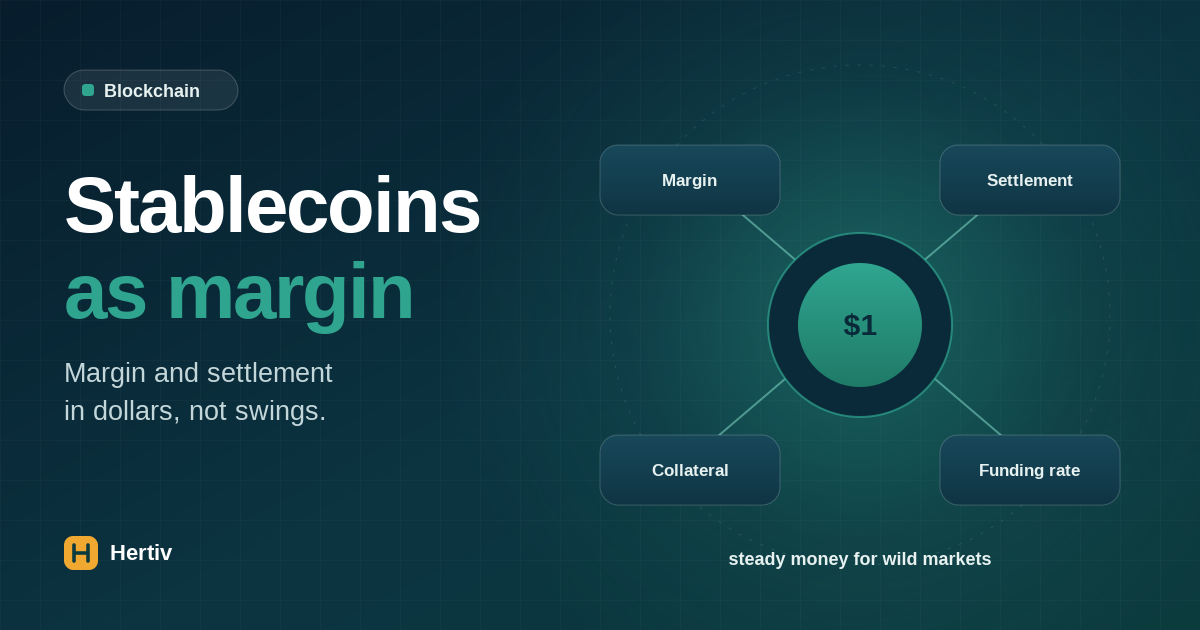
Stablecoins in crypto derivatives exchanges act as margin, settlement and collateral. Traders deposit a stablecoin such as USDT or USDC, post it as margin against futures and perpetual contracts, and settle profits and losses in the same coin. Using a stablecoin removes the price swing of the collateral itself, so a trader knows the dollar value of the margin at all times.
What are stablecoins in a derivatives exchange?
A stablecoin is a token designed to hold a steady value, usually one dollar, backed by reserves or by other crypto assets. On a derivatives exchange, stablecoins are the money traders use to open and settle contracts, instead of using a volatile coin such as bitcoin or ether as margin.
A derivatives exchange lets traders bet on the price of a crypto asset without owning it. The main contracts are futures, which settle on a set date, and perpetuals, which have no expiry and use a funding rate to track the spot price. Both need margin, which is the collateral a trader posts, and both need a settlement coin, which is what profits and losses are paid in.
Stablecoins fill both roles. A trader deposits USDT or USDC, the exchange holds it as margin, and every profit or loss is added or taken from that balance in the same coin. The trader never has to convert back to dollars, and the margin does not swing in value while the trade is open.
How do stablecoins work as margin?
Stablecoins work as margin by giving the exchange a dollar-valued deposit it can hold, measure and, if needed, sell. When a trader opens a position, the exchange locks part of the stablecoin balance as initial margin, and watches the remaining balance as maintenance margin. If losses eat into the maintenance margin, the exchange warns the trader or closes the position.
Using a stablecoin as margin has two clear effects. First, the margin value is stable, so a trader with $10,000 in USDT knows the margin is worth $10,000 an hour later. A trader who posts bitcoin as margin can see the margin itself fall 10% while the trade is open, which can trigger a liquidation even when the trade is going the right way.
Second, settlement is simple. A perpetual contract settled in USDT pays profits in USDT, so the trader's balance rises or falls in dollars. This is why most large derivatives exchanges settle their most traded contracts in USDT or USDC. For the basics of how these coins are built, see the guide to what a stablecoin is.
Which stablecoins do derivatives exchanges use?
The stablecoins most derivatives exchanges use are USDT and USDC, with smaller volumes in other dollar-pegged coins. USDT is the most widely accepted as margin, and USDC is often offered alongside it for traders who prefer its reserve reporting. Some exchanges also accept their own stablecoin or a fiat-backed coin from a partner.
| Stablecoin | Backing | Typical use on exchanges |
|---|---|---|
| USDT | Reserves, mostly short-term assets | Margin and settlement for most contracts |
| USDC | Cash and short-term US government debt | Margin and settlement, often alongside USDT |
| DAI | Over-collateralised crypto assets | Accepted on some decentralised venues |
| FDUSD | Cash and short-term assets | Margin on some exchanges |
Not every exchange accepts every coin, and the list changes. Check the exchange's margin page before depositing, and check whether the coin is accepted as margin, as settlement, or only as a deposit that is converted first. A coin that is only accepted as a deposit is less useful than one accepted directly as margin.
What are the risks of using stablecoins as margin?
The risks of using stablecoins as margin are the peg breaking, the issuer freezing funds, the exchange failing, and the trader's own position being liquidated. The margin itself is stable in normal times, but none of these risks disappears because the coin is called stable.
The peg is the first risk. A stablecoin can trade below a dollar when markets are stressed, and a trader whose margin is worth $0.95 on the dollar has less protection than they planned. The issuer is the second risk: centralised stablecoins can be frozen at an address, and a trader whose funds are frozen cannot trade or withdraw.
The exchange is the third risk. A trader's stablecoins sit in the exchange's wallets, so an exchange failure or hack can put them at risk. The fourth risk is the trade itself: high margin multiples mean a small price move can wipe out the margin, and the exchange closes the position automatically. Use lower margin multiples and keep part of the balance unposted, so one bad move does not close everything.
Example: a $10,000 stablecoin margin position
Example (hypothetical): a trader deposits $10,000 in USDT on a derivatives exchange and opens a long perpetual position worth $30,000, using a 3x margin multiple. The exchange locks $10,000 as initial margin, and the maintenance margin is $5,000, which is half of the initial margin.
The price of the underlying asset falls 10%. The position loses 10% of $30,000, which is $3,000, so the margin balance falls from $10,000 to $7,000. That is still above the $5,000 maintenance margin, so the position stays open.
Then the price falls a further 10% of the original $30,000, which is another $3,000. The margin balance falls to $4,000, below the $5,000 maintenance margin, and the exchange closes the position. The trader loses $6,000 of the $10,000 deposit and keeps $4,000. The loss is in USDT, so the remaining balance is still worth $4,000, which is the point of settling in a stablecoin.
What are the common mistakes?
The most common mistakes are using too high a margin multiple, keeping all funds on one exchange, and assuming the peg cannot break. Each one is avoidable with smaller positions and a habit of withdrawing what is not in use.
- Too high a margin multiple. A 20x position is wiped out by a 5% move; start with 2x or 3x and learn the funding rate first.
- All funds on one exchange. Split deposits across venues and withdraw idle stablecoins to a wallet you control.
- Ignoring the funding rate. Perpetuals charge a funding rate every few hours, and a long-held position can pay more in funding than it gains in price.
- Assuming the peg is fixed. Watch the coin's market price; if it trades below a dollar, your margin is worth less than you planned.
- No plan for liquidation. Decide the price at which you close before you open, and set the stop before the trade moves.
How to use stablecoins on a derivatives exchange safely
You use stablecoins on a derivatives exchange safely by choosing a widely accepted coin, keeping margin multiples low, and moving idle funds off the exchange. The steps below are a practical routine, not trading advice.
- Pick the settlement coin first. Choose USDT or USDC based on what the exchange accepts as margin, and check the coin's market price before depositing.
- Deposit only what you plan to trade. Keep the rest in a wallet you control, and top up only when you open a new position.
- Use a low margin multiple. Start at 2x or 3x, and raise it only after you understand the funding rate and the liquidation price.
- Watch the funding rate. Check it before opening a perpetual, and close positions that cost more in funding than they are worth.
- Set a stop and a take-profit. Decide both prices before you open, and let the exchange close the position if either is hit.
For a team building the exchange itself, the guide to crypto exchange development covers margin engines, settlement and risk controls from the builder's side.
Key takeaways
- Stablecoins act as margin and settlement on derivatives exchanges, so the collateral value stays steady
- USDT and USDC are the most widely accepted margin coins, with DAI and FDUSD on some venues
- The peg, the issuer and the exchange itself are all risks, even when the coin is called stable
- A 3x position loses $6,000 of a $10,000 margin on a 20% price fall, and is closed at the maintenance margin
- Keep margin multiples low, split deposits across venues, and withdraw idle funds
Frequently asked questions
Do all derivatives exchanges settle in stablecoins?
No. Some settle in the underlying coin, such as bitcoin, and some settle in stablecoins. Stablecoin-settled contracts are the most traded because the profit and loss is in dollars, which is easier to plan around. Check the contract page before trading.
What is the funding rate on a perpetual contract?
The funding rate is a periodic payment between long and short traders that keeps the perpetual price close to the spot price. When more traders are long, longs pay shorts, and the other way round. It is charged every few hours, so a long-held position can cost more in funding than it gains in price.
Can a stablecoin lose its peg while I hold a position?
Yes. A stablecoin can trade below a dollar when markets are stressed or when traders doubt the reserves. If your margin is in that coin, its dollar value falls with the peg, which can bring a liquidation closer. Watch the coin's market price, not just its name.
Is it safer to use USDT or USDC as margin?
Both are widely used, and neither is risk-free. USDT is accepted on more venues, while USDC publishes reserve reports more often. The safer choice depends on the exchange, the coin's market price at the time, and how much you keep on the exchange.
Why do exchanges prefer stablecoins over bitcoin as margin?
Because the margin value does not swing. A bitcoin margin can fall in value while the trade is open, which can trigger a liquidation even when the trade is going the right way. Stablecoin margin stays at its dollar value, so the risk math is simpler for both sides.
Can I withdraw my stablecoins at any time?
Usually yes, if the funds are not locked as margin for an open position. Close or reduce the position first to free the margin, then withdraw. Some exchanges pause withdrawals during maintenance or extreme market stress, so do not keep funds you need at short notice on an exchange.


