How Much Do Stablecoin Payments Cost?
Stablecoin payments usually cost from a few cents to about 1% of the amount sent. Network, provider and conversion fees make up the bill, and each one can be cut.
On this page
Short answer
A stablecoin payment usually costs from a few cents to about 1% of the amount sent, depending on the chain, the provider and whether the money is converted back to fiat. Network fees pay the chain, the payment provider takes a cut, and converting to bank money adds more. For most businesses the total lands well below card fees on cross-border orders, but above card fees on small domestic ones.
What are stablecoin payments?
A stablecoin payment is a transfer of a dollar-pegged token, such as USDT or USDC, from one wallet to another, settled on a blockchain instead of through card networks or bank rails. The value stays near one dollar, so the sender and receiver do not take on the price swings of other crypto assets.
The payment moves in minutes and can cross borders without a correspondent bank in the middle. That is the main reason businesses use stablecoins for supplier payments, payroll for remote staff and cross-border sales, where cards and wires are slow and take a larger cut.
Stablecoin payments still need the same plumbing as any payment: a way to hold the tokens, a way to check the receiver, and a way to turn tokens back into bank money when needed. Each of those steps can carry a fee, which is why the total cost is more than the network fee alone. A general guide to the setup is covered in stablecoin payments for business.
What makes up the cost of a stablecoin payment?
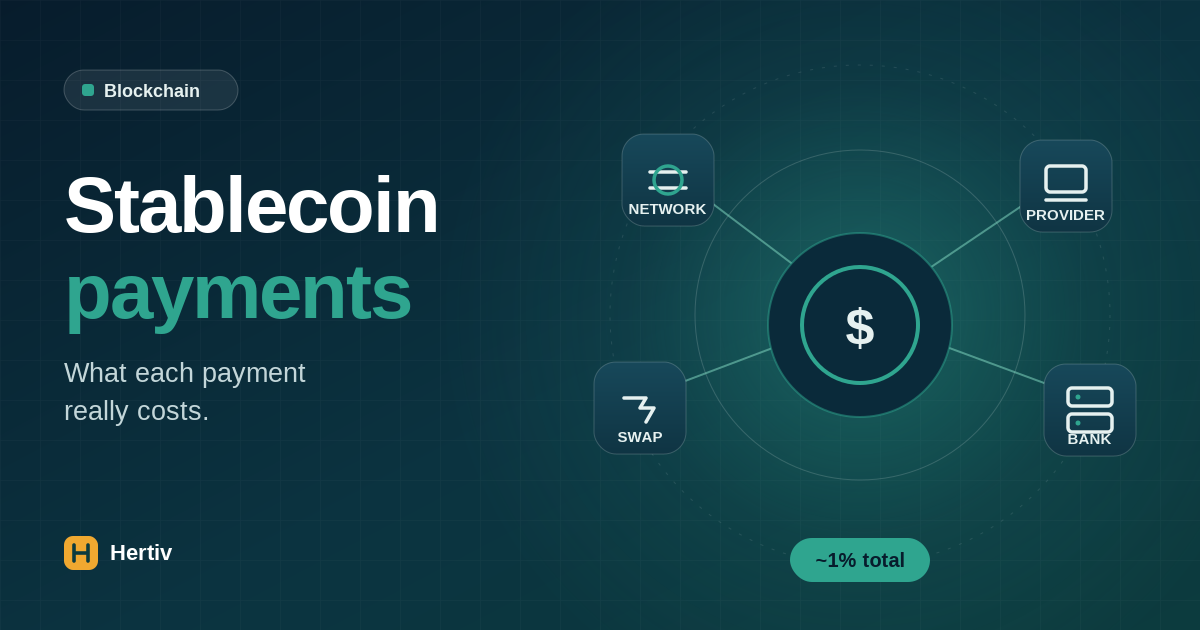
The cost of a stablecoin payment comes from four parts, and each one is set by a different party. Knowing which part you are paying is the first step to cutting the bill.
| Cost part | What it pays for | Who sets it | Typical size |
|---|---|---|---|
| Network fee | Validating the transfer on the chain | The chain, driven by congestion | A few cents to a few dollars |
| Provider fee | Processing, custody and compliance | Your payment provider | A percentage of the amount |
| Conversion spread | Swapping one token or currency for another | The exchange or market maker | A small percentage |
| Off-ramp fee | Moving fiat money to a bank account | The bank or provider | Flat fee or a percentage |
For a payment that stays in stablecoins from sender to receiver, only the network fee and the provider fee apply. The bill grows when the receiver needs bank money, because conversion and off-ramp fees are added on top. Most businesses that accept stablecoins from customers pay all four parts on at least some payments.
How network fees change the bill
Network fees depend on the chain you use and how busy it is at the moment of the transfer. A payment on a low-fee chain can cost a few cents, while the same payment on a congested chain can cost several dollars, even though the amount sent is identical.
Chain choice is the biggest single lever on network fees. Some chains are built for cheap transfers and keep fees low by design, while others prioritise security and decentralisation and charge more when demand is high. The token matters too: the same stablecoin can exist on several chains, and the fee differs on each one.
Timing and batching also matter. Sending one large payment is cheaper per dollar than sending many small ones, because the network fee is mostly per transfer rather than per dollar. Businesses that pay many people often batch payments into a single transfer or use a chain with lower fees for routine payouts. What a stablecoin is explains which chains the main stablecoins run on.
Provider fees and conversion costs
Payment providers charge for the work around the transfer: holding tokens in custody, checking the receiver, screening for sanctions, and keeping records for tax and audit. These fees are usually a percentage of the amount, and they vary widely between providers, so comparing them is worth the effort.
Conversion is where hidden costs appear. If a customer pays in USDC and your supplier wants USDT, someone swaps one for the other and takes a spread. If the receiver wants bank money, the provider sells the tokens and sends fiat, which adds an off-ramp fee and sometimes a currency conversion fee as well.
Ask providers for the full fee schedule before you commit, including the spread on conversions and the cost of withdrawing to a bank. A provider that advertises zero transfer fees may charge more on conversion, so the cheapest headline rate is not always the cheapest total. For the infrastructure behind this, see stablecoin payment infrastructure.
Example (hypothetical): a merchant's monthly stablecoin bill
Example (hypothetical): a merchant receives 1,000 stablecoin payments in a month, averaging $200 each, for $200,000 of volume. Each payment carries a network fee of $0.50, a provider fee of 0.5% and, on half the payments, an off-ramp fee of 0.25% when the money is converted to bank money.
The network fees add up to $500 (1,000 payments times $0.50). The provider fee is 0.5% of $200,000, which is $1,000. The off-ramp fee applies to $100,000 of volume at 0.25%, which is $250. The total bill is $1,750 for the month, or 0.875% of volume.
That total is well below the 2% to 3% a card network would take on the same volume, but the merchant still pays more than the network fee alone would suggest. If the merchant kept more of the money in stablecoins instead of converting it, the off-ramp fee would shrink and the total would fall further.
How to keep stablecoin payment costs down
You keep stablecoin payment costs down by choosing the cheapest chain that your customers and suppliers actually use, and by cutting the number of conversions in the flow.
- Pick a low-fee chain. Compare the network fee on the chains your counterparties use, and settle on the one that is cheapest for your typical payment size.
- Batch small payments. Group payouts into fewer, larger transfers so you pay the network fee once instead of many times.
- Reduce conversions. Pay suppliers in the same stablecoin you receive, so no swap or off-ramp fee is added.
- Compare provider fee schedules. Get the full schedule, including spreads, from at least two providers before choosing one.
- Review monthly. Fees change with congestion and provider pricing, so check the total cost as a share of volume each month.
Small changes add up. Cutting the network fee from $1.00 to $0.10 on 1,000 payments a month saves $900 a month, which is more than most provider discounts are worth.
Common mistakes with stablecoin payment costs
The most common mistakes are counting only the network fee, ignoring conversion spreads, and choosing a chain your customers do not use.
- Counting only the network fee. Provider, conversion and off-ramp fees often exceed the network fee on larger payments.
- Ignoring the spread. A swap that looks free can hide its cost in a worse exchange rate.
- Choosing an unpopular chain. A cheap chain is no help if your customers hold their tokens elsewhere and must bridge them over.
- Paying per payment instead of batching. Many small transfers multiply the network fee for no benefit.
- Forgetting tax and accounting. Stablecoin receipts still need records, and the cost of that work belongs in the total.
Key takeaways
- Stablecoin payments cost from a few cents to about 1% of the amount, depending on chain and provider
- Network fees, provider fees, conversion spreads and off-ramp fees are the four parts of the bill
- Chain choice is the biggest lever on network fees, and batching cuts the number of fees paid
- Conversion and off-ramp fees often exceed the network fee on larger payments
- Track total cost as a share of volume monthly to catch fees that drift upward
Frequently asked questions
What is the cheapest way to send a stablecoin payment?
Use a low-fee chain that both sides already use, batch small payments into fewer transfers, and avoid converting to fiat unless the receiver needs bank money. The network fee is usually the smallest part of the bill, so the chain and provider choice matter more than the token.
Are stablecoin payments cheaper than card payments?
On cross-border orders they usually are, because card fees run at 2% to 3% while a stablecoin payment often totals under 1%. On small domestic orders the comparison is closer, because a flat network fee is a larger share of a small amount.
Do stablecoin payments have hidden fees?
The common hidden cost is the conversion spread, where a swap or off-ramp uses a worse exchange rate instead of charging a visible fee. Provider fee schedules sometimes omit this, so ask for the spread as well as the headline rate.
Which stablecoin is cheapest to send?
The cost depends more on the chain than on the token, because the same stablecoin can run on several chains with very different fees. Compare the fee on the chain you will actually use, not the token in general.
Can I avoid provider fees entirely?
You can send tokens directly from your own wallet and pay only the network fee, but then you take on custody, compliance checks and record keeping yourself. Most businesses find a provider cheaper once that work is counted.
How do I compare stablecoin payment providers?
Ask each provider for the full fee schedule: transfer fee, conversion spread, off-ramp fee and any monthly charge. Then run your own typical month through it and compare the totals as a share of volume.


