How to Build a Stablecoin on Solana
A Solana stablecoin is an SPL or Token-2022 token backed by reserves, built for fast, low-cost payments. Here is the full build, from token program to audit.
On this page
Short answer
Building a stablecoin on Solana means creating a token with the SPL Token program or the Token-2022 program, backing every token with reserves such as dollars or short-term government bonds, and publishing regular audits that prove the backing. Solana suits payments because blocks arrive in well under a second and fees are usually a fraction of a cent.
What is a Solana stablecoin?
A Solana stablecoin is a token on the Solana blockchain that is designed to hold a steady value, usually one US dollar. Each token is backed by reserves, such as dollars in a bank account or short-term government bonds, and the issuer promises that any holder can redeem a token for a dollar. The best-known examples are USDC and USDT, which both exist as SPL tokens on Solana.
The token itself is simple: it is a standard Solana token with a fixed supply rule and a mint authority that creates new tokens only when new reserves arrive. The trust comes from outside the chain, from the reserves, the audits and the legal structure. A stablecoin with no reserves is not a stablecoin; it is a token with a price target and no way to keep it.
Solana is a popular home for stablecoins because payments settle fast and cost very little. A transfer usually confirms in seconds and costs a fraction of a cent, which makes the chain practical for everyday payments, remittances and trading. For a general guide to launching one, see how to launch a stablecoin.
Why build a stablecoin on Solana?
Three reasons draw stablecoin issuers to Solana: speed, cost and the payment apps already there. Blocks arrive in well under a second, so a payment confirms while the buyer is still looking at the screen. Fees are usually a fraction of a cent, so a one-dollar payment is worth sending, which is not true on chains where a transfer costs several dollars.
The third reason is the ecosystem. Solana already hosts payment apps, wallets, exchanges and merchant tools that accept SPL tokens, so a new stablecoin can reach users without building every integration from scratch. A wallet that already supports USDC can usually support a new SPL stablecoin with little extra work, as long as the token follows the standard.
There are trade-offs. Solana has had network outages in the past, and its history is shorter than Ethereum's, so some large institutions still prefer the older chain. A stablecoin issuer should weigh the speed and cost against the need for a long track record, and decide which matters more to its users.
SPL Token or Token-2022: which program?
Solana has two token programs, and the choice shapes what the stablecoin can do. The original SPL Token program is the simple standard behind most tokens on Solana, including USDC and USDT. Token-2022, also called Token Extensions, is the newer program, launched in January 2024, that adds optional features such as transfer fees, transfer hooks, confidential transfers and a pause control.
| Feature | SPL Token | Token-2022 |
|---|---|---|
| Basic transfers | Yes | Yes |
| Transfer fees | No | Yes |
| Transfer hooks | No | Yes |
| Confidential transfers | No | Yes |
| Pause control | No | Yes |
| On-chain metadata | No | Yes |
A simple payment stablecoin can use the original SPL Token program, which is the most widely supported and the easiest for wallets and exchanges to accept. A stablecoin that needs issuer controls, such as freezing an account under a court order or taking a fee on each transfer, needs Token-2022. The catch is that some older wallets and tools do not yet support Token-2022 tokens, so the issuer should check its users' wallets first.
Most regulated stablecoins on Solana use Token-2022, because regulators and partners expect the issuer to be able to freeze stolen funds and enforce rules. PYUSD, the PayPal stablecoin issued by Paxos, uses Token-2022 with extensions such as a permanent delegate and confidential transfers. A new issuer should expect the same questions from its own partners.
How to build it, step by step
Building a Solana stablecoin takes about three to six months for a first version, in seven steps. The token code is the smallest part; the reserves and the legal work take most of the time.
- Decide the model. Choose what backs the token, who can hold it, and which markets it will serve, before writing any code.
- Set up the legal entity and bank accounts. Create the company, open the reserve accounts with a regulated bank or custodian, and get legal advice on the markets you will serve.
- Choose the token program. Pick the SPL Token program for a simple payment token, or Token-2022 if you need issuer controls such as freezing or transfer fees.
- Write and test the mint program. Build the program that mints tokens when reserves arrive and burns them when tokens are redeemed, and test it on Solana's testnet.
- Build the mint and redeem flow. Connect payments, identity checks and wallets, so a user can buy tokens with dollars and redeem them back.
- Audit the code and the reserves. Get a security audit of the program and an audit of the reserves, and publish the reserve report.
- Launch on testnet, then mainnet. Run the full flow on testnet with real wallets, fix what breaks, then launch on mainnet with a small supply.
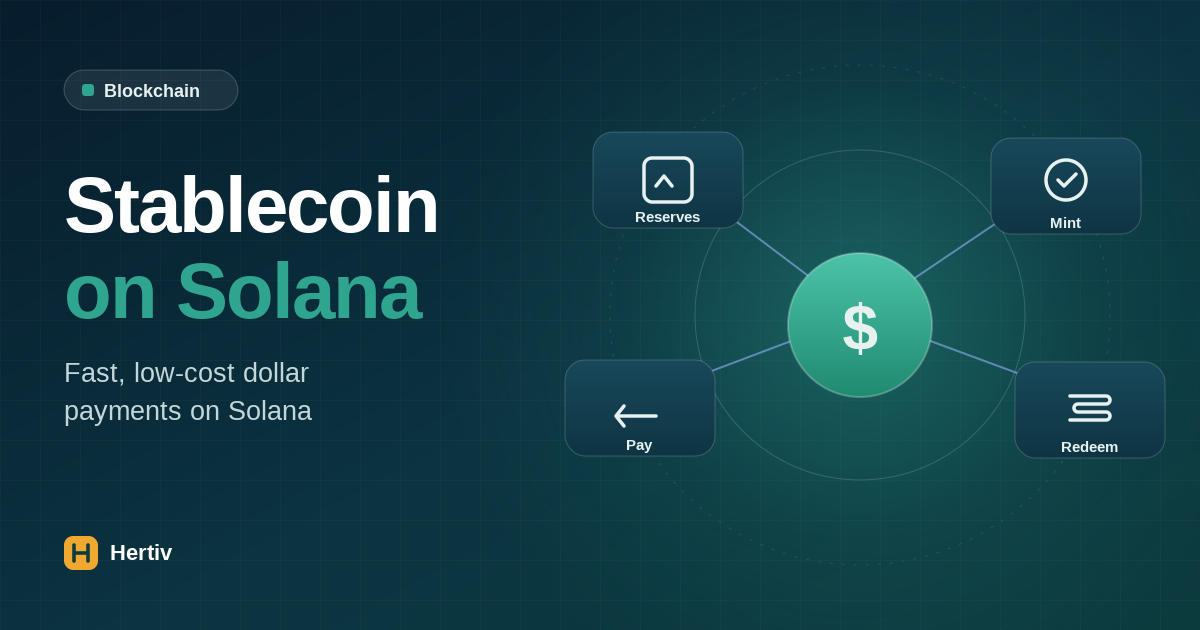
The mint and redeem flow is the core of the product. A user sends dollars, the issuer checks the payment, and the program mints the same number of tokens to the user's wallet. A redemption works in reverse: the user returns tokens, the program burns them, and the issuer sends dollars. The supply must always match the reserves, and any gap is a failure, not a rounding error.
Testing should happen on Solana's testnet first, with real wallets and real transfers, before any mainnet launch. The team should test failed payments, frozen accounts, large redemptions and a full audit of the supply, because these are the cases that break in production. For the network itself, see what Solana is.
Reserves, audits and rules
Reserves are the part of a stablecoin that users cannot see on the chain, and the part that matters most. A dollar-backed stablecoin should hold a dollar, or a dollar's worth of short-term government bonds, for every token in circulation. The reserves should sit with a regulated bank or custodian, not in the issuer's own operating account.
Audits prove the reserves exist. A reputable auditor checks the bank statements and the token supply on a regular schedule and publishes a report that anyone can read. Monthly reports are the norm for the larger stablecoins, and a new issuer should match that from the start. An issuer that hides its reserves, or publishes a report nobody can verify, will not win trust.
The rules depend on the market. In the European Union, the MiCA rules set reserve and licensing requirements for stablecoins. In the United States, the GENIUS Act, signed in July 2025, sets a federal framework for payment stablecoins. The United Kingdom is writing its own rules through the FCA.
A stablecoin that plans to serve users in more than one market needs legal advice in each one before launch. For the cost side, see stablecoin launch cost.
Example (hypothetical): a 1,000,000-token launch
Example (hypothetical): a payments company launches a Solana stablecoin with 1,000,000 tokens in circulation after three months. The reserves hold $1,000,000 in a bank account and short-term bonds, so each token is backed by exactly one dollar. The company charges merchants a 0.1% fee on payments, and $2,000,000 a month flows through the token.
The fee income is $2,000,000 times 0.1%, which is $2,000 a month. Running costs are $12,000 a month: $5,000 for the audit and legal work, $4,000 for custody and banking, and $3,000 for hosting and support. The stablecoin loses $10,000 a month at this size, which is normal for a new issuer: the reserves earn interest, and the business grows by adding volume.
At this volume the company needs about $12,000,000 a month in payments to break even on fees alone: $12,000,000 times 0.1% is $12,000, which matches the running costs.
The numbers are assumptions, not a promise. They show why a stablecoin is a volume business: the fee per payment is tiny, so the issuer needs large flows or other income, such as interest on reserves, to cover the fixed costs. For how to build on the network, see how to build on Solana.
What are the common mistakes?
The most common mistakes are treating the token as the product, skipping the reserve audit, and choosing the wrong token program.
- Launching without reserves. A stablecoin with no reserves cannot keep its price. The reserves must exist before the first token is minted.
- Skipping the audit. A reserve report nobody can verify is the same as no report. Publish audits from a reputable firm on a regular schedule.
- Choosing the wrong program. A simple SPL token cannot freeze accounts or take transfer fees. If regulators or partners expect those controls, use Token-2022.
- Ignoring wallet support. Some older wallets do not support Token-2022 tokens. Check what your users' wallets accept before you choose.
- No redemption plan. Users must be able to get their dollars back. A stablecoin with no working redemption flow will lose trust fast.
- Skipping legal advice. Stablecoin rules differ by market. Launching in a market without legal advice risks a forced shutdown.
Key takeaways
- A Solana stablecoin is a dollar-pegged token backed by reserves, built with the SPL Token or Token-2022 program
- Solana suits payments because blocks arrive in well under a second and fees are usually a fraction of a cent
- Token-2022 adds issuer controls such as transfer fees, hooks, confidential transfers and a pause control
- The supply must always match the reserves, and audits prove the backing
- A stablecoin is a volume business: tiny fees only cover fixed costs at large payment flows
Frequently asked questions
What is a Solana stablecoin?
A Solana stablecoin is a token on the Solana blockchain designed to hold a steady value, usually one US dollar. Each token is backed by reserves such as dollars or short-term government bonds, and the issuer promises that holders can redeem a token for a dollar.
What is the difference between SPL Token and Token-2022?
SPL Token is the original Solana token program behind most tokens, including USDC and USDT. Token-2022, launched in January 2024, adds optional features such as transfer fees, transfer hooks, confidential transfers, a pause control and on-chain metadata.
How much does it cost to build a stablecoin on Solana?
The cost depends on the scope, the legal work and the audits, which are usually the largest items. The token code itself is a small part of the budget. A team should get quotes for the legal setup, the security audit and the reserve audit before setting a budget.
Are Solana stablecoins regulated?
It depends on the market. The European Union sets reserve and licensing rules under MiCA, and the United States has a federal framework under the GENIUS Act, signed in July 2025. The United Kingdom is writing its own rules through the FCA.
Can I redeem a Solana stablecoin for dollars?
A well-run stablecoin lets holders redeem tokens for dollars through the issuer, usually after an identity check. The issuer burns the returned tokens and sends dollars from the reserves. A stablecoin with no working redemption flow should not be trusted.
Why do stablecoins use Token-2022?
Regulated issuers use Token-2022 because it gives them controls that the original SPL Token program does not have, such as freezing an account under a court order, taking a fee on transfers, and hiding transfer amounts with confidential transfers.


