Solar Asset Tokenization: How Solar Projects Become Tokens
Solar asset tokenization turns a share of a solar farm's output into a digital token on a blockchain. Here is how it works, who buys in, and where the risks sit.
On this page
Short answer
Solar asset tokenization is the process of recording ownership of a solar energy asset, or a share of the income it produces, as digital tokens on a blockchain. Each token stands for a defined share of the project, such as a fraction of its electricity output or its revenue.
What is solar asset tokenization?
Solar asset tokenization is the process of recording ownership of a solar energy asset, or a share of the income it produces, as digital tokens on a blockchain. Each token stands for a defined share of the project, such as a fraction of its electricity output or its revenue.
The idea is to split a large asset into small pieces. A solar farm costs far more than one small investor can buy, but tokens let many investors each hold a small share. The blockchain keeps the ownership record, and the tokens can be transferred between holders without a paper share register.
Tokenization does not change the solar panels. The farm still produces power, sells it to a buyer and earns revenue. What changes is how ownership and income are recorded and traded. For the basics of the idea, see what tokenomics is.
How does a solar project become a token?
A solar project becomes a token in a sequence that starts with the asset and ends with a token that investors can hold. Each step needs paperwork and checks before the next one starts.
- Value the asset and its expected output. Measure the site, the panels and the expected yearly generation in kilowatt-hours.
- Set up a legal vehicle that owns the project. A company or fund holds the farm, the land rights and the power sales contract.
- Choose the blockchain and token standard. Pick the chain and the token rules for supply, transfers and record keeping.
- Write the token rules. State what each token pays, when it pays, and what happens if output falls short.
- Offer the tokens to investors. Sell under the securities rules that apply, which usually limit who can buy.
- List the tokens where they can trade. Trading is only possible where the rules allow it and a market exists.
The legal step is the slowest. Securities rules differ by country, and in most places a token that pays income from a solar farm is treated as a security, which limits who can buy it and how it can be sold. Teams that skip this step usually have to stop later.
What does a solar token actually represent?
A solar token can represent different things, and the difference matters. Some tokens represent ownership of the project company. Others represent a claim on the income the project earns. A third type represents the energy itself, such as a set number of kilowatt-hours. Solar is one part of a wider energy story; see blockchain in the energy industry for how the ledger is used across power markets.
| Token type | What the holder gets | Main risk |
|---|---|---|
| Ownership token | A share of the project company | Value follows the whole project |
| Revenue-share token | A share of income from power sales | Income falls if output or prices fall |
| Energy token | A set amount of electricity | Energy must be delivered or settled |
| Carbon credit token | A certified emission reduction | Depends on certification rules |
Read the token terms before buying. Two tokens for the same solar farm can give different rights, and the name on the token does not tell you which one it is. The terms should state what the token pays, when it pays and what happens if the farm produces less than expected.
Why would an investor buy a solar token?
Investors buy solar tokens for three reasons: a share of steady income from selling power, access to an asset that is normally too large to buy into, and a record they can check on a public ledger. Solar farms earn income over 20 years or more, which suits investors who want regular returns rather than a quick sale.
- Smaller minimum investment. Tokens split a large project into pieces a small investor can afford.
- Income tied to power sales. The return comes from electricity sold, not from a token price alone.
- Transparent production data. Output figures can be published on the ledger for holders to check.
- Energy diversification. A solar token adds an energy asset to a portfolio of shares and bonds.
The income is only as steady as the power contract. A farm that sells power under a long-term agreement with a fixed price has steadier income than one that sells into a spot market where prices move daily. Check the contract before the token.
What are the risks and limits?
Solar tokenization carries risks that have nothing to do with the blockchain. The farm may produce less power than forecast if the weather is poor or panels degrade. The buyer of the power may pay late or default. And the token may be hard to sell, because few buyers trade in small solar tokens.
- Regulation. Rules differ by country and change often, and a token can be restricted after it is issued.
- Output risk. Cloudy years and panel wear cut generation below the forecast.
- Counterparty risk. The power buyer may fail to pay, which hits token income directly.
- Low liquidity. Few buyers trade small solar tokens, so selling can take time or mean a discount.
- Smart contract risk. A bug in the token code can lock funds or pay the wrong holders.
The blockchain record does not protect against a bad project. It only records who owns what. A well-built token for a weak solar farm is still a weak investment, and a token that cannot be traded is worth less than the same share in a liquid market. For how tokenized assets are structured more broadly, see the RWA tokenization guide.
Example (hypothetical): a 5 megawatt solar farm is tokenized
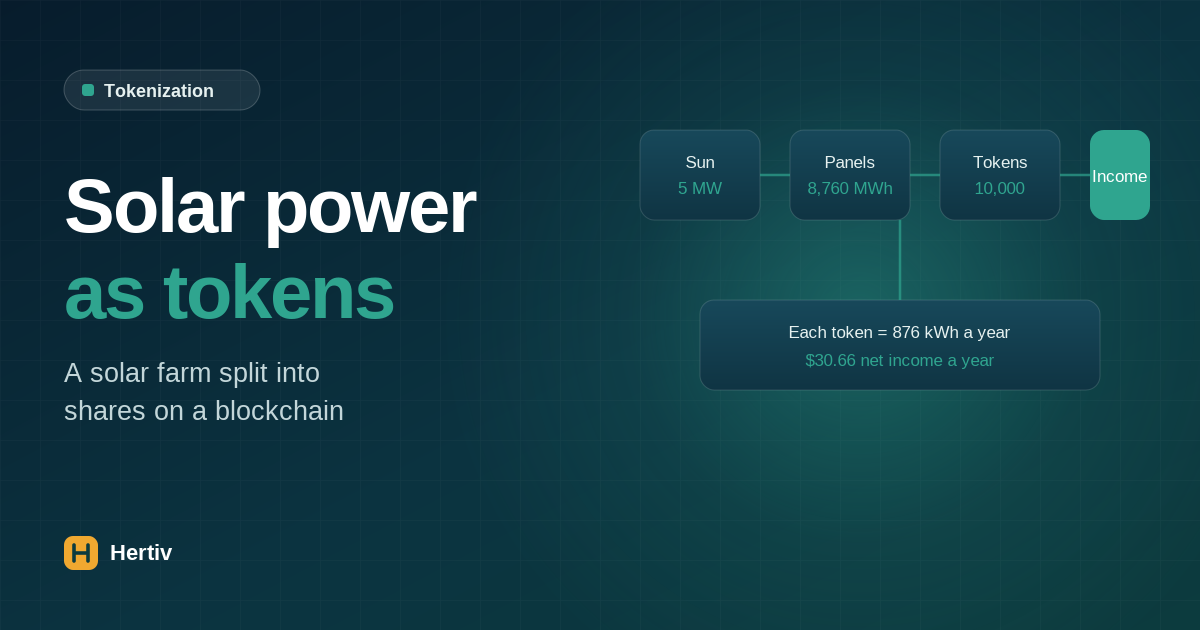
Example (hypothetical): a 5 megawatt solar farm runs at a capacity factor of 20%, which means it produces about 20% of its maximum output over a year. Yearly output is 5,000 kW x 8,760 hours x 0.20 = 8,760,000 kWh, or 8,760 MWh.
The project is split into 10,000 tokens, so each token stands for 8,760,000 / 10,000 = 876 kWh of yearly output. If the farm sells power at $50 per MWh, yearly revenue is 8,760 x $50 = $438,000, and each token earns 876 kWh x $0.05 = $43.80 a year before costs.
After operating costs of $15 per MWh, the net is $35 per MWh, so each token earns 0.876 x $35 = $30.66 a year. If the token sells for $400, the simple payback is $400 / $30.66 = about 13 years, which shows why buyers check the price per token against the income it pays.
What are the common mistakes?
The most common mistakes with solar tokenization are buying the token without reading the terms, assuming the token price will rise, and ignoring the power contract behind it.
- Buying without reading the terms. The token terms decide what you own and what you are paid; the marketing does not.
- Assuming the token price will rise. The value comes from power income, not from demand for the token itself.
- Ignoring the power contract. A farm without a buyer for its power has no income to share.
- No check on who runs the farm. Panels, inverters and maintenance decide whether output meets the forecast.
- Assuming tokens are easy to sell. Small solar tokens often have few buyers, so an exit can take months.
- Forgetting taxes and reporting. Token income and sales are usually taxable, and the rules differ by country.
Key takeaways
- Solar tokenization splits a large solar asset into small, tradable shares
- A token can mean ownership, a share of income, or a set amount of energy — read the terms
- Income depends on the power contract, the weather and the farm's upkeep
- The blockchain records ownership; it does not protect against a weak project
- Check price per token against yearly income before buying
Frequently asked questions
What is solar asset tokenization?
Solar asset tokenization records ownership of a solar project, or a share of the income it produces, as digital tokens on a blockchain. Each token stands for a defined share, such as a fraction of the farm's electricity output or revenue, and holders can transfer tokens without a paper share register.
How do solar tokens pay investors?
Most solar tokens pay from the income the farm earns by selling electricity. The operator collects the power revenue, deducts operating costs, and distributes the remainder to token holders, usually in a stablecoin or in local currency. The terms should state the payment schedule and the currency used.
Is solar asset tokenization legal?
It depends on the country and the token's design. In most places a token that pays income from a solar farm is treated as a security, which limits who can buy it and how it can be sold. Teams must follow the securities rules where they offer the token, and buyers should check that the offer complies.
How much can a solar token earn?
The income depends on the farm's output, the price it gets for power, and the operating costs. A token's yearly income is its share of output times the power price, less costs. Work through the numbers in the token terms before buying, and do not rely on a headline yield alone.
Can I sell a solar token later?
Only if a market exists for it. Some tokens trade on regulated exchanges or secondary platforms, while others can only be sold back to the issuer or held to maturity. Check whether trading is allowed, where it happens, and how many buyers are active before you buy.
What is the difference between a solar token and a carbon credit?
A solar token represents a share of a solar project or its income. A carbon credit represents a verified reduction in emissions, such as one tonne of carbon dioxide avoided. Some projects issue both, but they are different assets with different buyers, prices and rules.


