How Blockchain Is Changing the Energy Industry
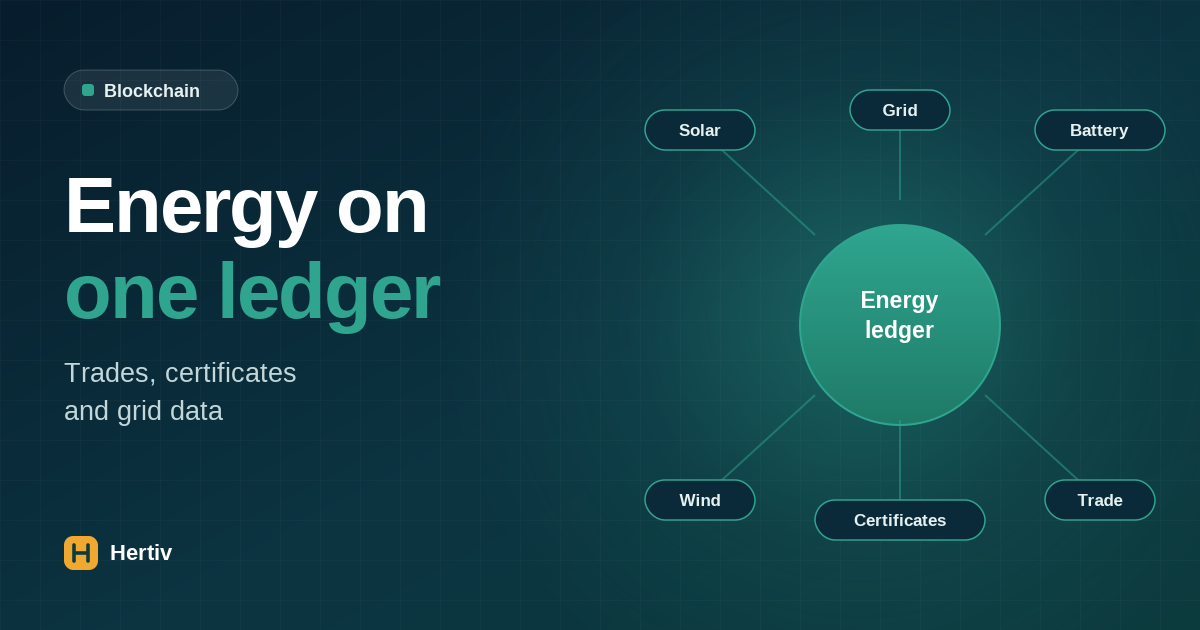
Blockchain gives energy a shared, tamper-proof record for trades, certificates and grid data, cutting paperwork and disputes between producers and buyers.
On this page
Short answer
Blockchain in the energy industry is a shared digital ledger that records energy trades, certificates and grid events in a form that all parties can check and none can quietly change. It replaces paper records and separate databases with one record that producers, grid operators, traders and buyers all trust.
What is blockchain in the energy industry?
Blockchain in the energy industry is a shared digital ledger that records energy trades, certificates and grid events in a form every party can check and no single party can quietly rewrite. Each entry is grouped into a block, linked to the one before it, and copied across the computers of the network.
The point is not the ledger itself but the trust it creates between organisations that do not fully trust each other. A solar farm, a grid operator, a trader and a buyer can all read the same record of what was produced, when it was produced and who owns it, without asking a central office to confirm it.
Most energy projects use permissioned chains, where only known organisations can write entries, rather than open public chains. That keeps the data private while still giving every participant the same version of the truth.
How does blockchain work for energy trading?
Energy trading on a blockchain starts when a producer records a batch of energy, for example one megawatt-hour from a solar farm, as a token or an entry on the ledger. A buyer then purchases that entry, and the ledger records the transfer along with the time, price and the parties involved.
Smart contracts automate the steps in between. A contract can release payment as soon as the meter data confirms delivery, or split the revenue between a farm owner and an investor the moment a sale clears. That removes days of manual matching between invoices, meter readings and bank transfers.
Settlement is the biggest gain. In traditional power trading, two parties can disagree for weeks about what was delivered and when. On a shared ledger, both sides read the same meter data and the same trade record, so the dispute has nowhere to start. Read what blockchain is first if the basics are new.
What can blockchain do for renewable energy certificates?
Renewable energy certificates prove that a unit of electricity came from a renewable source. Today they are issued, traded and retired through registries that can be slow and hard to audit, and the same certificate can sometimes be claimed twice by mistake.
On a blockchain, each certificate is a unique token with a clear history. When it is sold, the ledger shows the new owner. When it is retired, the token is marked as used and cannot be sold again. Anyone can trace a certificate back to the wind farm or solar plant that produced it.
That traceability matters for companies that report their emissions. An auditor can check the chain of ownership in minutes instead of requesting documents from several registries. The table below shows where the ledger helps most.
| Energy use case | What the ledger records | Main benefit |
|---|---|---|
| Peer-to-peer trading | Energy produced and sold between neighbours | Settlement without a middleman |
| Renewable certificates | Origin, owner and retirement of each certificate | No double counting |
| Grid balancing | Battery and flexible load responses | Faster, checkable payments |
| Supply chain tracking | Fuel and equipment origin | Auditable chain of custody |
| Carbon credits | Issuance, sale and retirement | One clear ownership history |
Can blockchain help the electricity grid?
The grid is becoming harder to manage as more homes add solar panels, batteries and electric cars. Power now flows in many directions, and the operator needs to know, minute by minute, who is producing, who is consuming and who can help balance the system.
Blockchain gives the grid a shared record of these small transactions. A home battery that discharges power at peak time can be paid automatically through a smart contract, and the record of that discharge is visible to the operator, the battery owner and the retailer at the same time.
The ledger does not replace the physical grid or its control systems. It records the commercial side: who did what, when, and what they are owed. That makes it easier to pay thousands of small producers fairly instead of only the large power plants.
What are the limits and risks?
Blockchain is not a fix for every energy problem. A ledger only records what is fed into it, so if a meter is faulty or a reading is entered wrongly, the chain will faithfully record a wrong number. Good data at the source matters more than the ledger itself.
Cost is a second limit. Running a network, writing smart contracts and connecting meters and billing systems takes real engineering work, and a small pilot can cost more than the paperwork it replaces. The business case only works when the volume of trades or certificates is large enough.
Rules are a third limit. Energy is heavily regulated, and a trade that is valid on a ledger still has to follow market rules, tax rules and grid codes. A project that ignores the regulator will be stopped, however good its technology is.
Example (hypothetical): a neighbourhood solar trade
Imagine a street with 20 homes, each with rooftop solar panels. On a sunny day the homes produce more power than they use, and the surplus flows to the local grid. Today the retailer buys that surplus at a fixed rate and resells it, and the homeowners see the result on a monthly bill.
With a blockchain pilot, each home's smart meter writes its surplus to a shared ledger every 15 minutes. A neighbour who charges an electric car at noon buys directly from the homes with surplus, and a smart contract settles the payment at the end of the day.
Take one day: the 20 homes export 400 kilowatt-hours in total. The neighbour buys 60 kilowatt-hours at 12 cents each, paying $7.20. The ledger shows 60 units sold, 340 units sent to the grid, and $7.20 owed to the sellers, split by how much each home exported. Nobody has to trust a single company's spreadsheet, because every home can read the same record.
Common mistakes
The first mistake is treating the ledger as a database. A blockchain is slow and expensive compared with an ordinary database, so it only earns its place when several organisations need the same record and do not trust a single keeper of it.
The second mistake is starting with the technology instead of the trade. Teams build a chain, then search for a problem it can solve. Start with the paperwork, the dispute or the delay that costs money, and only then ask whether a shared ledger removes it.
The third mistake is forgetting the meter. A ledger full of bad readings is worse than a spreadsheet, because people trust it more. Test the sensors, the data feeds and the smart contract on a small pilot before promising results to a regulator or a customer.
Key takeaways
- Blockchain is a shared, checkable record for energy trades, certificates and grid events.
- Smart contracts can settle trades and split revenue the moment meter data confirms delivery.
- Renewable certificates on a ledger are unique tokens, so they cannot be counted twice.
- The grid gains a fair way to pay many small producers, but the ledger cannot fix bad meter data.
- Start from the paperwork or dispute that costs money, not from the technology.
Frequently asked questions
Is blockchain used in energy today?
Yes, in pilots and early production systems for peer-to-peer trading, renewable certificates, grid balancing and carbon credits, mostly on permissioned chains run by known organisations.
Does blockchain replace the electricity grid?
No. It records the commercial side of energy, such as who produced, sold and bought power, while the physical grid and its control systems still move the electricity.
What is a smart contract in energy?
A smart contract is code on the ledger that runs a step automatically, such as releasing payment when meter data confirms delivery, without a person checking the paperwork.
Can blockchain stop double counting of certificates?
Yes, when each certificate is a unique token. Once it is retired, the ledger marks it used, so it cannot be sold or claimed a second time.
Is blockchain expensive for energy projects?
It can be. Running a network, writing contracts and connecting meters takes real work, so the case only pays when the volume of trades or certificates is large enough.
Do energy blockchain projects need a regulator?
Yes. Energy trades must follow market rules, tax rules and grid codes, so a project should involve the regulator early rather than after launch.


