Solana vs Base: Which Chain Should You Build On?
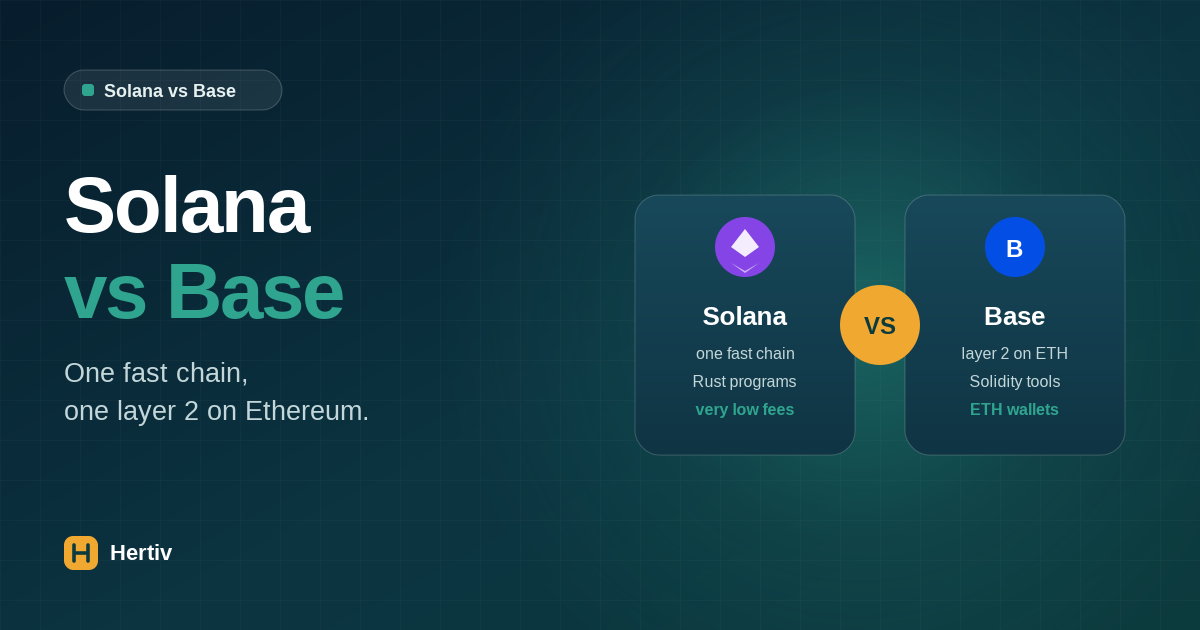
Solana is a fast single chain, while Base is a layer 2 on Ethereum. Compare speed, fees, tooling and ecosystem before you pick one.
On this page
Short answer
Solana and Base are two different answers to the same problem: how to run apps cheaply and quickly. Solana is a single high-speed chain with its own validators and token, while Base is a layer 2 network that settles on Ethereum and inherits its security. The right choice depends on the users you need, the tools you want, and how much you value Ethereum's ecosystem.
What is the difference between Solana and Base?
Solana and Base differ in where they get their security and speed. Solana is a layer 1 chain: it runs its own consensus, its own validators and its own token, and it is built to process many transactions quickly on one chain.
Base is a layer 2 chain built on Ethereum. It processes transactions off the main Ethereum chain, then posts the results back to Ethereum, which keeps the final record. Base is run by Coinbase, and it uses ETH for fees, so it sits inside the Ethereum world rather than outside it.
The practical difference is simple. On Solana you build in a self-contained system with its own tools and users. On Base you build in the Ethereum system, with access to its apps, wallets and liquidity, but with an extra layer between your app and the base chain. For the Solana side in detail, what Solana is explains how it works.
How do Solana and Base compare?
Solana and Base compare differently on speed, fees, security and ecosystem, and no single row decides the choice. The table below shows the main differences.
| Factor | Solana | Base |
|---|---|---|
| Type | Layer 1 chain | Layer 2 on Ethereum |
| Speed | Very fast, thousands of transactions a second | Fast, limited by how often it posts to Ethereum |
| Fees | Very low per transaction | Low, paid in ETH |
| Security | Its own validators and stake | Settles on Ethereum |
| Language | Mainly Rust | Solidity, like Ethereum |
| Ecosystem | Its own apps, wallets and tokens | Ethereum apps, wallets and liquidity |
Speed and fees favour Solana for high-volume, low-value activity such as games or micro-payments. Ecosystem and tooling favour Base when the app needs Ethereum's wallets, stablecoins or existing contracts.
How does each chain work?
Solana works by processing transactions in parallel and reaching agreement quickly, which is what lets it handle high volume on one chain. Its validators run the same software, agree on the order of transactions, and finalise them in seconds. The trade-off is that running a validator needs strong hardware, and the network has stopped or slowed down in the past.
Base works as a rollup. It runs transactions on its own sequencer, bundles them, and posts the bundle to Ethereum, where the record becomes final. This means Base can be fast and cheap while still using Ethereum as the source of truth.
The trade-off is that the sequencer is run by one operator today, and withdrawing to Ethereum takes longer than a transaction on Base itself. For the layer 2 idea in general, what layer 2 is explains how rollups work.
What about fees, speed and finality?
Fees, speed and finality are where the two chains feel most different to a user. Solana transactions usually cost a fraction of a cent and confirm in seconds, which makes it natural for apps where users act often, such as trading, games or tipping.
Base transactions cost more than Solana's but far less than a direct Ethereum transaction, and they confirm quickly on Base itself. Full finality waits until the bundle is posted to Ethereum, which takes longer, but most apps do not need to wait for that before showing the result to the user.
For a builder, the question is what the app does. If users pay a few cents per action and act many times a day, Solana's fees are hard to beat. If users act rarely and the app needs Ethereum's assets, Base's fees are low enough not to matter.
Which tools and ecosystem should you expect?
Solana's tools are built around Rust and its own program model, with wallets and apps that live in the Solana world. A team that already writes Rust will feel at home, and a team that does not will need to learn a new stack, including how Solana accounts and programs work.
Base's tools are Ethereum's tools. Solidity contracts, the same wallets, the same libraries, and the same stablecoins work on Base with little change, so a team that already builds on Ethereum can move an app to Base quickly. The ecosystem is the larger one: more wallets, more liquidity, and more apps that a new product can connect to.
That gap matters for hiring too. Solidity developers are easier to find than Rust developers for chain work, while Solana specialists are fewer and often cost more. A team should weigh the hiring cost against the performance gain before choosing. For the practical side of building on Solana, how to build on Solana covers the first steps.
Example (hypothetical): a team picks a chain for a payments app
Example (hypothetical): a small team builds a payments app for street vendors. Each vendor takes about 200 small payments a day, each worth about $2, and the app must settle fast so the vendor can see the money.
On Solana, 200 payments at a fraction of a cent each cost the vendor almost nothing, and each payment confirms in seconds. The team writes the app in Rust and uses Solana wallets, which the vendors already have.
On Base, the same 200 payments cost more in total, but the app can use the stablecoins and wallets the vendors already use on Ethereum, and the team can reuse a Solidity contract it already wrote. The team picks Base, because the vendors' existing wallets matter more than the fee difference on $2 payments. The lesson is that the users' wallets and assets often decide the chain, not the fee table.
What are the common mistakes?
The most common mistakes when choosing between Solana and Base are picking on fees alone, ignoring the users' wallets, and assuming a chain choice is easy to undo later.
- Choosing on fees alone. Fees matter for high-volume apps, but most apps are limited by users and distribution, not by a few cents per transaction.
- Ignoring the wallet gap. If your users hold their money on Ethereum, building on Solana means asking them to move it first.
- Assuming the choice is reversible. Moving an app between chains means rewriting contracts, wallets and integrations. Pick as if it is a long-term choice.
- Forgetting the sequencer. Base relies on one operator to order transactions today, so downtime or ordering rules are part of the risk.
- Overlooking outages. Solana has stopped in the past. A payments app needs a plan for the chain being down, whichever chain it picks.
Key takeaways
- Solana is a fast single chain; Base is a layer 2 that settles on Ethereum
- Solana wins on fees and speed for high-volume, low-value actions
- Base wins on Ethereum wallets, stablecoins, Solidity tooling and liquidity
- Users' existing wallets often decide the chain more than the fee table
- Treat the chain choice as long-term, because moving later means rewriting the app
Frequently asked questions
Is Base the same as Ethereum?
No. Base is a separate network that settles on Ethereum. Transactions run on Base and are bundled and posted to Ethereum, which keeps the final record. Base uses ETH for fees and works with Ethereum wallets and contracts, but it is not the Ethereum main chain itself.
Is Solana cheaper than Base?
Usually yes, per transaction. Solana transactions cost a fraction of a cent, while Base transactions cost more but are still far cheaper than a direct Ethereum transaction. For apps with many small payments, the gap matters; for apps with few transactions, it rarely decides the choice.
Can I move an app from Solana to Base later?
It is possible but expensive. Solana apps are written in Rust with Solana's program model, while Base apps use Solidity like Ethereum. Moving means rewriting the contracts, the wallets and the integrations, so it is better to treat the choice as long-term.
Which chain is better for a new token?
It depends on the audience. A token for Solana users belongs on Solana, where the wallets and trading apps already are. A token that needs Ethereum's stablecoins, exchanges and apps fits Base better. The users and the liquidity decide, not the chain's speed.
Does Base inherit Ethereum's security?
Partly. Base posts its transaction data to Ethereum, so the record is anchored there. But Base's own sequencer orders transactions today, and that is a separate point of trust. Read how the sequencer works before building an app that depends on it.
Why would a team pick Solana over Base?
For speed and cost on high-volume activity, and for a self-contained system where the team controls the whole stack. Games, trading and micro-payments fit Solana well, because users act often and each action must be cheap and fast.


