Solana Upgrades: Alpenglow, Firedancer and What Changes
Solana upgrades in 2026 centre on Alpenglow, a new consensus design, and Firedancer, a second validator client. Here is what each one changes and when it lands.
On this page
Short answer
Solana upgrades are changes to the Solana blockchain's protocol and software, proposed as Solana Improvement Documents (SIMDs), voted on by validators, and rolled out through validator client releases. The two largest upgrades in 2026 are Alpenglow, a new consensus design, and Firedancer, an independent validator client.
What are Solana upgrades?
Solana upgrades are changes to the Solana blockchain's protocol and software, proposed as Solana Improvement Documents (SIMDs), voted on by validators, and rolled out through validator client releases. A SIMD describes the change, the reasons for it and the risks, and validators vote with their stake before the change is scheduled for mainnet.
Upgrades fall into two groups. Protocol upgrades change the rules every validator follows, such as how blocks are agreed on or how fees work. Client upgrades change the software validators run, such as a faster client or a second independent implementation of the same rules.
The upgrades that matter most in 2026 are Alpenglow (SIMD-0326), which replaces the consensus system, and Firedancer, a new validator client built by Jump Crypto. Together they target the two weaknesses critics have pointed at for years: slow finality and a single validator client. For the basics of the network, see what Solana is.
What is Alpenglow and what does it change?
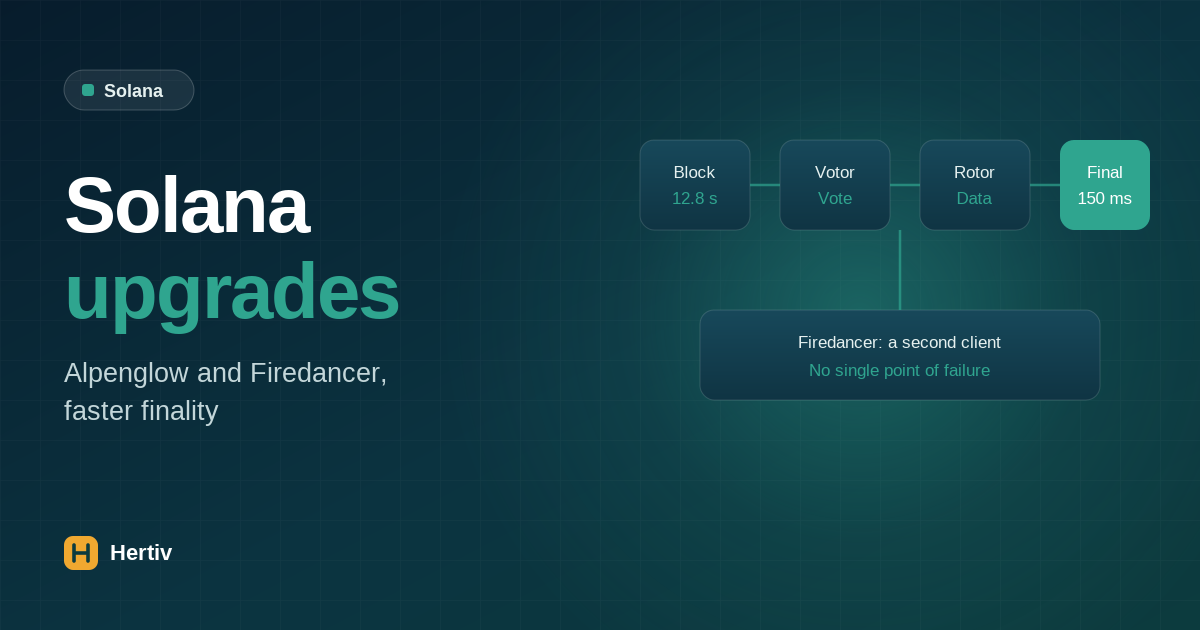
Alpenglow is a new consensus design for Solana, formalised as SIMD-0326. It replaces the two layers that have run consensus since launch: Proof of History, which orders events, and TowerBFT, which votes on blocks. In their place it puts two new components, Votor and Rotor.
Votor is the voting and finality system. It moves validator voting off-chain and reaches agreement in one or two rounds. If more than 80% of validators approve in the first round, the block is final at once; if approval lands between 60% and 80%, a second round runs and finality follows once approval passes 60%. The target is finality in about 100 to 150 milliseconds, down from roughly 12.8 seconds today.
Rotor is the data distribution system. It replaces Turbine, the current block propagation layer, and is designed to move block data between validators more efficiently. The first mainnet phase covers Votor, with Rotor following later. The table below sums up the change.
| Part | Before Alpenglow | After Alpenglow |
|---|---|---|
| Ordering | Proof of History clock | Removed from consensus |
| Voting | TowerBFT, on-chain votes | Votor, off-chain votes |
| Finality | About 12.8 seconds | About 100 to 150 milliseconds |
| Block data | Turbine propagation | Rotor propagation |
| Vote fees | Validators pay per vote | Vote fees removed |
Removing vote fees matters for smaller validators, because voting costs were a fixed expense that hit small operators hardest. A new admission ticket mechanism is planned to keep the validator set from growing without limit once those fees go away.
What is Firedancer and why does client diversity matter?
Firedancer is an independent validator client for Solana, built from scratch by Jump Crypto in C and C++. It implements the same protocol rules as the original Agave client, but it shares no code with it. That is the point: if a bug breaks one client, the other keeps running.
For most of its life Solana ran on a single validator client, which meant a single software bug could halt the network. Firedancer changes that by giving validators a second implementation to choose from. It went live on mainnet in December 2025 and began producing blocks, after a phased rollout that started with a hybrid client called Frankendancer, which pairs Firedancer's networking stack with Agave's execution layer.
Firedancer is built as a set of separate stages, each handling one part of transaction processing, such as signature checks, deduplication or execution. That design is aimed at high throughput under load, and it includes its own implementation of the QUIC transport protocol for receiving transactions. The table below compares the clients.
| Client | Built by | Language | Role |
|---|---|---|---|
| Agave | Anza | Rust | Reference client |
| Firedancer | Jump Crypto | C and C++ | Independent client, live on mainnet |
| Frankendancer | Jump Crypto | Mixed | Hybrid: Firedancer networking, Agave execution |
| Jito-Solana | Jito Labs | Rust | Agave fork with block building features |
Client diversity is a safety measure, not a speed contest. The value of a second client shows up on the day the first one has a bug, when the network keeps producing blocks instead of stopping. For how Solana compares with its main rival, see Solana vs Ethereum.
What is the upgrade timeline?
Alpenglow moved from proposal to testing in about a year. It was introduced in May 2025, passed a validator governance vote in September 2025 with 98.27% of participating stake voting yes and 52% of network stake taking part, and went live on a community test cluster in May 2026. Mainnet activation is targeted for the second half of 2026, through the Agave client release line, subject to testnet results and audits.
| Milestone | When | Status |
|---|---|---|
| Alpenglow proposed (SIMD-0326) | May 2025 | Done |
| Governance vote passed | September 2025 | Done, 98.27% yes |
| Firedancer live on mainnet | December 2025 | Done, producing blocks |
| Alpenglow on test cluster | May 2026 | Done, community testing |
| Alpenglow mainnet activation | Second half of 2026 | Targeted, not yet live |
| Rotor rollout | After Votor | Planned, later phase |
Timelines slip, and Solana upgrades are no exception. A mainnet date is a target until the client release is cut, the audits are finished and enough validators have upgraded. Teams building on Solana should plan around the testnet state, not the announced date, and keep their apps working on the current consensus until activation is confirmed.
What changes for users and developers?
For users, the visible change is faster confirmation. A payment or swap that today takes about 13 seconds to become final should settle in well under a second once Alpenglow is live. That matters most for apps where the user waits on the result, such as checkouts, game actions and trading, and it lets apps drop the loading screens they currently show while waiting for finality.
For developers, the main change is that finality becomes fast enough to treat as instant in most flows. Code that polls for confirmation, retries on timeouts or warns users about slow settlement can be simplified, but it should not be removed until mainnet activation is confirmed. A second change is client choice: developers who run their own validators or RPC nodes can pick between Agave and Firedancer, and should test their setup against both.
Fees do not change directly. Alpenglow removes vote fees, which validators pay, not users. User fees are set by the fee market and by priority fees, which are separate from consensus. Anyone promising lower user fees from Alpenglow alone is overstating it. Developers planning a new project can start with how to build on Solana.
Example (hypothetical): a payment app waits for finality
Example (hypothetical): a payment app processes 1,000 Solana payments a day, and each payment waits for finality before the app shows it as complete. At about 12.8 seconds per payment, the app's users spend 1,000 x 12.8 = 12,800 seconds, or about 3.6 hours, waiting across the day.
With Alpenglow finality at about 0.15 seconds, the same 1,000 payments take 1,000 x 0.15 = 150 seconds, or 2.5 minutes, of waiting in total. The app can show each payment as settled almost at once, which removes the need for a pending screen and lets the merchant release goods without a delay.
The gain is real but it is not the whole story. The app still needs to handle failed transactions, network congestion and wallet errors, and finality speed does not fix any of those. Faster settlement helps the happy path; the error paths still need the same care.
What are the common mistakes?
The most common mistakes around Solana upgrades are treating a testnet date as a mainnet date, assuming faster finality means lower fees, and building on only one client.
- Planning around an announced date. Mainnet activation follows testnet results and audits, and dates move. Ship against the current network, not the target.
- Confusing finality with fees. Alpenglow speeds up settlement; it does not set user fees, which come from the fee market.
- Testing on one client only. If your node or app only works with Agave, a Firedancer bug is not your problem, but an Agave bug is. Test both.
- Treating Firedancer as a consensus change. Firedancer is a client, not a protocol change. It runs the same rules, written in different code.
- Ignoring the vote-fee change. Validators that budget around vote fees need to rework their costs once Alpenglow removes them.
- Skipping the test cluster. Upgrades land on testnet first for a reason. Run your app there before mainnet activation.
Key takeaways
- Solana upgrades are proposed as SIMDs and voted on by validators
- Alpenglow replaces Proof of History and TowerBFT with Votor and Rotor
- Finality drops from about 12.8 seconds to about 100 to 150 milliseconds
- Firedancer gives Solana a second, independent validator client
- Mainnet activation is targeted for the second half of 2026, after testing
Frequently asked questions
What is the biggest Solana upgrade in 2026?
Alpenglow, formalised as SIMD-0326, is the largest change. It replaces the Proof of History and TowerBFT consensus layers with Votor, a new voting and finality system, and Rotor, a new data distribution system. It passed a validator vote in September 2025 and is targeted for mainnet in the second half of 2026.
What is Firedancer on Solana?
Firedancer is an independent validator client built by Jump Crypto in C and C++. It runs the same Solana protocol rules as the Agave client but shares no code with it, so a bug in one client does not have to stop the network. It went live on mainnet in December 2025 and began producing blocks.
How fast will Solana finality be after Alpenglow?
The target is about 100 to 150 milliseconds, down from roughly 12.8 seconds today. Votor reaches agreement in one or two voting rounds: the fast path finalises at once when more than 80% of validators approve, and the slow path finalises after a second round when approval passes 60%.
Do Solana upgrades change transaction fees?
Not directly. Alpenglow removes vote fees, which validators pay, not users. User fees are set by the fee market and by priority fees, which are separate from consensus. Faster finality does not by itself make a transaction cheaper.
What is the difference between Alpenglow and Firedancer?
Alpenglow is a protocol change: it rewrites how validators agree on blocks. Firedancer is a client change: it is new software that implements the same protocol rules in different code. Alpenglow changes the rules; Firedancer changes who writes the software that follows them.
When will Alpenglow go live on mainnet?
Mainnet activation is targeted for the second half of 2026, through the Agave client release line. The date depends on community test cluster results, audits and validator coordination, so it can move. Alpenglow went live on a public test cluster in May 2026.


