Solana Restaking: How One Stake Secures More Networks
Solana restaking lets staked SOL, or a liquid staking token, secure extra services beyond the base chain for extra rewards. Here is how Jito and Solayer work.
On this page
Short answer
Solana restaking is the reuse of SOL that is already staked, or of a liquid staking token that represents staked SOL, to secure additional services on Solana and earn extra rewards for it. One deposit keeps earning base staking rewards while also backing services such as oracles, bridges and data networks.
What is Solana restaking?
Solana restaking is the reuse of SOL that is already staked, or of a liquid staking token that represents staked SOL, to secure additional services on Solana and earn extra rewards for it. Instead of a deposit doing one job, it does two: it still secures the base chain, and it also backs services that need economic security of their own.
The idea arrived from Ethereum, where EigenLayer introduced restaking for staked ETH. On Solana, the extra services are called Node Consensus Networks, or NCNs. An NCN is a set of node operators that reach consensus on work done off-chain, such as an oracle feed or a bridge, and enforce the result on-chain. Restaked assets give those operators an economic commitment to follow the rules.
A normal SOL holder delegates SOL to a validator, the validator votes on blocks, and rewards arrive once per epoch, roughly every two days. Restaking adds a second layer on top of that: the same stake, or a receipt token for it, is delegated to an NCN, and the NCN pays its own rewards. For the base layer itself, see what is Solana and how its staking works.
How does restaking differ from plain staking?
Restaking differs from plain staking in what the stake secures and what can go wrong. Plain staking secures one chain; restaking secures the chain plus one or more extra services, and each extra service adds its own reward and its own risk.
| Feature | Plain staking | Restaking |
|---|---|---|
| What it secures | Solana base chain | Base chain plus NCNs |
| Rewards | Validator rewards | Validator plus NCN rewards |
| What you hold | SOL, or a liquid staking token | A vault receipt token |
| Main extra risk | Validator downtime | NCN slashing and smart contract risk |
| Liquidity | Depends on the token | Receipt token can be used in DeFi |
| Complexity | Low | Higher: vaults, operators, NCNs |
The key point is that restaking does not remove the base staking rewards. The deposit keeps earning those while it is restaked. What changes is that the principal is now exposed to the extra services as well, so a failure in an NCN can cost part of the deposit.
How does Jito restaking work?
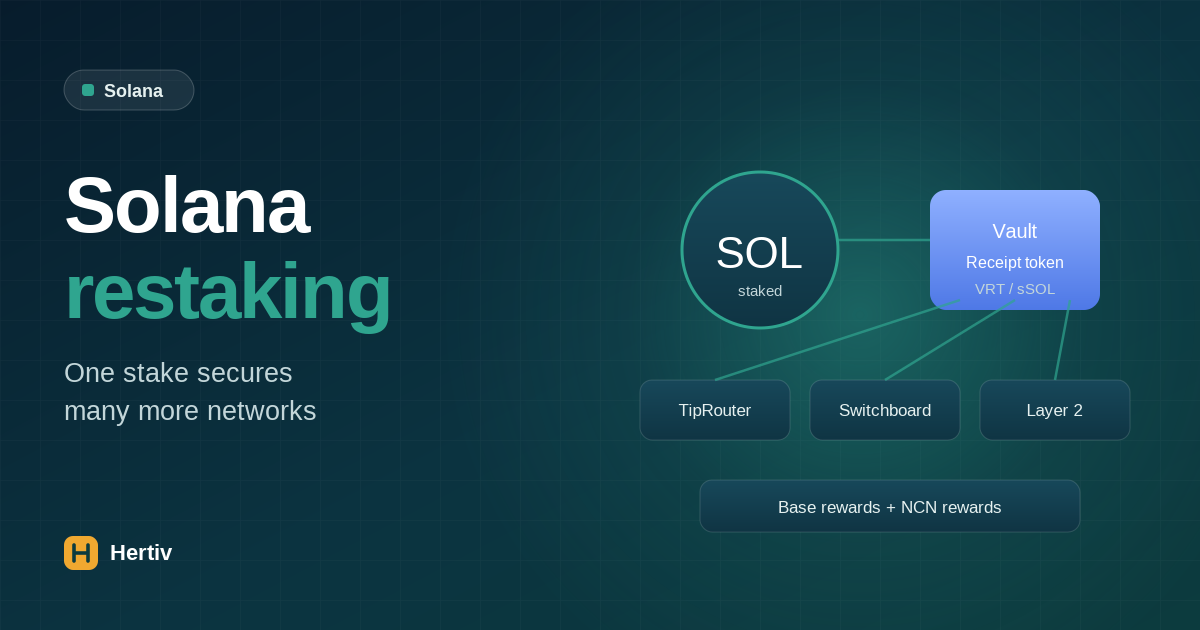
Jito restaking works through vaults. A holder deposits an asset such as JitoSOL, the liquid staking token for staked SOL, into a vault, and the vault issues a vault receipt token, or VRT, that represents the deposit. The vault then delegates that stake to approved node operators that serve specific NCNs.
Jito's restaking service launched in August 2024. Vaults accept JitoSOL, JTO and native SOL, and each vault defines which NCNs it supports, how stake is allocated across operators, and what fees it charges. Supported NCNs include TipRouter, which distributes MEV and priority fee revenue, and Switchboard, a decentralised oracle network.
MEV, short for maximal extractable value, is the extra value earned from the order of transactions inside a block. TipRouter shares that revenue with restakers, which is one of the ways NCN rewards are produced. VRTs stay liquid, so a holder can use them elsewhere in DeFi while the underlying stake is restaked. For a comparison of the chains involved, see Solana vs Ethereum.
How does Solayer restaking work?
Solayer restaking works by accepting native SOL or liquid staking tokens such as mSOL, JitoSOL and bSOL, and issuing sSOL as the receipt token. The holder can then delegate sSOL to secure services inside the Solana ecosystem, such as Layer 2 chains, native applications and decentralised cloud infrastructure.
Solayer launched on Solana mainnet in August 2024 and focuses on services that run inside Solana's base layer, which it calls endogenous services. That is the main difference from Jito's model: Jito's vaults secure NCNs that can be any off-chain service, while Solayer's sSOL is delegated to applications and infrastructure built on Solana itself.
Solayer also offers sUSD, a synthetic dollar backed by US Treasury bills. Like any receipt token, sSOL carries the risk of the underlying protocol: if the vault or the services it secures fail, the receipt token can lose value. For teams building on the chain, how to build on Solana covers the development side.
What are the risks of restaking SOL?
The risks of restaking SOL are smart contract risk in the vault, operator risk in the NCN, and slashing at the NCN level, on top of the risks plain staking already carries.
Smart contract risk is the risk that a bug in the vault or receipt token lets funds be taken or frozen. Vaults are new code, and audits reduce the risk without removing it. Operator risk is the risk that the node operators serving an NCN do the job badly or go offline, which can cut the NCN's rewards and, in some designs, trigger penalties.
Slashing deserves care. Solana has no base-level slashing, so a plain staker does not lose principal for a validator mistake. Restaked positions are different: each NCN defines its own slashing conditions, and a restaker agrees to them when depositing. That means the principal is at risk under NCN rules even though base staking never slashes. Rewards from NCNs are also not guaranteed; each NCN decides whether and how much it pays.
Example (hypothetical): restaking 100 JitoSOL
Example (hypothetical): a holder owns 100 JitoSOL and restakes it in a Jito vault. The vault issues a VRT representing the 100 JitoSOL, and the vault delegates that stake to operators serving two NCNs, TipRouter and Switchboard.
The position keeps earning base staking rewards on the underlying SOL, because the JitoSOL itself is still staked. On top of that, the NCNs pay their own rewards to the vault, which passes them to the restaker after fees. If TipRouter distributes revenue in a given epoch and Switchboard pays its oracle fee, the holder receives both, less the vault fee.
Now suppose one NCN slashes for an operator failure. If the vault had allocated 40 of the 100 JitoSOL to that NCN and the slashing condition takes 5% of the allocated stake, the loss is 40 x 0.05 = 2 JitoSOL.
The base staking rewards on the remaining 98 JitoSOL continue, but the holder has lost 2 JitoSOL to the NCN penalty. The lesson is to check how much stake each vault allocates to each NCN before depositing.
What are the common mistakes?
The most common mistakes in Solana restaking are treating NCN rewards as guaranteed, ignoring slashing terms, and depositing without reading the vault's allocation.
- Assuming rewards are fixed. NCN rewards depend on each network's revenue and rules, and they can be zero in an epoch.
- Skipping the slashing terms. Each NCN defines its own penalties, and restaking means accepting them.
- Not checking vault allocation. A vault that puts most of its stake in one NCN concentrates the risk in that network.
- Ignoring the receipt token. A VRT or sSOL can trade below the value of the underlying stake if the market doubts the protocol.
- Restaking everything. Keeping part of the stake in plain staking limits the exposure to vault and NCN failures.
- Forgetting the audit. A vault without a public audit, or with an audit that flags unresolved issues, deserves a second look.
How to decide whether to restake
You decide whether to restake by checking the vault, the NCNs it supports, and how much of your stake you are willing to put at risk for extra rewards.
- Read the vault terms. Check which assets it accepts, what receipt token it issues, and what fees it charges.
- List the NCNs. For each NCN the vault supports, note what it does, how it pays rewards, and what its slashing conditions are.
- Check the allocation. See how much of the vault's stake goes to each NCN and whether one network dominates.
- Check the audit. Look for a public audit of the vault contracts and whether the findings were fixed.
- Start small. Restake a small share of your stake first, watch the rewards and the receipt token price for a few epochs, and only then decide whether to add more.
Restaking is a young market on Solana, and the services it secures are still growing. The RWA side of the same ecosystem shows how new Solana services develop, as covered in Solana RWA tokenization, where issuers also weigh new infrastructure against the risks.
Key takeaways
- Restaking reuses staked SOL or a liquid staking token to secure extra services called NCNs
- Jito uses vaults and vault receipt tokens; Solayer issues sSOL for services inside Solana
- Base staking rewards continue while restaked, but NCN rewards are not guaranteed
- Solana has no base-level slashing, yet each NCN defines its own slashing conditions
- Check vault allocation, audits and slashing terms before depositing, and start small
Frequently asked questions
What is Solana restaking?
Solana restaking is the reuse of SOL that is already staked, or of a liquid staking token that represents staked SOL, to secure additional services on Solana and earn extra rewards for it. The deposit keeps earning base staking rewards while also backing services such as oracles and bridges.
How is restaking different from staking SOL?
Plain staking secures the Solana base chain and earns validator rewards. Restaking adds extra services, called Node Consensus Networks, on top of that, so one deposit earns validator rewards plus NCN rewards, and takes on the NCN's slashing and smart contract risks.
What are Jito and Solayer in Solana restaking?
Jito (Re)staking, launched in August 2024, uses vaults that accept JitoSOL, JTO and native SOL and issue vault receipt tokens. Solayer, also launched in August 2024, accepts SOL and liquid staking tokens and issues sSOL, focused on services inside Solana.
Can you lose money restaking SOL?
Yes. Solana has no base-level slashing, but each NCN defines its own slashing conditions, and a restaker accepts them on deposit. A vault bug or a failing NCN can also cost part of the deposit, so restaking puts the principal at risk, not just the rewards.
Is restaking the same as liquid staking?
No. Liquid staking gives you a receipt token for staked SOL, such as JitoSOL. Restaking takes that receipt token, or native SOL, and puts it to work securing extra services. Many restakers start with a liquid staking token and then restake it.
Do you need to restake all your SOL?
No, and most holders should not. Restaking a small share first lets you watch the rewards, the receipt token price and the vault's behaviour over a few epochs before deciding whether to add more.


