How to Choose a Software Development Partner
A software development partner builds and supports your product over months or years. Choose by checking their work, their process and how they handle problems.
On this page
Short answer
A software development partner is an outside team that designs, builds and supports your software over months or years, working as an extension of your own team rather than as a one-off supplier. Choosing well means checking their past work, their process, their communication and how they handle problems, not just their price.
What is a software development partner?
A software development partner is an outside company that designs, builds and supports your software over a long period, sharing responsibility for the result. Unlike a freelancer hired for one task, a partner stays through design, build, launch and the fixes that follow.
The relationship matters more than the contract. A good partner challenges weak requirements, flags risks early and tells you when a feature is not worth building. A poor partner builds exactly what you asked for, even when it is wrong.
Partners come in several models, from fixed-scope projects to dedicated teams. The right model depends on how clear your requirements are and how long you need the team.
What does a good partner actually do?
A good partner does more than write code. They help shape the product, run the delivery process, and keep the software healthy after launch.
| Partner model | Who manages the work? | Best when |
|---|---|---|
| Fixed-scope project | The partner, against a spec | Requirements are clear and stable |
| Dedicated team | You, with partner staff | You need capacity for months |
| Staff augmentation | You, day to day | You need one or two specialists |
| Product partnership | Shared, with joint goals | Long-term product evolution |
| Advisory and build | The partner advises, then builds | You need design and delivery |
Look for evidence, not claims. A partner should show real products they built, explain what went wrong on a project and how they fixed it, and let you talk to a past client. If they cannot do any of these, keep looking.
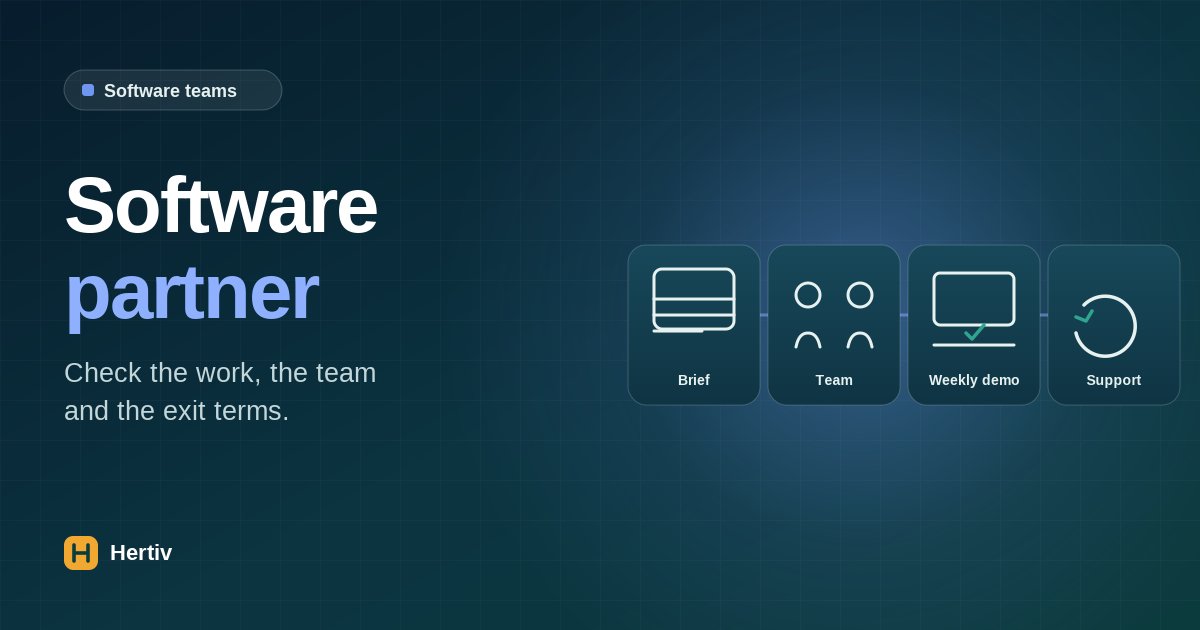
Communication is part of the work. Weekly demos, a shared task board and a single point of contact are basic expectations, not extras. See what is a dedicated development team for how the team model works in practice.
Support after launch is part of the job too. A partner should fix bugs, keep dependencies updated and handle small improvements after release. Ask how support is priced and how fast urgent issues get a response before you sign.
How do you judge a partner before signing?
You judge a partner before signing by checking their past work, their process and their people, in that order. A polished sales deck proves nothing; a shipped product proves a lot.
Ask for two or three products they built that are still live, and check them yourself. Then ask who actually built them: the people on your project should be the people you interviewed, not a different team assigned later.
Run a small paid trial before a large contract. Two weeks of real work on a real feature tells you more about communication, code quality and speed than any number of meetings. The comparison of dedicated team vs freelance developer helps decide which model fits your trial.
Also ask for references you can call, not just written quotes. A five-minute call with a past client reveals how the partner handled delays, budget changes and disagreements. Ask what the client would do differently if they started again.
What should the contract and working rhythm cover?
The contract and working rhythm should cover scope, ownership, communication and exit terms before work starts. Most partner problems come from gaps in these four areas.
Scope should state what is included and what is not, with a process for changes. Ownership should state that you own the code, the designs and the data from day one. Communication should set a weekly demo, a shared board and response times for urgent issues.
Exit terms matter most and are discussed least. Agree how knowledge is handed over, how code is documented and what happens if either side ends the contract. A partner that resists clear exit terms is a warning sign.
Intellectual property and confidentiality should be written down too. The contract should state that your product ideas, data and customer details stay yours, and that the partner cannot reuse your code for another client. This is standard, and a partner should accept it without argument.
Example (hypothetical): a retailer picking a partner for a rebuild
Example (hypothetical): a retailer needs to rebuild its online store and shortlists three partners. Each quotes a similar price, so the retailer runs a two-week paid trial with each on the same small feature: a new checkout step.
Partner A ships the feature in 9 days but with no tests. Partner B ships in 12 days with tests and clear documentation. Partner C asks for more time and ships in 14 days with tests and a note about a security issue they found.
The retailer picks Partner C, even though it was slowest. The trial cost $8,000 per partner, or $24,000 in total, but it revealed how each team works under real conditions. A wrong partner on a $200,000 rebuild would cost far more than the trial.
What are the common mistakes?
The most common mistakes when choosing a software development partner are picking on price alone, skipping the trial, and signing without exit terms.
- Cheapest quote wins. A low price often means junior staff, no testing or hidden change fees.
- No trial. Signing a six-month contract without two weeks of real work together is a gamble.
- No exit terms. If the partner holds your code or knowledge, leaving becomes expensive.
- Ignoring time zones. A team eight hours away needs a working rhythm, not just a weekly call.
- One decision maker. If only one person vetted the partner, the team may not trust the choice.
A partner should also be judged on the companies they have worked with. The list of software development companies shows what to look for when comparing firms.
Red flags to walk away from
Walk away from a partner that cannot show live work, will not let you meet the team, or refuses clear ownership and exit terms.
- No live products. Every project is confidential or unfinished.
- No team access. You meet sales staff only, never the developers.
- Vague pricing. No breakdown of rates, hours or change costs.
- No bad news. A partner that never flags a risk is either inexperienced or hiding problems.
- Pressure to sign fast. A discount that expires this week is a sales tactic, not a reason to commit.
Trust your notes from the trial more than the pitch. If communication was slow, documentation was thin or problems were hidden during two weeks, those patterns will repeat for six months.
Finally, involve your own engineers in the decision. They will work with the partner every day, and their view of code quality and communication matters as much as any manager's view of price.
Key takeaways
- A partner shares responsibility for the product, not just the code
- Judge partners on live work, the actual team and a paid trial
- The contract must cover scope, ownership, communication and exit terms
- A two-week trial on a real feature reveals more than any sales deck
- Walk away from vague pricing, no live work and no team access
Frequently asked questions
What is the difference between a partner and a vendor?
A vendor delivers a defined task and leaves. A partner stays involved across design, build and support, shares responsibility for the result and challenges weak requirements. The difference shows in how they handle problems, not in the contract title.
How much does a software development partner cost?
It depends on team size, location and model. A small dedicated team costs far less than a large one, and a fixed-scope project depends on the spec. Get a breakdown of rates and hours, and compare trials rather than headline prices.
Should I choose a local partner or a remote one?
It depends on how you work. A local partner helps for in-person workshops and shared hours, while a remote partner often costs less. What matters most is the working rhythm: weekly demos, shared boards and fast answers to questions.
How long should the first contract be?
Start with a short trial of two to four weeks, then a contract of three to six months. A long first contract removes your leverage if the partnership is not working, while a short one lets both sides learn how to work together.
Who owns the code the partner writes?
You should. The contract must state that you own the code, designs and data from day one, and that the partner hands over documentation and access if the contract ends. Never sign a deal where the partner keeps ownership of your product.
What if the partnership is not working?
Raise it early with specific examples, and agree a short fix period. If communication, quality or delivery do not improve, use the exit terms in the contract. A clean handover plan agreed at the start makes this far less painful.


