Dedicated Team vs Freelance Developer: Which Fits Your Project?
A dedicated team works only on your product, while a freelancer handles one defined task. The right choice depends on project size, length and oversight.
On this page
Short answer
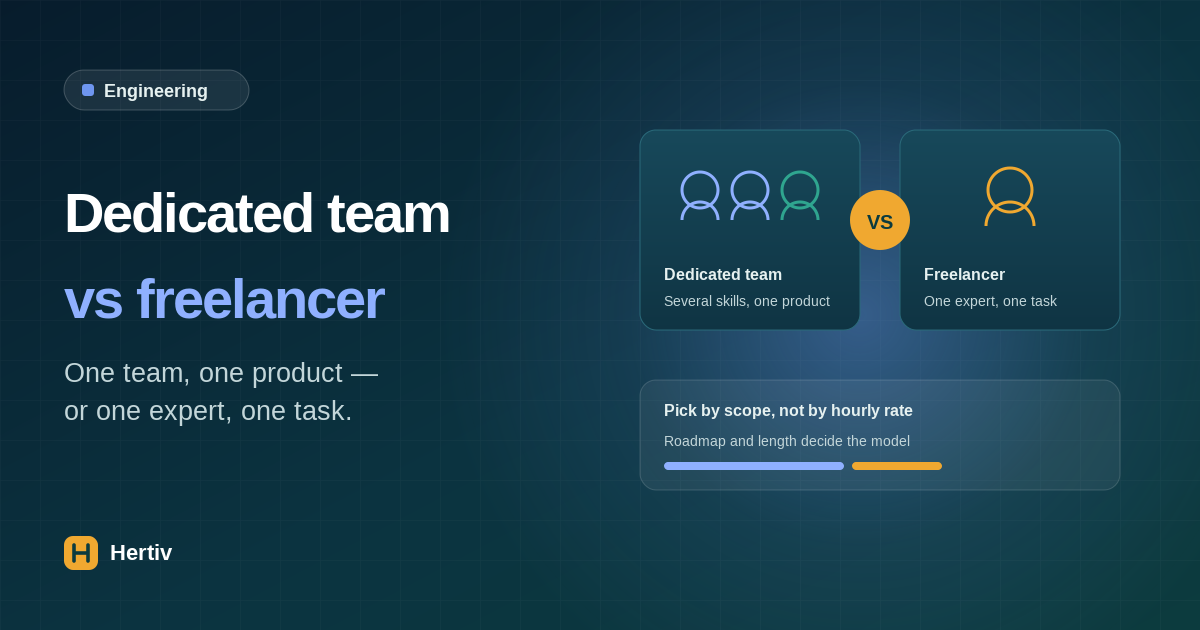
A dedicated team is a group of developers hired to work only on your product for months at a time, while a freelance developer is one person hired for a specific task or a short period. Choose a dedicated team when the project is large, ongoing or needs several skills at once, and choose a freelancer when the work is small, well defined and short.
What is a dedicated team, and what is a freelance developer?
A dedicated team is a group of developers, and often a designer or tester, hired to work only on your product for an agreed period, usually months. The team works to your priorities, joins your meetings and learns your product the way an in-house team would, but the hiring and payroll stay with the provider.
A freelance developer is one person you hire directly for a defined task, such as building a feature, fixing a bug or reviewing code. The engagement is short, the scope is narrow, and the freelancer usually works on several clients at once.
The two models solve different problems. A dedicated team fits work that keeps growing, while a freelancer fits work with a clear end. Mixing them up is how projects stall: a freelancer cannot carry a whole roadmap, and a full team is too much for a one-week fix.
How do a dedicated team and a freelancer compare?
The two models differ in team size, speed, management load and continuity. The table below compares them on the points that matter most when you are choosing, so you can see the trade-off instead of comparing hourly rates alone.
| Point | Dedicated team | Freelance developer |
|---|---|---|
| People | Several, often with a designer or tester | One person |
| Best for | Large or ongoing products | Small, defined tasks |
| Time to start | Days to a few weeks to assemble | Often within days |
| Management | A lead handles day-to-day work | You manage the person directly |
| Continuity | Knowledge stays in the team | Knowledge leaves when the job ends |
| Cost shape | Monthly, predictable | Per hour or per project |
The table shows why the hourly rate is a poor comparison. A freelancer may cost more per hour and still be cheaper for a small job, while a team may cost more per month and still be cheaper for a product that changes every week. The dedicated development team model explains how the team option is usually set up.
When does a dedicated team make sense?
A dedicated team makes sense when the product is the business, not a side project. If you are building a platform that will grow for a year or more, you need people who know the codebase, the users and the roadmap, and that knowledge only builds when the same people stay on the work.
It also fits when the work needs several skills at once. A product that needs back-end work, a mobile app and testing in the same week cannot be covered by one person, however skilled. A team can split the work and keep all three moving.
Choose a dedicated team when:
- The roadmap runs for six months or more
- You need two or more skills in the same week
- Releases happen often and need testing each time
- Losing one person would stop delivery
- You want one accountable group, not several contracts
When does a freelancer make sense?
A freelancer makes sense when the work has a clear end and a clear scope. Fixing a payment bug, adding one integration, reviewing an architecture or building a landing page are all jobs one person can finish without knowing the whole product.
Freelancers also fit when you need a skill your team lacks for a short time. A specialist in a rare framework or a performance problem can finish in two weeks what would take a generalist two months, and you pay only for those two weeks.
Choose a freelancer when:
- The task is small and well defined
- The work lasts days or a few weeks
- You can describe the result in one page
- You can review the work yourself
- The project does not need daily coordination
Be honest about the scope. If the task keeps growing, the freelancer model stops fitting, and you should move to a team before the work stalls. The staff augmentation versus dedicated team comparison covers a middle option, where one or two developers join your existing team.
Example (hypothetical): the same project, two ways
Example (hypothetical): a startup wants a booking feature built and tested in three months. A dedicated team of two developers works 12 weeks at 40 hours a week, which is 2 times 12 times 40, or 960 hours. At a hypothetical rate of $70 an hour, the team costs 960 times 70, which is $67,200.
One freelancer takes the same feature alone and needs 16 weeks, because one person cannot do design, code and testing in parallel. That is 16 times 40, or 640 hours. At a hypothetical rate of $95 an hour, the freelancer costs 640 times 95, which is $60,800.
The freelancer is $6,400 cheaper, but the feature ships a month later, and nobody else knows the code. If the feature earns money from the day it ships, the extra month of team delivery can be worth far more than $6,400. The numbers are invented to show the arithmetic, not a real quote; for real rates, see vendor site or ask for a scoped estimate.
What are the common mistakes?
The most common mistakes are choosing by hourly rate alone, hiring a freelancer for a roadmap, and hiring a team for a one-week job. Each mistake looks cheap at the start and costs more later.
- Hiring a freelancer for a roadmap. One person cannot cover design, code and testing in parallel, so the schedule slips.
- Hiring a team for a small fix. A team needs onboarding and coordination, which costs more than the fix itself.
- No single owner. Splitting work across several freelancers without an owner leaves nobody responsible for the result.
- Skipping a trial task. A short paid task shows how a person or team works before you commit for months.
- Ignoring knowledge loss. When a freelancer leaves, the knowledge leaves too, unless the code and docs are kept up to date.
A short trial and a written scope prevent most of these. Agree on what done means, who reviews it, and what happens when the work grows beyond the first task.
How do you choose between the two?
You choose between a dedicated team and a freelancer by sizing the work, the timeline and the management you can give, then picking the model that fits those three facts.
- Write the scope in one page. If it does not fit, the work is bigger than a freelancer can carry.
- Count the skills needed in the same week. Two or more at once points to a team.
- Set the horizon. Work that runs past three months needs continuity, which a team gives.
- Check your own time. If you cannot review work daily, you need a team lead, not a freelancer.
- Run a small trial first. One paid task shows quality and communication before a long commitment.
If the answers point both ways, start with the smaller model and a trial. A freelancer who proves reliable can grow into a team, while a team hired too early is hard to shrink without losing momentum. For the product itself, custom software development teams usually start from the scope and the timeline, not from the hiring model.
Key takeaways
- A dedicated team fits large, ongoing products; a freelancer fits small, defined tasks
- Hourly rate is a poor comparison: continuity, speed and knowledge matter more
- Two or more skills needed in the same week points to a team
- A freelancer is cheaper for a short job but ships later and keeps the knowledge alone
- Write the scope in one page and run a paid trial before a long commitment
Frequently asked questions
How much does a dedicated team cost compared to a freelancer?
A freelancer often charges more per hour, but a small job still costs less in total because the hours are fewer. A dedicated team costs more per month, but it covers several skills at once and keeps knowledge in the team, so the cost per delivered feature can be lower on long projects.
Can a freelancer build a whole product?
One freelancer can build a small product with a clear scope, but a large product needs design, code and testing in parallel, which one person cannot do well. For anything beyond a simple app, a team or several freelancers with one owner is the safer choice.
How long does it take to hire a dedicated team?
A provider can usually assemble a small team in a few days to a few weeks, depending on the skills needed. A freelancer can often start within days, which is one reason freelancers fit urgent, small work better than teams.
What happens if a freelancer leaves mid-project?
The project pauses until a replacement is found, and the replacement must learn the code from scratch unless it is well documented. A team absorbs one departure better, because other members already know the product and the code.
Is a dedicated team the same as outsourcing?
Not exactly. Outsourcing can mean handing a whole project to a vendor, while a dedicated team works under your direction on your priorities, like an in-house team. The provider handles hiring and payroll, but you set the roadmap and review the work.
Should I hire a freelancer to test a dedicated team provider?
A short trial task with the provider's team is a better test than hiring a freelancer separately, because it shows how the team communicates and delivers. A freelancer trial tells you about one person, not about how a team will work for you.


