Software Development Companies: How to Pick the Right One
The right software development company matches your product and way of working. Compare well-known firms and a shortlist that avoids the usual mistakes.
On this page
Short answer
A software development company builds custom software for clients, from web and mobile products to data platforms and integrations. The right choice depends on the size of your project, the skills it needs and how closely you want the team to work with your own staff.
Software development companies at a glance
Software development companies differ in size, focus and way of working. Some are large consultancies with thousands of engineers, while others are small studios that take on a handful of projects at a time. The table below compares firms that are well known in the industry, so you can see the shape of each before you talk to anyone.
| Company | Known for | Typical client |
|---|---|---|
| Thoughtworks | Engineering practices, agile delivery | Large enterprises |
| EPAM Systems | Large engineering teams, many industries | Enterprises and scale-ups |
| Globant | Digital products, AI and design | Brands and enterprises |
| Accenture | Consulting plus large delivery teams | Large enterprises |
| Cognizant | Enterprise software and modernisation | Large enterprises |
| Endava | Product engineering, payments and retail | Mid-size and large firms |
Size is not a quality score. A large firm can staff a big project quickly, while a smaller firm may give a project more attention from senior people. What matters is whether the firm has done work like yours, and whether its way of working fits your team. For pricing, ask each firm directly or see the vendor site, as rates depend on team size, location and scope.
1. Thoughtworks: best for engineering practices
1. Thoughtworks: best for engineering practices
Thoughtworks is known for strong engineering habits: test-driven development, continuous delivery and close work with client teams. It suits organisations that want to improve how their own engineers work, not just ship one product.
Its teams are usually senior and work in small groups alongside client staff. That makes it a good fit for complex products where quality and long-term maintainability matter more than raw speed.
- Pros: strong engineering culture, good for complex products, works closely with client teams.
- Cons: rates are usually at the higher end, and small projects may not be a fit.
2. EPAM Systems: best for large engineering teams
2. EPAM Systems: best for large engineering teams
EPAM Systems is one of the largest engineering services firms, with delivery teams in many countries. It can staff large projects quickly and covers a wide range of technologies, from web and mobile to data and cloud.
That scale suits enterprises that need many engineers at once or work across several products. Smaller clients should check how much senior attention their project will get, as large firms run many projects in parallel.
- Pros: very large talent pool, broad technology coverage, works across many industries.
- Cons: a large firm can feel less personal, and onboarding takes time on big engagements.
3. Globant: best for digital products and design
3. Globant: best for digital products and design
Globant combines engineering with design and AI work, and it is often chosen for customer-facing products where the experience matters as much as the code. Its teams cover web, mobile, data and cloud, with design studios that work on the product from the start.
It fits brands and enterprises that want a product that looks and feels polished, and that need design and engineering to move together rather than in sequence.
- Pros: strong design and product sense, good for customer-facing products, wide service range.
- Cons: a full-service engagement can cost more than a narrow engineering-only team.
4. Accenture: best for large enterprise programmes
4. Accenture: best for large enterprise programmes
Accenture is a global consultancy with very large delivery teams, and it is usually chosen for programmes that combine strategy, technology and change management. It can run multi-year work across many countries and business units.
That scale fits large enterprises with complex programmes. A single product build is usually better served by a smaller, more focused team, unless it sits inside a larger transformation.
- Pros: global scale, covers strategy through delivery, strong in regulated industries.
- Cons: large engagements are expensive, and small projects get less attention.
5. Cognizant: best for enterprise modernisation
5. Cognizant: best for enterprise modernisation
Cognizant works mainly with large enterprises, often on modernising older systems and moving them to the cloud. Its teams cover application development, data, infrastructure and support, so it can take over a system end to end.
It suits organisations that need a long-term partner for a system they already run, rather than a short project to build something new from scratch.
- Pros: deep enterprise experience, can run and support systems long term, broad coverage.
- Cons: less suited to small, fast product builds, and engagements tend to be long.
6. Endava: best for product engineering in payments and retail
6. Endava: best for product engineering in payments and retail
Endava is a product engineering firm with a strong presence in payments, retail and financial services. Its teams build and run digital products, often working closely with client product teams over several years.
It fits mid-size and large firms that need a product built and improved over time, rather than a one-off project. Its industry focus means its engineers often arrive with useful context about the domain.
- Pros: strong product engineering, useful industry knowledge, long-term partnership style.
- Cons: smaller than the global consultancies, so very large programmes may need more than one partner.
How to choose a software development company
Choosing a software development company is a shortlist exercise, not a search for a single best firm. Start with your product and your constraints, then test each candidate against them before you sign anything.
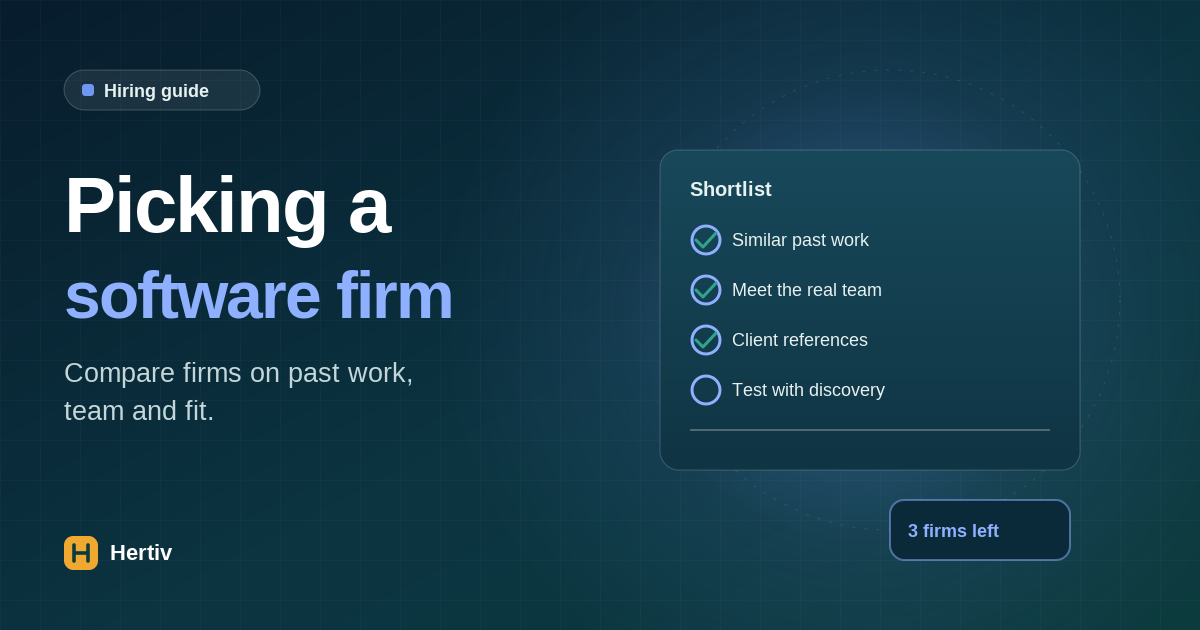
- Write down what you need. List the product, the skills it needs, the timeline and the budget range, so every firm answers the same question.
- Ask for similar work. Look for projects in your industry and of your size, and ask to talk to a client reference.
- Meet the actual team. Ask who will work on your project, what they have built before, and how much of their time is yours.
- Test how they work. A short paid discovery or prototype shows how they communicate, estimate and handle feedback.
- Compare the whole offer. Price, team seniority, communication and exit terms all matter, and the cheapest quote is rarely the cheapest project.
If you are weighing a partner for a product build, custom software development is the usual starting point, and a short discovery phase is the safest way to test the fit before a larger commitment.
Common mistakes when hiring a software development company
Common mistakes when hiring a software development company start with choosing on price alone. A low rate can mean junior engineers, slow delivery or hidden costs when the scope changes, and the cheapest quote often becomes the most expensive project.
- Skipping references. A sales call is not evidence; a short call with a past client tells you how the firm behaves when things go wrong.
- Not meeting the real team. The people in the pitch may not be the people who build your product, so ask for the team by name.
- Vague scope. Without a clear list of what is included, every change becomes a negotiation.
- Ignoring exit terms. Make sure you own the code, the documentation and the access to your systems from day one.
For teams that need engineers inside their own organisation rather than a project team, staff augmentation is a different model worth comparing before you decide.
Key takeaways
- No single firm is best for everyone; the right one matches your product, size and way of working
- Large firms offer scale and process, while smaller firms offer senior attention and speed
- Ask for similar past work and a client reference before you shortlist anyone
- Meet the actual team that will build your product, not just the sales team
- Test the fit with a short paid discovery before a large commitment
Frequently asked questions
How much does hiring a software development company cost?
It depends on team size, location, seniority and scope, so there is no useful single number. A small team for a few months costs far less than a large team for a year. Ask each firm for a written estimate against the same scope, and see the vendor site for current rates.
Should I hire a local or offshore company?
Local teams make communication and meetings easier, while offshore teams usually cost less per engineer. Many projects use a mix: product and design close to home, and engineering in a lower-cost location. What matters most is overlap in working hours and clear communication habits.
How long does a typical project take?
A small product or prototype often takes two to four months, while a full product with integrations usually takes six to twelve months. The timeline depends on scope, the number of features and how quickly you can give feedback, so treat any fixed date with caution until discovery is done.
What should be in the contract?
The contract should list the scope, the team, the timeline, the price model, who owns the code, and how changes are handled. It should also cover confidentiality, data protection and what happens if either side ends the work early.
Is a fixed price or time and materials better?
Fixed price fits work with a clear, stable scope, while time and materials fits work that will change as you learn. Most product builds sit in between: a fixed price for discovery and a first release, then time and materials for later work.
What is the difference between a software company and staff augmentation?
A software company takes responsibility for delivering a product, while staff augmentation adds engineers to your own team and you manage the work. Choose a company when you want a result delivered, and augmentation when you have the management and need extra hands.


