Software Development Methodologies in Australia
Australian teams mostly run Agile and hybrid methods, shaped by government standards, regulated industries and time zones. Here is how each method fits local work.
On this page
Short answer
Software development methodologies in Australia are the same methods used worldwide, applied to local conditions: government digital standards, regulated finance and health work, and teams spread across Australian time zones and offshore partners. Agile and Scrum lead for product work, while hybrid and waterfall methods still appear in government and large enterprise projects.
What are software development methodologies in Australia?
Software development methodologies in Australia are the structured ways Australian teams plan, build and release software, from Agile and Scrum to Kanban, waterfall and hybrid blends. The methods themselves are international; what makes the Australian picture distinct is the setting they run in.
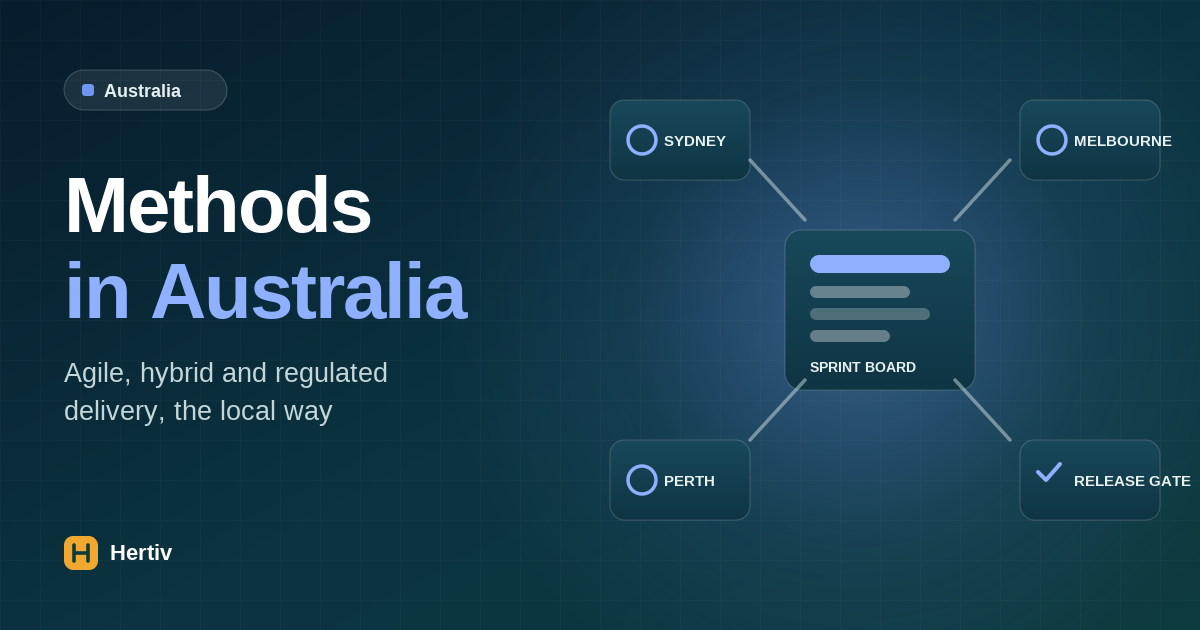
Three local factors shape the choice. First, government work follows the Digital Transformation Agency's Digital Service Standard, which expects iterative delivery and user research. Second, regulated sectors such as banking and health add compliance steps that a pure Agile team must plan around. Third, Australian teams often work across three domestic time zones and with offshore partners in Asia, which changes how ceremonies and handoffs are scheduled.
The result is a pragmatic mix. Most product teams run Scrum or Kanban, many enterprises run a hybrid of Agile delivery with stage-gate governance, and a small share of fixed-scope government and infrastructure projects still use waterfall. The method matters less than whether it fits the funding model, the compliance load and the team's locations.
Which methodologies do Australian teams use most?
Australian teams use Agile methods most, with Scrum the common default for product teams and Kanban common for support and operations work. Hybrid and waterfall methods persist where contracts or regulators demand fixed scope and formal sign-off.
| Methodology | Where Australian teams use it | Strength | Watch out for |
|---|---|---|---|
| Scrum | Product teams in Sydney, Melbourne, Brisbane | Regular feedback and clear ownership | Ceremonies strain teams across time zones |
| Kanban | Support, operations, small agencies | Steady flow without fixed sprints | Scope can drift without a backlog owner |
| Hybrid Agile | Enterprise and government programmes | Agile delivery with formal governance | Two reporting styles can double the admin |
| Waterfall | Fixed-scope government and infrastructure | Predictable contracts and sign-off | Late changes are expensive |
| DevOps | Teams running cloud services | Fast, repeatable releases | Needs automation investment up front |
| Lean | Startups and small product teams | Cuts waste and tests ideas early | Thin process can hide quality gaps |
Choosing between them is less about fashion and more about who funds the work and who signs it off. A startup with its own budget can run Lean; a bank project under APRA supervision needs the audit trail that a hybrid method provides. Agile software development explains the core Agile loop that most of these methods share.
How does government and regulated work change the choice?
Government and regulated work changes the choice because the funder, not the team, sets the reporting rhythm. Government digital projects are expected to deliver in small increments with user research at each stage, which pushes teams towards Agile, but funding and procurement still run in stages with formal gates.
In banking, APRA's expectations around operational risk and change management mean releases need evidence: test results, rollback plans and approval records. Teams handle this by keeping Agile sprints for building and adding a release gate with the evidence attached. Health projects add privacy and clinical safety reviews, which work best when a compliance reviewer sits in the sprint rather than at the end.
The practical pattern is a hybrid: iterative build, fixed checkpoints. A team that ignores the checkpoint will find its release blocked; a team that treats the checkpoint as the whole method will lose the feedback loop that makes Agile worth using. The balance is to make the evidence a by-product of the sprint, not a separate phase.
How do Australian time zones shape delivery?
Australian time zones shape delivery because a team in Perth is three hours behind Sydney and Melbourne, and offshore partners in India or the Philippines are several hours behind that. A daily stand-up that suits Sydney at 9 am is 6 am in Perth and outside working hours for many offshore developers.
Teams handle this in a few ways. Some run two shorter stand-ups, one for the east coast and one for Perth and offshore staff. Others replace the daily meeting with written updates in a shared channel and keep one live meeting a week for planning and review. Sprint planning and retrospectives are usually scheduled in the overlap window, late morning east coast time.
Asynchronous habits matter more than meeting times. Written decisions, recorded demos and a shared board mean a developer in Perth can pick up work without waiting for Sydney to wake up. Teams that rely on hallway conversations across offices tend to lose a day each sprint to handoff delays.
Example (hypothetical): a Melbourne fintech team picks a method
Example (hypothetical): a Melbourne fintech team of eight builds a payments dashboard for a bank. The bank requires a formal release gate with test evidence, and the team also works with two developers in the Philippines.
The team runs two-week sprints for building, with a release gate every second sprint. Each sprint holds 40 hours of planned work per developer, so eight developers give 320 hours per sprint, of which the team reserves 40 hours for compliance evidence and review. That leaves 280 hours for building, which the product owner splits across three features.
Stand-ups run at 10 am Melbourne time, which is 7 am in Manila, so the offshore developers join twice a week and post written updates on the other days. After three sprints the team has shipped two features and one release gate, and the bank has the evidence it needs without the team stopping work for a separate audit phase.
What are the common mistakes?
The most common mistakes are copying a method from another company, letting governance swallow the build, and ignoring the time-zone arithmetic.
- Copying a big-tech method. A method that works for a 500-person platform team will swamp a 6-person agency. Scale the ceremonies to the team.
- Treating the gate as the method. If the release gate is the only process, feedback arrives too late to act on.
- Ignoring time zones. Scheduling every ceremony for Sydney mornings leaves Perth and offshore staff out of the loop.
- No definition of done. Without agreed quality and evidence checks, sprints end with work that is 'almost' finished.
- Changing methods mid-project. Switching from Scrum to waterfall halfway through confuses the team and the funder.
A method that the team actually follows beats a perfect method that exists only in a slide deck. Agile versus Scrum clears up the most common confusion before you choose.
How to choose a methodology for your Australian team
You choose a methodology for your Australian team by matching the method to the funder, the compliance load and the team's locations, then testing it for one or two sprints.
- List the constraints first. Note the funder's reporting rhythm, the regulator's evidence needs and the time zones involved.
- Pick the smallest method that fits. Start with Scrum or Kanban for product work and add gates only where a funder or regulator requires them.
- Agree a definition of done. Include testing, evidence and review so 'done' means releasable, not just coded.
- Fix the meeting window. Choose one overlap window for planning and review, and make the rest asynchronous.
- Review after two sprints. Check whether feedback reaches the team in time and whether the evidence load is sustainable, then adjust.
If you are building the product itself and want help setting up the delivery method, a partner for custom software development can set up the team, the board and the release gates together.
Software development project planning covers the planning steps that sit around the method.
Key takeaways
- Agile and Scrum lead for Australian product work; hybrid and waterfall persist in government and enterprise
- Government standards expect iterative delivery, while funding and procurement still run in stages
- Regulated sectors need release evidence, so add gates to Agile sprints rather than replacing them
- Three domestic time zones plus offshore partners make written updates and one overlap window essential
- Pick the smallest method that fits the constraints, then review it after two sprints
Frequently asked questions
What is the most common software development methodology in Australia?
Scrum is the most common for product teams, with Kanban close behind for support and operations work. Enterprise and government programmes often run a hybrid: Agile sprints for building, with stage gates for funding and sign-off.
Does the Australian government require Agile?
Government digital work is expected to follow the Digital Service Standard, which asks for iterative delivery and user research. Funding and procurement still run in stages, so most government teams run Agile delivery inside a staged programme.
How do APRA rules affect software delivery in banking?
Banking teams must show evidence for changes, including test results, rollback plans and approvals. The usual approach is to keep Agile sprints for building and add a release gate that collects the evidence, rather than running a separate audit phase.
How do Australian teams work across time zones?
Teams pick one overlap window, usually late morning on the east coast, for planning and review, and use written updates for daily stand-ups. Recorded demos and a shared board let Perth and offshore developers pick up work without waiting.
Is waterfall still used in Australia?
Yes, mainly for fixed-scope government and infrastructure projects where the contract requires a set scope and formal sign-off. It is a poor fit for products where the requirements will change during the build.
Should a startup use the same method as a bank?
No. A startup can run Lean or Kanban with light process, while a bank needs the evidence trail a hybrid method provides. Match the method to who funds the work and who signs off on it.


