Software Development Life Cycle Architecture: How to Design It
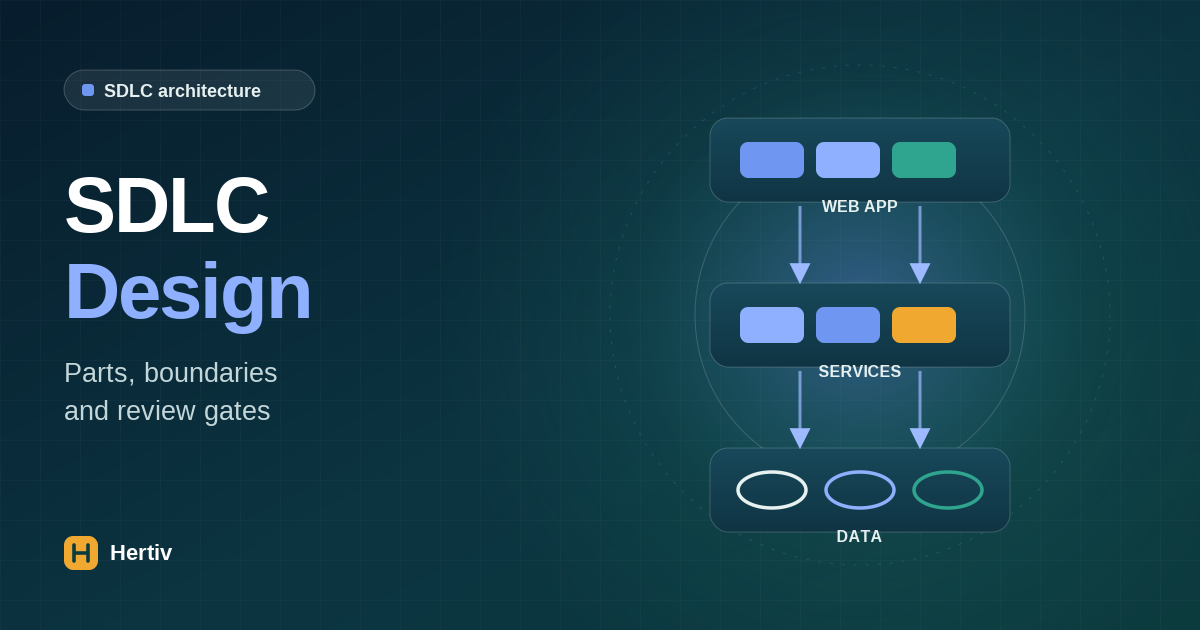
SDLC architecture is the design of a system across its life cycle: how it is split into parts, how those parts talk, and where the quality checks happen.
On this page
Short answer
Software development life cycle architecture is the design work that runs through every phase of the life cycle, from planning to maintenance. It decides how the system is split into parts, how those parts communicate, where data lives, and which checks must pass before work moves on. It is written down, reviewed at phase boundaries, and updated as the system changes.
What is software development life cycle architecture?
Software development life cycle architecture is the design of a system as it moves through the life cycle: the parts it is split into, how those parts talk to each other, where data lives, and which checks must pass before work moves from one phase to the next.
It is not a single diagram. It is the set of decisions that shape the system, recorded so the team can build, test and change it without guessing.
Architecture work starts in planning, when the team sketches the main parts and their boundaries, and it continues through design, building, testing and maintenance. Each phase adds detail: planning sets the shape, design fixes the interfaces, building proves the choices, and maintenance changes them as the system grows. Use this table to see what each phase produces.
| Life cycle phase | Architecture work | Output |
|---|---|---|
| Planning | Sketch the main parts and boundaries | High-level diagram |
| Analysis | Map requirements to parts | Responsibility list |
| Design | Fix interfaces and data flows | Architecture document |
| Development | Build to the interfaces | Working code |
| Testing | Check behaviour at boundaries | Test results |
| Deployment | Confirm the running shape | Deployment diagram |
| Maintenance | Change parts without breaking others | Updated document |
For the phases themselves, the software development life cycle explains each one and the models teams choose between. This article covers the architecture work that runs through them.
How does architecture fit into each phase?
Architecture fits into each phase as a different kind of work. In planning, the team decides the shape: how many parts the system has, what each part owns, and what it must never depend on. These are coarse decisions, but they are the hardest to change later, so they get the most discussion. A wrong boundary here costs weeks to fix in code.
In analysis and design, the team turns the shape into detail. Each part gets a clear job, an interface other parts can call, and a data model. The team also records the rules that cut across parts, such as how users log in, how errors are reported, and how data is backed up. These shared rules are often where projects fail, because each part invents its own version.
In development and testing, architecture becomes a check. Code that crosses a boundary the diagram forbids is caught in review, and tests at the boundaries prove the parts fit together. In deployment and maintenance, the diagram is the map for changes: it shows which parts a change touches and which teams need to know. The document stays alive because the system keeps changing.
What should an architecture document contain?
An architecture document should contain the decisions a new team member needs to build or change the system safely. Start with a diagram of the parts and the arrows between them, with each arrow labelled by what travels across it. A diagram without labels hides the most important information: whether two parts share a database, call each other directly, or pass messages through a queue.
Next, list each part with its job, its owner, and what it must never do. Then record the decisions that were considered and rejected, with one line each on why. A decision log is what stops the next team from re-arguing the same choice, or from undoing it by accident. Keep the log short: a date, the decision, the alternatives, and the reason.
Finally, record the rules that apply everywhere: how errors are reported, how secrets are stored, how logs are kept, and how the system is observed in production. One page of shared rules prevents ten different habits. The document should be short enough to read in one sitting, because a document nobody reads is the same as no document at all.
How do teams choose an architecture style?
Teams choose an architecture style by matching it to the size of the system, the size of the team, and how often the parts change. A small team building one product usually starts with a modular monolith: one deployable system with clear internal boundaries. It is simple to run, easy to test end to end, and fast to change, which is what a small team needs most.
Microservices suit teams that need to release parts independently, scale one part far harder than the rest, or let separate teams own separate parts. The cost is real: each service needs its own deployment, monitoring and failure handling, and a request that crosses services is harder to trace. A team that picks microservices for a system with one release train pays that cost for no benefit.
Event-driven design fits systems where parts react to things that happened, such as an order placed or a payment received, rather than calling each other directly. It decouples the parts, but it makes the flow of work harder to follow, so it needs good logging of every event. The style follows the work: choose the one that matches how the system actually behaves, not the one that sounds most modern.
How do architecture reviews and gates work?
Architecture reviews and gates work as checks at the points where the system changes shape. A review happens before design is approved, before a new part is added, and before a boundary is moved. The reviewer is someone who did not write the design, because the author cannot see their own blind spots. The review asks a short list of questions, not a long one, so it finishes in an hour.
- Show the diagram. The author presents the parts, the arrows and the data flows, with nothing hidden.
- Check the boundaries. Does each part own one job, and does any arrow cross a boundary it should not?
- Ask about failure. What happens when each part fails, and who notices?
- Ask about change. What happens when a requirement changes, and how many parts must move?
- Record the decision. Write down what was agreed, including what was rejected and why.
A gate is the same review with a decision attached: work does not move to the next phase until the review passes. Gates slow a project by hours and save it weeks, because a bad boundary found in design costs a sketch to fix and the same boundary found in code costs a rewrite.
For the wider set of steps, how to implement the software development life cycle covers the same checks with the tooling and ownership.
Example (hypothetical): a clinic booking app's architecture
Example (hypothetical): a clinic wants a booking app with three parts: a patient web app, a booking service, and a records service. The team draws the boundaries first. The web app may call the booking service, the booking service may call the records service, and no part may read another part's database directly. The records service owns all patient data, so one team owns the privacy rules.
The team then sizes the work. The booking service takes about 3 weeks to build, the records service about 4 weeks, and the web app about 3 weeks, which is 10 weeks of building if one developer works on one part at a time. With three developers working in parallel, the build takes about 4 weeks, because the parts meet at the interfaces and the interfaces were fixed in design.
At the design review, a reviewer asks what happens when the records service is down. The team adds a rule: the booking service stores the booking and marks it pending, then retries, instead of failing the patient. That one review question prevents a failure that would have shown up in the first week of live use.
The arithmetic is simple: 3 plus 4 plus 3 is 10 weeks of work, and 10 weeks split across three developers is about 4 weeks on the calendar.
What are the common mistakes?
The most common mistakes are drawing the diagram after the code exists, letting parts share a database, and never updating the document. Each of these makes the architecture a decoration instead of a tool, and the team pays for it in rework.
- Drawing the diagram after the code exists, so it describes the mess instead of guiding it
- Letting two parts share one database, so they cannot change independently
- Recording no decisions, so the same argument repeats every quarter
- Choosing microservices for a system with one team and one release train
- Skipping the review, so a bad boundary is found in code instead of in design
- Never updating the document, so new joiners trust a map that no longer matches the system
- Treating architecture as a one-off phase instead of work that continues in maintenance
Key takeaways
- Architecture is the design work that runs through every life cycle phase, not a single diagram
- Each phase produces an architecture output, from the high-level diagram to the updated document
- An architecture document needs labelled diagrams, a decision log and shared rules
- Choose the style that matches team size and how the parts change
- Review gates at phase boundaries catch bad decisions while they are still cheap to fix
Frequently asked questions
What is the difference between SDLC and software architecture?
The life cycle is the sequence of phases a team follows, from planning to maintenance. Architecture is the design of the system that runs through those phases: the parts, their boundaries and the rules between them. The life cycle says when work happens; architecture says what the system looks like.
When should architecture be designed?
Early, but not all at once. The main parts and boundaries are set in planning and design, because they are the hardest to change later. Detail is added as each part is built. Designing everything up front wastes time on parts that may never be built, while designing nothing leaves the team guessing.
Does a small team need architecture documents?
Yes, but a short one. A one-page diagram with labelled parts and arrows, plus a short list of decisions, is enough for a small team. The document exists so a new joiner can build safely and so the team does not re-argue the same choices. If it takes more than an hour to read, it is too long.
What is a modular monolith?
A modular monolith is one deployable system with clear internal boundaries between its parts. Each part owns one job and talks to the others through defined interfaces, but the whole system ships as one unit. It suits small teams because it is simple to run and test, and parts can be split out later if they need to scale alone.
How often should architecture be reviewed?
At every phase boundary and whenever a boundary moves, a part is added, or a shared rule changes. A short review with a fixed list of questions is enough. Reviews that happen only once a year miss the decisions that matter, because most architecture decisions are made during building.
Who owns the architecture?
The team owns it together, with one person named as the keeper of the document. That person makes sure the diagram matches the code and that decisions are recorded. Without a named keeper, the document goes stale within weeks, because nobody feels responsible for updating it.


