How the Software Development Life Cycle Works
The software development life cycle moves a product from idea to release and maintenance in set phases. Here is what each phase does and where projects go wrong.
On this page
Short answer
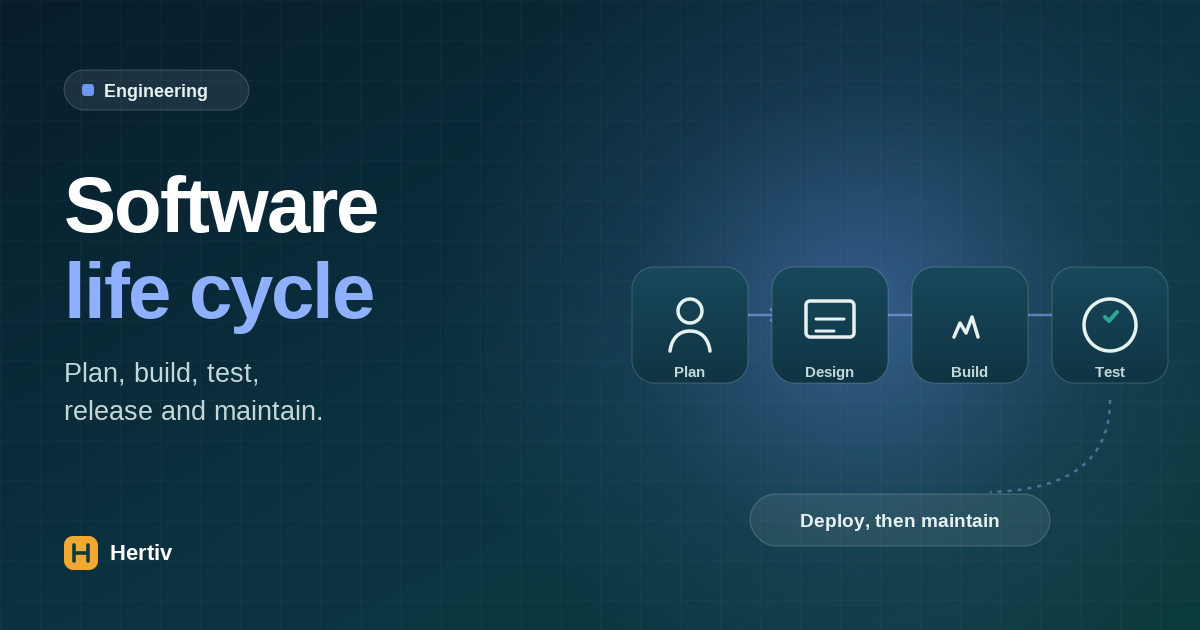
The software development life cycle, or SDLC, is the set of phases a team follows to plan, design, build, test, deploy and maintain software. The phases are planning, requirements, design, development, testing, deployment and maintenance. Teams run them in sequence in waterfall, or in short repeated cycles in agile, depending on how much the requirements are expected to change.
What is the software development life cycle?
The software development life cycle is a structured way to turn an idea into working software that can be released and maintained. It breaks the work into phases, so each phase has a clear purpose, a clear output, and a point where the team can check the work before moving on.
Without a life cycle, teams tend to start coding before the problem is clear, skip testing when time runs short, and discover after release that nobody planned for support. The life cycle does not remove those risks, but it makes them visible early enough to act on.
| Phase | What happens | Main output |
|---|---|---|
| Planning | Define the goal, scope and budget | Project plan |
| Requirements | Record what users need | Requirements list |
| Design | Decide architecture and screens | Design documents |
| Development | Write and review the code | Working software |
| Testing | Check it against the requirements | Test report |
| Deployment | Release it to users | Live product |
| Maintenance | Fix bugs and add features | Updates and fixes |
Each phase feeds the next. A weak requirements phase produces a design that solves the wrong problem, and a rushed testing phase produces a release that fails in front of users. The cost of fixing a problem grows the later it is found, which is why the life cycle puts checks at every step.
Planning and requirements: what are we building?
Planning and requirements answer what the software must do and why. The team talks to users and stakeholders, records what they need, and agrees on scope, budget and timeline before any code is written.
Good requirements are specific enough to test. "Users can reset their password" is a requirement a tester can check. "The system should be user-friendly" is not, because nobody can agree on whether it passed. Teams often write requirements as short user stories, such as "as a customer, I want to track my order so I know when it arrives".
This phase also sets priorities. Not every request can fit in the first release, so the team agrees on what must ship and what can wait. That decision is the difference between a project that ships on time and one that grows until it collapses. Product discovery covers how teams test an idea before committing to build it.
Design: how will the system work?
Design turns requirements into a plan for the system. Architects decide how the software is structured, which database it uses, how services talk to each other, and how the screens look and behave.
Design work happens at two levels. High-level design covers the architecture: the main components, the data model, and the interfaces between them. Low-level design covers the detail: the screens, the data fields, the error messages, and the rules each screen follows.
Good design saves time later. A clear data model prevents rework when a new feature arrives, and a tested screen design prevents building an interface users cannot follow. Skipping design feels fast, but it moves the same decisions into the coding phase, where they are more expensive to change.
Development and testing: building and checking the software
Development is where the code is written, reviewed and integrated. Developers work in small pieces, each tied to a requirement, and merge their work into a shared codebase. Code review and automated checks run as the code is added, so problems are caught while the work is still fresh.
Testing checks the software against the requirements. It includes unit tests for small pieces of code, integration tests for how pieces work together, system tests for the whole product, and acceptance tests where users check that it does what they asked for. Each level catches a different kind of mistake.
Testing is not a single step at the end. Teams that test as they build find problems when they are cheap to fix. Teams that leave testing until the end find the same problems, but after the budget and the schedule have already been spent. Custom software development teams usually run testing alongside development for this reason.
Deployment and maintenance: shipping and keeping it running
Deployment is the release of the software to users. It includes moving the code to production servers, migrating data, setting up monitoring, and having a plan to roll back if the release fails. A release that cannot be rolled back is a risk the team will regret at the worst possible moment.
Maintenance starts the day the software goes live. It covers fixing bugs, patching security issues, updating libraries, and adding small features users ask for. Maintenance is often the longest and most expensive phase, because software lives for years while the original build took months.
Teams that plan for maintenance from the start write clearer code, keep documentation current, and set up monitoring that shows problems before users report them. DevOps services cover the release and monitoring practices that make deployment and maintenance reliable.
Which SDLC model fits your project?
The SDLC model decides how the phases are ordered. Waterfall runs them in sequence, one after the other, which works when requirements are stable and well understood. Agile runs them in short cycles called sprints, repeating planning, building and testing every few weeks, which works when requirements will change.
Other models sit between the two. The iterative model builds the product in versions, each adding more features. The spiral model adds risk analysis to each round, which suits large or high-risk projects. The V-model pairs each development step with a matching test step, which suits systems where testing must be rigorous.
| Model | How it runs | Best when |
|---|---|---|
| Waterfall | Phases in sequence | Requirements are fixed |
| Agile | Short repeated cycles | Requirements will change |
| Iterative | Versions that grow over time | Early feedback matters |
| Spiral | Rounds with risk checks | Risk is high or unclear |
| V-model | Each build step has a test step | Testing must be rigorous |
Most teams today use agile or a mix: agile cycles for building, with waterfall-style planning for fixed deadlines and compliance. The model matters less than the discipline of following the phases and checking the work at each step.
Example: splitting a 1,000-hour project across the phases
Example (hypothetical): a team estimates a small product at 1,000 hours of work and splits the effort across the phases. Planning takes 10%, or 100 hours. Requirements take 10%, or 100 hours. Design takes 15%, or 150 hours. Development takes 40%, or 400 hours. Testing takes 15%, or 150 hours. Deployment takes 5%, or 50 hours. Maintenance in the first three months takes 5%, or 50 hours.
Adding those shares gives 100 plus 100 plus 150 plus 400 plus 150 plus 50 plus 50, which is 1,000 hours. The split is a planning guide, not a rule: a data-heavy product may need more design time, while a product with strict compliance needs may need more testing time.
The useful part of the exercise is what it reveals. If testing is squeezed to 50 hours to meet a deadline, the team is choosing to accept the risk of bugs reaching users. Writing the split down makes that choice visible before the release, when it can still be changed.
What are the common mistakes?
The most common mistakes in the software development life cycle are skipping phases, writing requirements nobody can test, and treating maintenance as an afterthought.
- Skipping requirements. Building before the problem is clear produces software that works but solves the wrong problem.
- Untestable requirements. Requirements written as wishes, such as "fast" or "easy to use", cannot be checked and cannot be signed off.
- Testing left to the end. When testing starts late, bugs are found after the budget is spent and the schedule has no room to fix them.
- No rollback plan. A release without a tested rollback turns a small failure into an outage.
- Treating maintenance as free. Software needs fixes, patches and updates for years. A project with no maintenance budget decays from the day it ships.
- Picking a model by fashion. Agile does not fix unclear requirements, and waterfall does not fix changing requirements. Match the model to the project, not to the trend.
For teams starting a new product, MVP development is a practical way to run the life cycle on a small scope first and learn what works before building the full product.
Key takeaways
- The SDLC turns an idea into software in set phases, each with a checkable output
- Weak requirements produce designs that solve the wrong problem
- Testing works best when it runs alongside development, not after it
- Deployment needs a rollback plan; maintenance is the longest phase
- Match the model to the project: waterfall for fixed requirements, agile for changing ones
- Every phase should end with something a reviewer can read or run
Frequently asked questions
What does SDLC stand for?
SDLC stands for software development life cycle. It is the set of phases a team follows to plan, design, build, test, deploy and maintain software, from the first idea to years of updates after release.
How many phases are in the SDLC?
Most descriptions list seven: planning, requirements, design, development, testing, deployment and maintenance. Some teams merge planning and requirements into one phase, but the work in each phase still has to happen somewhere.
Is agile part of the SDLC?
Yes. Agile is a model for running the life cycle, not a replacement for it. Agile teams repeat the phases in short cycles called sprints, so planning, building and testing happen every few weeks instead of once.
What is the difference between SDLC and waterfall?
The SDLC is the set of phases. Waterfall is one model for running those phases in sequence, from planning to maintenance, with each phase finishing before the next starts. Other models, such as agile, run the same phases in cycles.
Which SDLC phase is most important?
Requirements, because every later phase builds on them. A clear, testable requirement list prevents wrong designs, wasted development and arguments at acceptance testing. Testing is a close second, because it is the last check before users see the product.
How long does the SDLC take for a small product?
It depends on scope, but a small product often takes a few months from planning to first release, followed by ongoing maintenance. The first release is not the end of the life cycle; maintenance and updates continue for as long as the product is used.


