Smart Contracts for Royalties: How They Pay Creators
A smart contract can split a royalty the moment it arrives, paying each rights holder by the agreed share. Here is how the split, the reporting and the setup work.
On this page
Short answer
Smart contracts in royalties management are programs on a blockchain that hold the split rules for a work and pay each rights holder automatically when money arrives. Instead of a distributor collecting royalties and paying out months later, the contract divides each payment by the agreed shares and records every transfer on chain.
What are smart contracts in royalties management?
Smart contracts in royalties management are programs on a blockchain that hold the split rules for a creative work and pay each rights holder automatically when money arrives. The contract stores who owns what share, receives the payment, divides it, and sends each share to the right wallet.
The problem they solve is delay and opacity. Today a royalty usually passes through several hands: a streaming platform or publisher collects the money, takes its fee, sends the rest to a distributor or label, and months later the creators get a statement they cannot check. Each step adds delay and room for error.
A smart contract replaces the middle steps with code that anyone can read. The split is written into the contract when the work is registered, and every payment follows it. The table below shows a typical split for a song.
| Rights holder | Share | Paid when |
|---|---|---|
| Songwriter | 40% | Each payment arrives |
| Performer | 30% | Each payment arrives |
| Producer | 20% | Each payment arrives |
| Publisher | 10% | Each payment arrives |
The shares add up to 100%, and the contract enforces them every time. No one has to chase a payment, and no one can quietly change the split after the work is released.
How does a royalty split work on chain?
A royalty split works on chain in four steps: the payment arrives at the contract, the contract reads the split, it sends each share to the right wallet, and it records the whole payment on the blockchain. The process runs the same way every time, without anyone pressing a button.
First, the money has to reach the contract. A streaming platform, a marketplace or a licensee sends the payment to the contract address, usually in a stablecoin so the amount does not swing with crypto prices. The contract checks the amount and the source, then applies the split rules that were written when the work was registered.
Each share is then sent to the wallet listed for that rights holder. If a wallet cannot receive the payment, the contract holds that share until the address is fixed, rather than sending it to the wrong place. The transaction is recorded on chain, so every rights holder can see what arrived, what was split and what they received.
The cost of running this is the network fee for each transaction. On a busy chain that fee can eat a small payment, so many royalty contracts batch payments or run on a chain with low fees. The trade-off is speed against cost, and it is worth testing with real payment sizes before launch.
What kinds of royalties can smart contracts manage?
Smart contracts can manage royalties for music, books, film, photography and licensed intellectual property. The pattern is the same in each case: a work earns money, the contract splits it by agreed shares, and every rights holder is paid at the same time.
Music is the most common use. A song may have a songwriter, a performer, a producer and a publisher, each with a share, and a smart contract can pay all four whenever streaming income arrives. For how the music side works in detail, see smart contracts in music.
Books and publishing work the same way, with author, illustrator and publisher shares. Film and video add more parties: director, writers, actors and the production company. Photography and stock images use contracts to pay the photographer each time a licence is sold. Licensed intellectual property, such as a character or a brand, can pay the licensor automatically on each sale.
The limit is the money coming in. A contract can only split what it receives, so if the platform or licensee pays late or pays off chain, the contract has nothing to divide. The payment source has to be connected to the contract for the system to work.
How do reporting and audits work?
Reporting and audits work because every payment is recorded on the blockchain, where anyone with the right access can read it. A rights holder does not have to trust a statement from a distributor; they can check the chain and see what arrived and what they were paid.
The contract keeps a log of each payment: the amount, the date, the source and the split. A dashboard or a simple report can turn that log into a statement each rights holder can read. Because the log cannot be changed after the fact, disputes about what was paid become disputes about the split rules, which are visible in the contract code.
Audits still need a human. An auditor checks that the split rules match the signed agreements, that the payment sources are complete, and that the wallets listed belong to the right people. The chain proves the money moved; it does not prove the agreement was fair or that a payment source was honest.
Privacy is the trade-off. A public chain shows amounts and addresses to anyone, so many royalty contracts run on a private chain or use a reporting layer that shows each rights holder only their own payments. The choice depends on who needs to see what.
How to set up a royalty contract, step by step
Setting up a royalty contract takes seven steps, from the agreement to the first payment. The agreement comes first, because the contract only enforces what the parties have signed.
- Write the agreement. Agree the shares, the payment currency and the term in a signed contract before any code is written.
- Pick the chain. Choose a chain with low fees and stablecoin support, and check that the payment source can send to it.
- Write the contract. Code the split rules, the wallets and the fallback for failed payments, then have it audited.
- Register the work. Link the work, its rights holders and their wallets to the contract.
- Connect the payment source. Set up the platform or licensee to send payments to the contract address.
- Test with small amounts. Send a small payment, check that every share lands in the right wallet, and fix any errors.
- Go live and monitor. Watch the first real payments, share the reports with rights holders, and keep a process for disputes.
The audit step matters more than most teams expect. A bug in a split rule can send money to the wrong wallet, and a contract that cannot be fixed after deployment will keep making the same error. For the build and audit side, see smart contract development.
Example (hypothetical): a book's royalty split
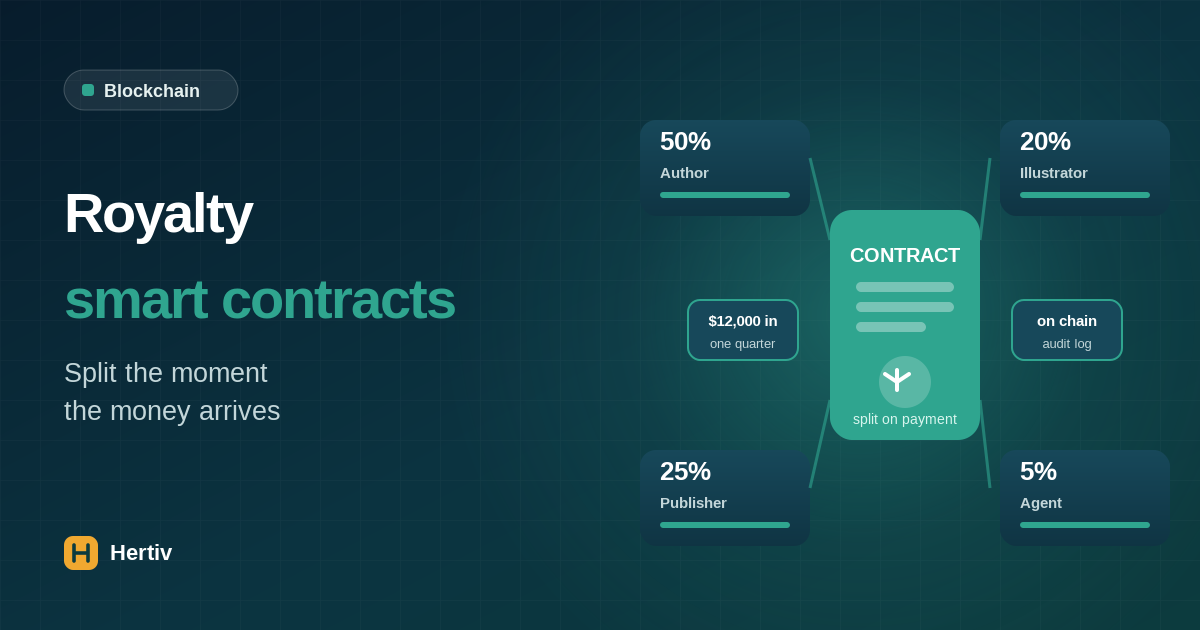
Example (hypothetical): a book earns $12,000 in royalties in one quarter. The agreement gives the author 50%, the illustrator 20%, the publisher 25% and the agent 5%.
The smart contract receives the $12,000 and splits it by the agreed shares. The author receives 50% of $12,000, which is $6,000. The illustrator receives 20%, which is $2,400. The publisher receives 25%, which is $3,000. The agent receives 5%, which is $600.
The four shares add up: $6,000 + $2,400 + $3,000 + $600 = $12,000, so nothing is left unaccounted for. Each rights holder is paid at the same time, and each one can check the chain to see the payment arrive.
The lesson is that the contract is only as good as the agreement behind it. If the shares are wrong, the contract will pay the wrong amounts faithfully and on time. Get the agreement right first, then write the code.
What are the common mistakes?
The most common mistakes teams make with royalty smart contracts are writing code before the agreement, skipping the audit, and forgetting the payment source.
- Code before agreement. A contract that enforces the wrong shares will pay the wrong amounts on time, every time.
- Skipping the audit. A bug in a split rule can send money to the wrong wallet, and a deployed contract may not be fixable.
- Forgetting the payment source. A contract can only split what it receives. If the platform pays late or off chain, nothing happens.
- Ignoring fees. Network fees on small payments can eat the royalty. Batch payments or pick a low-fee chain.
- Public by default. A public chain shows amounts and addresses to anyone. Use a private chain or a reporting layer when privacy matters.
- No dispute process. The chain proves money moved, not that the agreement was fair. Keep a human process for disputes.
Key takeaways
- The contract enforces the split, not a distributor
- Every payment is recorded on chain for all to check
- The agreement comes before the code
- Fees and privacy decide which chain to use
- A dispute process is still needed
Frequently asked questions
What is a smart contract for royalties?
A smart contract for royalties is a program on a blockchain that holds the split rules for a work and pays each rights holder automatically when money arrives. It divides each payment by the agreed shares and records every transfer on chain, so no one has to chase a payment or trust a distributor's statement.
Which royalties can smart contracts manage?
They can manage royalties for music, books, film, photography and licensed intellectual property. The pattern is the same in each case: a work earns money, the contract splits it by agreed shares, and every rights holder is paid at the same time, with the whole payment recorded on chain.
Do smart contracts pay royalties faster?
Yes, when the payment source is connected to the contract. Money is split the moment it arrives, instead of waiting months for a distributor to collect and pay out. The speed depends on the payment source, though: if the platform pays late or off chain, the contract has nothing to divide.
Are royalty payments on a blockchain public?
On a public chain, amounts and wallet addresses are visible to anyone. Many royalty contracts run on a private chain or use a reporting layer that shows each rights holder only their own payments. The choice depends on who needs to see what, and privacy should be decided before launch.
What happens if a payment goes to the wrong wallet?
It depends on the contract. A well-written contract holds a share if the wallet cannot receive it, rather than sending it to the wrong place. A bug in the split rules can send money to the wrong wallet, which is why the contract should be audited before it goes live.
Do I still need a lawyer for royalty smart contracts?
Yes. The smart contract enforces the split, but a signed agreement is what makes the split valid and gives rights holders a way to settle disputes. The chain proves the money moved; it does not prove the agreement was fair. Keep a human dispute process alongside the code.


