Smart Contracts in Enterprise Applications: Benefits and Challenges
Smart contracts can cut settlement time and manual checks for enterprises, but they bring legal, integration and upgrade risks. Here is a balanced look.
On this page
Short answer
Smart contracts in enterprise applications are programs on a blockchain that carry out agreed business terms automatically when set conditions are met. They can speed up settlement, cut manual checks and leave a shared audit trail, but they also bring legal uncertainty, code that is hard to change, integration work with older systems and new risks that a company must plan for before it commits.
What are smart contracts in enterprise applications?
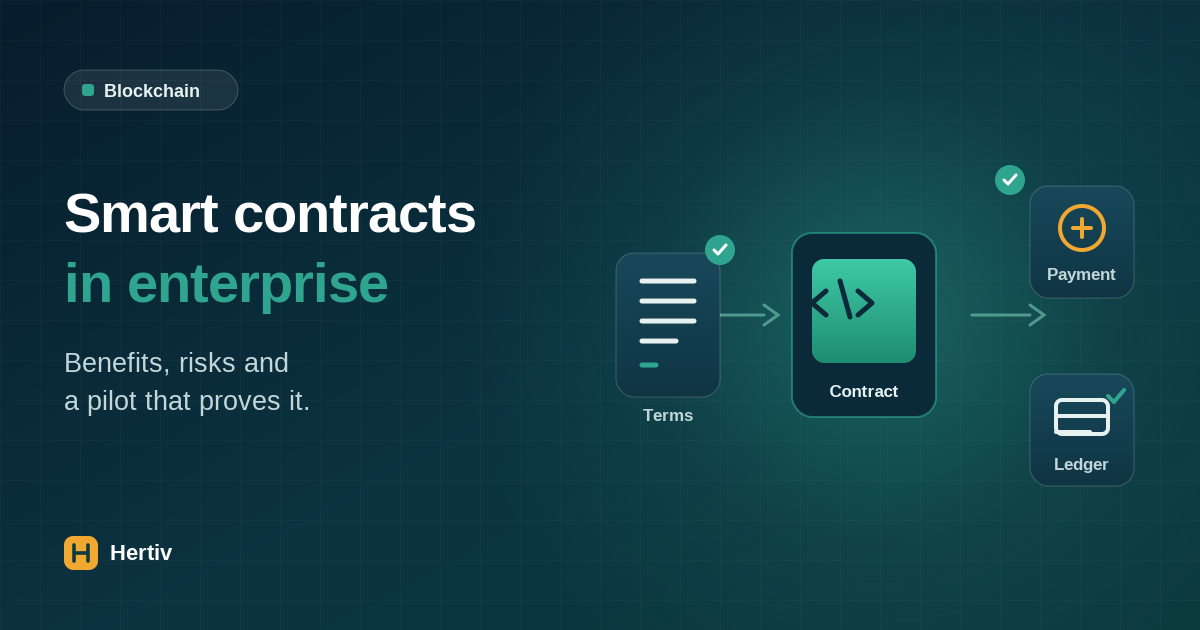
Smart contracts in enterprise applications are programs stored on a blockchain that run agreed business terms on their own when the stated conditions are met. A company writes the terms as code, both sides agree to them, and the program then carries them out without a person having to approve each step.
A typical enterprise use is a payment that releases when a delivery is confirmed, or a licence fee that is split between partners when a sale is recorded. The contract reads the agreed facts, such as a signed delivery note or a sensor reading, and acts on them. Nothing moves until the conditions are satisfied, and every step is recorded on the shared ledger.
An enterprise application differs from a small crypto project in what surrounds the code. The contract must fit the company's legal agreements, its existing systems and its audit rules. It usually runs on a permissioned network or a private chain, where only known companies can take part, rather than on a public chain anyone can join. For the wider picture, see enterprise blockchain and how it is set up.
What benefits do smart contracts offer enterprises?
Smart contracts offer enterprises faster settlement, fewer manual checks and a record that all parties can trust. The table below shows the main benefits and where each one shows up in practice.
| Benefit | How it works | Where it shows |
|---|---|---|
| Faster settlement | Payment releases when the agreed condition is met | Supplier invoices, trade finance |
| Fewer manual checks | The code checks terms instead of a person re-reading them | Claims, royalties, licence fees |
| Shared audit trail | Every action is recorded on the ledger | Compliance checks, disputes |
| Fewer intermediaries | Escrow and clearing steps are built into the code | Cross-border payments, settlements |
| Consistent terms | The same code runs for every deal of that type | Standard contracts, repeat orders |
| Less dispute risk | Terms and evidence sit in one place | Delivery, quality and milestone claims |
The largest saving is usually time. A payment that used to wait for three approvals and a weekly batch run can settle on the day the delivery is confirmed. The second saving is accuracy: the code applies the same rule every time, so a tired clerk cannot misread a rate or miss a date.
The audit trail is a third benefit, because a dispute can be settled from the ledger instead of from two companies' conflicting emails.
What challenges do enterprises face with smart contracts?
Enterprises face legal, technical and organisational challenges with smart contracts, and the legal questions are usually the hardest. The table lists the main challenges and what helps with each one.
| Challenge | Why it matters | What helps |
|---|---|---|
| Legal standing | Code alone may not count as a contract in court | A written agreement naming the code |
| Hard to change | Deployed code is difficult to fix or update | Upgrade patterns, a pause function |
| Integration work | Old systems must feed the contract reliable facts | Oracle services, staged rollouts |
| Data privacy | Ledger records may be visible to all parties | Permissioned networks and off-chain data |
| Bugs and audits | A bug in live code can move real money | Independent audit before launch |
| Skills gap | Few teams can write, test and run contracts | Training and a specialist partner |
The legal question comes first. In most places a smart contract is not a legal contract on its own; it is a tool that carries out a deal the parties have already agreed in writing. A company needs a legal agreement that says what the code must do, who is responsible when it fails, and how a dispute is settled.
The second problem is change. Once code is live it is hard to alter, so a mistake in the terms can leave the company stuck. Teams handle this with upgradeable patterns, a pause function that halts the contract, and a clear owner for each contract. A smart contract audit before launch catches bugs while they are still cheap to fix.
Where do enterprises use smart contracts today?
Enterprises use smart contracts today where the terms are clear, the facts can be checked, and several companies must agree on the same record. Supply chains, trade finance, insurance and royalty payments are the most common areas.
In supply chains, a contract releases payment when a shipment is scanned at the port or a quality check is signed off. In trade finance, it holds funds in escrow until the shipping documents arrive. In insurance, it pays a fixed amount when a flight is cancelled or a shipment is delayed past a set time, using data the insurer and the customer both accept.
Royalties and licence fees are another fit. A contract can split each sale between the creator, the distributor and the platform the moment the sale is recorded, instead of waiting for a quarterly report. Smart contracts in supply chains covers the logistics side in more detail.
The pattern across all of these is the same: the deal can be written as numbers and checkable facts. A long-term partnership, a service judged on quality, or a deal that needs renegotiation does not fit, because the code cannot judge quality or renegotiate. Those deals stay on paper, with code used only for the parts that are clear.
How do you run a smart contract pilot?
You run a smart contract pilot by picking one narrow process, writing the legal agreement first, and testing the code on a small volume before it touches real money.
- Pick one process. Choose a repeatable deal with clear terms, such as supplier payments on delivery or royalty splits. Avoid processes that need judgement.
- Write the legal agreement. State what the code must do, who is responsible if it fails, and how disputes are settled. Get a lawyer to review it before any code is written.
- Choose the network. Decide whether the contract runs on a permissioned network with known parties or a public chain, and who operates the nodes.
- Build and audit the code. Write the contract, test it against the agreed cases, and have it reviewed by an independent auditor. Fix what the audit finds.
- Run it in parallel. Let the contract handle a small set of real deals while the old process still runs, and compare the results line by line.
- Measure and decide. Compare settlement time, error count and staff hours with the old process. Expand only if the pilot beats it on a measure the business cares about.
Keep the pilot small and inside one team. One supplier and one product is easier to defend and fix than a company-wide rollout, and it gives the board real numbers. For the build side, smart contract development covers how the code is written and tested.
Example: a manufacturer pays suppliers on delivery
Example (hypothetical): a manufacturer pays 40 suppliers a month, with invoices of 2,000 units each, a total of 80,000 units a month. Today each invoice waits about 30 days: the goods arrive, the warehouse signs a paper receipt, accounts checks it against the order, and the payment runs in a weekly batch.
The manufacturer pilots a smart contract with three suppliers. When the warehouse scans a delivery, the scan is recorded on the ledger, and the contract checks it against the order: the right goods, the right quantity, the right price. If everything matches, the payment of 2,000 units releases the same day. If something does not match, the contract holds the payment and tells accounts what is wrong.
Payment time falls from 30 days to 2 days for those three suppliers, and the checking work falls from 45 minutes per invoice to about 5 minutes, because the contract does the matching.
Across 40 invoices that is 30 hours of checking a month falling to about 3 hours, a saving of roughly 27 hours a month. The manufacturer keeps the old process for the other 37 suppliers until the pilot has run a full quarter.
What are the common mistakes?
The most common mistakes with smart contracts in enterprises are treating code as a replacement for legal advice, skipping the audit, and writing terms that cannot handle the real world.
- No legal agreement behind the code. Code does not make a deal lawful. A lawyer should still check the deal, the parties and the jurisdiction.
- Skipping the audit. Unreviewed code holding real funds is a risk no saving is worth, and bugs in live contracts are costly to fix.
- Terms too rigid. A contract that cannot handle a late delivery, a changed scope or a refund will fail at the first surprise. Build in a pause and a dispute path.
- Bad data in. A contract is only as good as the facts it reads. If the delivery scan or the price feed is wrong, the contract will act on the wrong facts.
- No named owner. If nobody owns the contract, nobody fixes it, upgrades it or answers for it when it misbehaves. Name the owner before launch.
- Measuring the wrong thing. Counting contracts deployed says nothing about value. Measure settlement time, error rate and staff hours instead.
Key takeaways
- Smart contracts suit deals that can be written as numbers and checkable facts — not deals that need judgement
- The main benefits are faster settlement, fewer manual checks and a shared audit trail all parties can read
- The main challenges are legal standing, code that is hard to change, integration with old systems and data privacy
- Start with one narrow process, write the legal agreement first, audit the code, then run it in parallel with the old process
- Measure settlement time, error rate and staff hours — not the number of contracts deployed
Frequently asked questions
Are smart contracts legally binding for enterprises?
Not on their own in most places. A smart contract is a tool that carries out a deal the parties have already agreed in writing. The enterprise needs a legal agreement that says what the code must do, who is responsible if it fails, and how disputes are settled.
What happens if a smart contract has a bug?
The contract keeps running the buggy code, which is why audits matter. Teams reduce the risk with independent audits before launch, upgrade patterns that allow fixes, and a pause function that halts the contract while a problem is investigated.
Which enterprise processes fit smart contracts best?
Repeatable deals with clear terms and checkable facts: supplier payments on delivery, trade finance escrow, royalty splits, licence fees and insurance payouts tied to agreed data. Deals that need judgement, renegotiation or quality assessment do not fit.
Do smart contracts replace lawyers and accountants?
No. Lawyers still write the agreement behind the code, and accountants still check the books. The code replaces the manual steps of checking terms and moving money, not the judgement about what the deal should be.
How long does an enterprise smart contract pilot take?
A narrow pilot on one process with one or two partners usually takes a few months, including the legal review, the build and the audit. The legal review often takes longer than the code, so start it first and keep the pilot small.
What does a smart contract pilot cost?
It depends on the legal work, the audit and the integration with existing systems, which are usually the largest parts of the bill. The contract code itself is the smallest part. Any quote should itemise legal, audit and integration separately, and pricing for a specific build is on the vendor site.


