3 Ways Smart Contracts Streamline Supply Chains
Smart contracts streamline supply chains by releasing payment on delivery proof, keeping one tamper-evident record of goods, and checking compliance automatically.
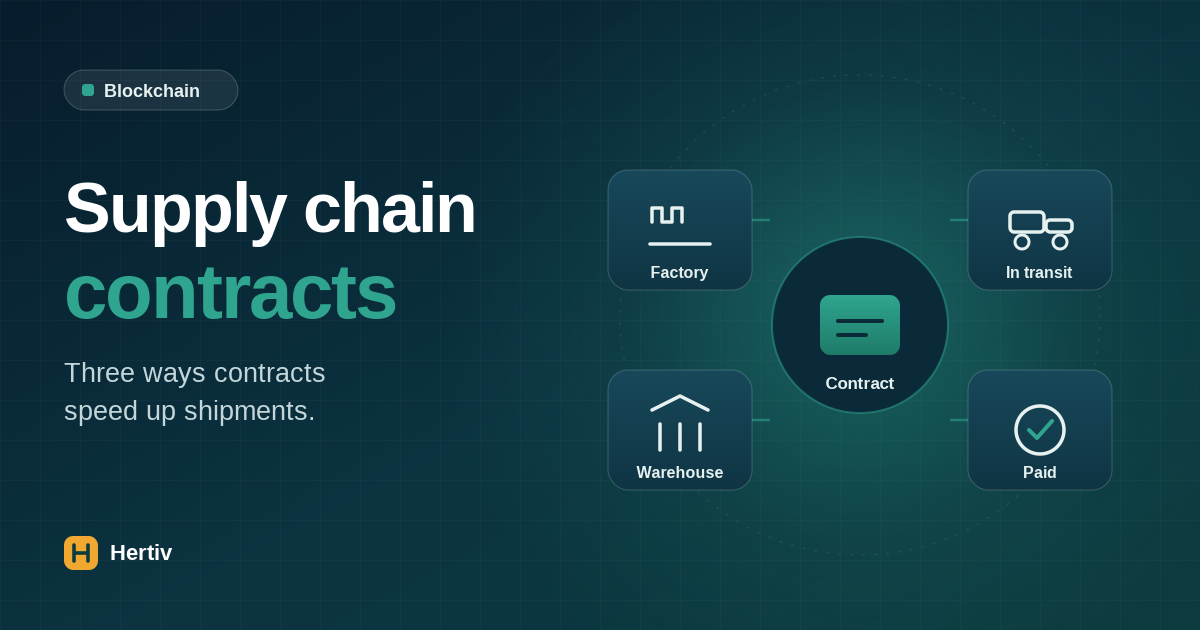
On this page
Short answer
Smart contracts streamline supply chains in three main ways: they release payment automatically when delivery is proven, they keep a single tamper-evident record of where goods have been, and they enforce checks such as certificates and temperature limits without manual sign-off. The gains are real when several companies share one process, and small when one company controls the whole chain.
How do smart contracts streamline supply chain management?
Smart contracts streamline supply chains by turning shared paperwork into shared rules: when an agreed event happens, the contract acts, and every party sees the same record. The value is in the handoffs between companies, where delays and disputes normally live.
The table below compares the usual supply-chain steps before and after smart contracts, so you can see where the gain actually sits.
| Step | Usual way | With smart contracts | What improves |
|---|---|---|---|
| Order and payment terms | Paper contracts and emails | Terms coded and shared | Fewer disputes over terms |
| Shipment tracking | Each party keeps its own log | One shared, signed record | One version of the truth |
| Delivery proof | Signed paper or portal entry | Sensor or scan triggers release | Payment without chasing |
| Quality and certificates | Documents checked by hand | Certificate checked on chain | Faster, auditable checks |
| Recalls | Phone calls and spreadsheets | Affected batches flagged at once | Quicker, narrower recalls |
| Settlement | Invoices, then waiting | Payment on agreed proof | Shorter payment cycles |
Three of these steps carry most of the value, and they are the three ways below. Start with one of them, not all three at once, and only where two or more companies share the process.
Automatic payment on delivery proof
1. Automatic payment on delivery proof: best for slow settlements
Automatic payment on delivery proof means the contract releases payment as soon as delivery is proven, instead of waiting for an invoice, an approval chain and a payment run. The proof is usually a signed scan, a sensor reading or a warehouse receipt recorded on chain.
This helps suppliers most, because they stop funding the gap between delivery and payment. A supplier who delivers on Monday and is paid on Friday instead of in sixty days needs less working capital, and the buyer spends less time answering payment-chasing calls. The contract does not remove the need for a dispute process: someone must still decide what happens when the goods arrive damaged or short.
Pros
- Suppliers are paid faster, with less chasing
- Payment rules are visible to both sides up front
- Fewer manual steps between delivery and settlement
Cons
- Needs reliable proof of delivery, or the trigger fails
- Disputes still need a human process behind the contract
- Requires both sides to agree the rules in advance
One tamper-evident record of provenance
2. One tamper-evident record of provenance: best for traceability
One tamper-evident record of provenance means every handoff of a product is signed and recorded in a shared ledger, so any party can trace a batch from origin to shelf. A food producer, a shipper and a retailer all write to the same record instead of keeping three separate logs.
The gain shows up in audits and recalls. When a batch is suspect, the team finds every affected shipment in minutes instead of calling suppliers and comparing spreadsheets. It also helps with claims about origin, such as organic or fair-trade status, because the claim is backed by a signed chain of custody rather than a single document.
For a wider view of where contracts help, smart contract use cases covers the patterns that hold up in production.
Pros
- Recalls and audits become faster and narrower
- Origin claims are backed by a signed record
- All parties see the same version of events
Cons
- Only as good as the data entered at each step
- Needs every key party to take part
- Recording everything can add cost and complexity
Self-enforcing compliance and condition checks
3. Self-enforcing compliance and condition checks: best for regulated goods
Self-enforcing compliance means the contract checks the conditions itself before goods move on: a valid certificate, a temperature reading inside the agreed range, or a customs document that matches the shipment. If a check fails, the goods are held and the right people are told.
This matters most for regulated goods such as food, medicine and chemicals, where a missed check can mean a recall or a fine. Instead of a person reading a certificate after the fact, the check happens at the moment it matters, and the result is recorded. Temperature is a good example: a cold-chain shipment that warms up on the way can be flagged on arrival rather than discovered after it reaches a pharmacy shelf.
Pros
- Checks happen at the moment they matter, not after
- Every check leaves an auditable record
- Bad shipments are caught before they spread
Cons
- Needs sensors and data feeds that can be trusted
- Rules must be written precisely, or good goods get held
- Regulators may still want paper evidence alongside
How to choose the right first use case
Choosing the right first use case matters more than choosing the right chain. A small, shared process with a clear pain is a better start than a whole-network redesign.
- Find a handoff between two companies. If one company owns the whole process, a shared database is usually simpler and cheaper.
- Pick a pain with a price. Slow payment, slow recalls or failed audits are good candidates because the cost is visible.
- Check the data exists. Delivery scans, sensor readings or certificates must already be captured, or the contract has nothing to check.
- Agree the rules and the exceptions. Write down what happens when goods arrive damaged, short or late, before any code is written.
- Run one lane end to end. One product line, one route, two or three parties. Expand only after the pilot settles real payments or recalls.
If you are scoping the build, smart contract development covers how contracts are designed, tested and audited before they touch real goods and money.
Common mistakes in supply chain smart contracts
Most supply-chain contract projects fail on process, not on code. These mistakes come up in almost every pilot that stalls.
- Automating a broken process. A contract that encodes a confused manual process just makes the confusion faster.
- Trusting data nobody checks. A signed record of a wrong temperature reading is still wrong; sensors and entry points need their own checks.
- Leaving disputes out of the design. Contracts handle the happy path well; the project needs a written process for damaged, short or late goods.
- Inviting too many parties at once. Every new party adds onboarding, training and agreement work. Start with the smallest group that covers the lane.
- Skipping the audit. A contract that moves money or releases goods needs an independent security review before launch.
- Forgetting the off-chain world. Paper certificates, customs stamps and physical inspections still exist; the system must handle them, not pretend they do not.
For the logistics side of the picture, AI and blockchain for logistics covers how these tools fit the wider supply chain.
Key takeaways
- Smart contracts help most where several companies share one process
- Payment on delivery proof shortens settlement and cuts chasing
- One signed record makes recalls and audits faster and narrower
- Automatic checks catch bad shipments at the moment they matter
- Start with one lane and a written exception process, not a whole network
- A contract is only as good as the delivery scans and sensor data it checks
Frequently asked questions
What is the main benefit of smart contracts in supply chains?
Faster, more trusted handoffs between companies: payment on proven delivery, one shared record of where goods have been, and checks that run automatically. The benefit is largest where several companies share a process.
Do smart contracts replace ERP or tracking software?
No. They sit alongside it. The ERP still plans and records, tracking software still follows shipments, and the contract adds shared rules and a shared record between companies that do not share a system.
How do smart contracts know a delivery happened?
Through agreed proof: a signed warehouse scan, a sensor reading, a customs record or an IoT feed written to the chain. The proof must be trustworthy, because the contract acts on it without asking a person.
Which supply chains benefit most?
Those with many parties, regulated goods or slow settlement: food, pharmaceuticals, chemicals and cross-border trade. A single-company warehouse gains little from a shared ledger.
What happens when goods arrive damaged?
The contract should not release payment, and a written exception process takes over: inspection, a claim, and a decision by the parties. That process must be agreed before launch, not invented during a dispute.
Are supply chain smart contracts expensive to build?
A single-lane pilot is a modest project, while a multi-party network is a large one. Costs depend on the number of parties, integrations and audits. See vendor site for current build pricing.


