How Much Does a Security Token Cost to Issue?
Issuing a security token costs roughly $75,000 to $340,000 for a small private placement. Here is what each part costs, what drives the price, and a worked example.
On this page
Short answer
A security token is a digital token that represents a regulated asset such as a share, bond or fund unit, and issuing one costs roughly $75,000 to $340,000 for a small private placement. Legal work and the token platform are the largest items, followed by the audit, investor checks and filings, with running costs of about $20,000 to $80,000 a year.
What is a security token?
A security token is a digital token on a blockchain that represents a regulated financial asset, such as a share, a bond, a fund unit or a share of a property. It carries the same legal rights as the asset it represents, and it is issued under securities law.
That legal status is what sets security tokens apart from utility tokens and payment tokens. A security token offering needs a licensed issuer or an exemption, investor checks, and a way to record who owns what. The cost of issuing one comes from those requirements, not from the token itself.
Issuers usually work with a platform that handles the token contract, the investor register and the compliance checks, plus lawyers who handle the offering documents.
What does it cost to issue a security token?
The cost of issuing a security token depends on the asset, the jurisdiction and the size of the raise. A small private placement costs far less than a public offering, and a simple fund token costs less than a token with complex payout rules.
Use these planning ranges to size a budget. Figures are ranges for planning, not quotes; ask providers for a scoped price.
| Cost item | Planning range | What it covers |
|---|---|---|
| Legal and offering documents | $15,000 - $60,000 | Prospectus or private placement memorandum, legal opinions |
| Token platform and smart contracts | $30,000 - $120,000 | Token contract, investor register, compliance rules |
| Smart contract audit | $10,000 - $50,000 | Independent review of the token and payout logic |
| Investor checks (KYC and AML) | $5,000 - $20,000 | Identity checks, sanctions screening, accreditation |
| Licence or exemption filing | $5,000 - $40,000 | Regulatory filing or exemption paperwork |
| Listing or secondary market | $10,000 - $50,000 | Admission to a licensed trading venue, if any |
A typical small private placement lands in the $75,000 to $340,000 range for these items combined. Public offerings cost more because the disclosure and audit requirements are heavier.
What drives the cost up or down?
Three factors move the cost most: the jurisdiction, the complexity of the token, and the size of the investor base. A single-jurisdiction private placement with a plain token is the cheapest shape. Adding countries, investor classes or payout rules adds legal and engineering work at every step.
Cost drivers to watch:
- Jurisdiction. Some regulators require a full prospectus; others allow a lighter private placement. The choice can change legal costs by tens of thousands of dollars.
- Token complexity. A token that pays dividends, votes or converts needs more contract logic and more audit time than a plain ownership token.
- Investor numbers. A few dozen investors need light checks; hundreds of investors need automated KYC, a larger register and more support.
- Secondary trading. Listing on a licensed venue adds admission fees, market-making and ongoing reporting.
- Asset type. Real estate and funds need valuation and custody work that a simple equity token does not.
For the platform side, how much a tokenization platform costs covers the build-versus-buy decision in more detail.
How does cost vary by asset type?
Cost varies by asset type because each asset brings different legal, valuation and custody work. A fund token and a real estate token can cost very different amounts even at the same raise size.
| Asset type | Relative cost | Why |
|---|---|---|
| Fund units | Lower | Existing fund documents, standard custody |
| Company shares | Lower to medium | Simple cap table, standard shareholder rights |
| Real estate | Medium | Valuation, title checks, property custody |
| Bonds and debt | Medium | Coupon and redemption logic, trustee work |
| Revenue-share tokens | Higher | Payout logic, reporting, tax treatment |
Real estate is the most common first security token because the asset is easy to explain to investors. For the steps involved, how to launch a security token walks through the process end to end.
What are the running costs after launch?
Running costs after launch are smaller than the launch cost, but they never stop. Budget for platform hosting, investor support, reporting and annual legal review, and treat them as a fixed yearly line.
Typical running costs:
- Platform hosting and maintenance. The investor portal, register and compliance checks need hosting, monitoring and updates.
- Investor support. Transfers, lost access and tax documents generate steady support work.
- Reporting and audit. Annual financial statements, asset valuations and audit fees continue every year.
- Secondary market fees. If the token trades, the venue charges admission and trading fees.
- Legal review. Rule changes can force updates to the offering documents and the token rules.
Plan for running costs of roughly $20,000 to $80,000 a year for a small issuance. Larger issuances with more investors and venues cost more, mainly through support and reporting.
For the platform decision behind these costs, enterprise tokenization platform cost compares build and buy options.
Example (hypothetical): a $10 million fund token
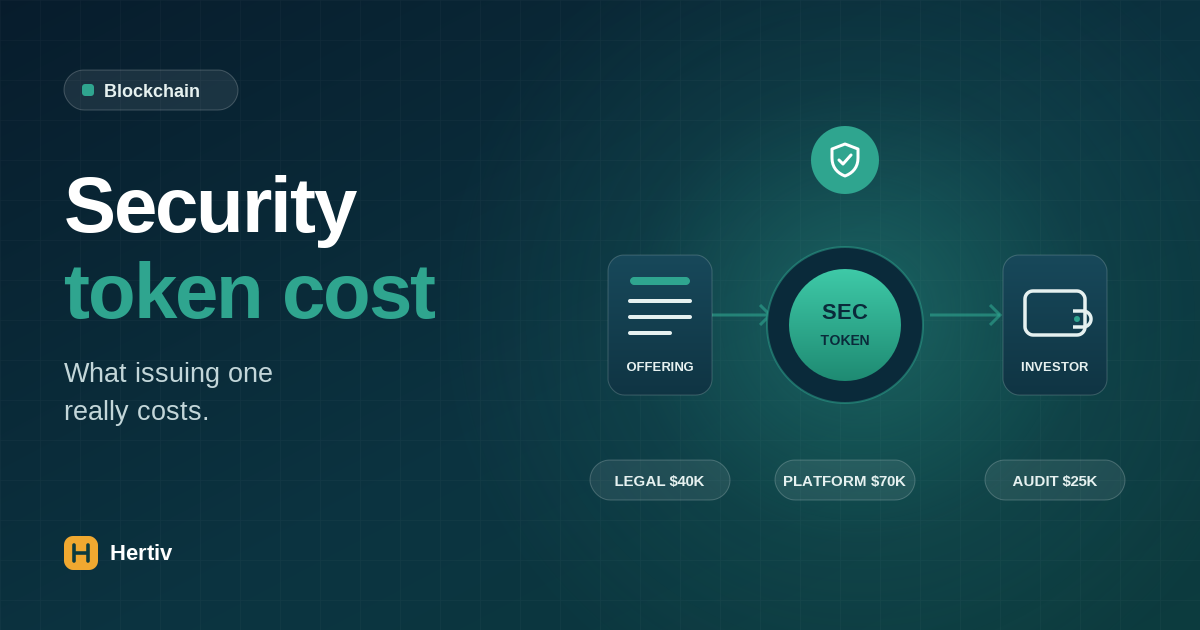
Example (hypothetical): a fund manager tokenizes a $10 million fund with 200 investors. Legal and offering documents cost $40,000. The token platform and smart contracts cost $70,000. The audit costs $25,000. Investor checks cost $12,000. The exemption filing costs $15,000.
Add them up: $40,000 + $70,000 + $25,000 + $12,000 + $15,000 = $162,000 to launch. That is about 1.6% of the $10 million raise. Running costs are $50,000 a year, so the first year costs $212,000 in total, or about 2.1% of the raise.
The same fund with 2,000 investors would cost more, because investor checks and support scale with investor numbers, while legal and platform costs stay roughly flat. The lesson is that investor count, not raise size, drives much of the cost.
If the token is meant to trade, how to bring liquidity to security tokens explains the routes and their costs.
Common mistakes when budgeting a security token
Most budgeting mistakes come from treating a security token like a utility token launch, where the main cost is development. A security token is a regulated offering, and the legal and compliance work dominates the budget.
- Budgeting only for development and forgetting legal, audit and filings
- Choosing a jurisdiction by price alone, then finding the rules do not fit the asset
- Skipping the audit to save money, then paying more to fix problems later
- Forgetting running costs: support, reporting and annual legal review
- Assuming a listing is cheap; venue admission and market-making add up
- Underestimating investor checks when the investor base grows
For the platform shortlist behind a security token issue, security token platforms for startups compares the main providers.
Key takeaways
- A small private placement costs roughly $75,000 to $340,000 to launch.
- Legal work and the token platform are the two largest cost items.
- Jurisdiction, token complexity and investor numbers drive the price.
- Running costs run about $20,000 to $80,000 a year after launch.
- Get a legal opinion on the token's status before spending on the platform.
- Investor count, not raise size, drives much of the cost.
Frequently asked questions
How much does it cost to issue a security token?
A small private placement usually costs $75,000 to $340,000 for legal, platform, audit, investor checks and filings combined. Public offerings cost more. The exact figure depends on jurisdiction, asset type and investor numbers, so get a scoped quote.
What is the biggest cost in a security token issue?
Legal work and the token platform are usually the two largest items. Legal covers the offering documents and the regulatory position, while the platform covers the token contract, the investor register and the compliance rules. Together they are often more than half the launch budget.
Do security tokens have ongoing costs?
Yes. Expect platform hosting, investor support, annual reporting and audit, and legal review, typically $20,000 to $80,000 a year for a small issuance. Tokens that trade on a venue also carry admission and trading fees every year.
Is a security token cheaper than a traditional offering?
It can be, mainly through automation of the investor register and transfers, but the saving shows up over years, not at launch. The launch itself is often similar in cost to a small traditional offering because the legal work is the same.
Can I issue a security token without a lawyer?
No. A security token is a regulated offering, and the offering documents, the regulatory position and the investor checks all need legal input. Skipping legal advice risks an unlawful offering, which costs far more to fix than the advice.
What affects security token cost most?
Jurisdiction, token complexity and investor numbers matter most. A single-jurisdiction private placement with a plain token is cheapest. Adding countries, payout rules or hundreds of investors raises legal, engineering and support costs at every step.


