How to Bring Liquidity to Security Tokens
Security tokens often trade rarely because buyers are few and rules limit who can buy. Here are the routes that add real trading activity, and how to choose one.
On this page
Short answer
You bring liquidity to a security token by giving more qualified buyers a compliant way to trade it: a licensed secondary market, a market maker, fractional units, or a listing on a regulated venue. The route that works depends on the token's investor base, the rules in each market where it trades, and whether the issuer keeps transfer controls that still allow settlement.
What does liquidity mean for a security token?
Liquidity for a security token means an investor can sell it at a fair price without waiting weeks or accepting a large discount. A liquid token has buyers ready to trade, a visible price, and settlement that completes without manual steps.
Most security tokens start illiquid. They are sold to a small group of investors under rules that limit resale, and there is no exchange where those investors can meet buyers. The token may be well designed and the asset behind it may be sound, but without a place to trade, an investor's money is locked in until the issuer buys it back or the asset is sold.
That is why liquidity is planned, not assumed. An issuer that thinks about trading before the token is issued has far more options than one that tries to add it later. Security tokens explains what these tokens are and how they differ from utility tokens.
Why are most security tokens hard to trade?
Security tokens are hard to trade because the rules that protect investors also narrow the market. Only certain investors may buy, transfers must be checked against those rules, and the token may be listed nowhere.
| Barrier | Why it blocks trading |
|---|---|
| Small buyer pool | Only accredited or qualified investors may buy in most markets |
| Transfer checks | Every trade must pass identity and eligibility checks |
| No listing | Few venues accept security tokens, so buyers cannot find them |
| Wide spreads | Few orders on each side mean a buyer and seller rarely agree on price |
| Fragmented holdings | Tokens issued on different chains or standards cannot trade together |
These barriers compound. A small buyer pool means few orders, few orders mean wide spreads, and wide spreads push buyers away. Breaking the cycle needs a venue, a market maker or a rule change, one of them has to move first.
What are the main routes to liquidity?
There are four practical routes to liquidity, and most issuers combine two of them. Each route trades off speed, cost and control, so the choice depends on the token and its investors.
| Route | How it works | Best for |
|---|---|---|
| Licensed secondary market | A regulated venue lists the token and matches buyers and sellers | Tokens with a broad investor base |
| Market maker | A firm quotes buy and sell prices all day | Tokens with steady but thin trading |
| Fractional units | The token is split into smaller pieces so more investors can buy | High-value assets such as property |
| Regulated listing | The token lists on a licensed exchange or ATS | Issuers ready for full disclosure and reporting |
A listing is the slowest route but the most durable one, because it brings a visible price and a standing order book. Launching a security token covers the issuance steps that come before any of these routes work.
How do you set up secondary trading?
Setting up secondary trading is a compliance project first and a technology project second. The venue, the transfer rules and the investor checks all have to be agreed before a single trade happens.
- Confirm who may buy and sell the token in each market where it will trade.
- Choose a venue: a licensed exchange, an alternative trading system, or a private bulletin board run by the issuer.
- Put transfer controls in the token contract so ineligible buyers cannot receive it.
- Appoint a market maker or set opening hours when the issuer will quote prices.
- Publish a price feed and trade history so buyers can see what the token is worth.
- Test settlement end to end with a small number of trades before opening to all investors.
Each step needs a lawyer or compliance adviser who knows the rules in the relevant markets. Technology choices come after the legal shape is settled, because the venue and the transfer rules decide what the token contract must do.
Example (hypothetical): a tokenized fund opens secondary trading
Example (hypothetical): a fund tokenizes $10 million of private credit into 100,000 tokens priced at $100 each. In the first year the tokens trade only by private arrangement, and about 200 tokens change hands each month. A seller who needs cash quickly accepts $96, a $4 discount, because there is no standing buyer.
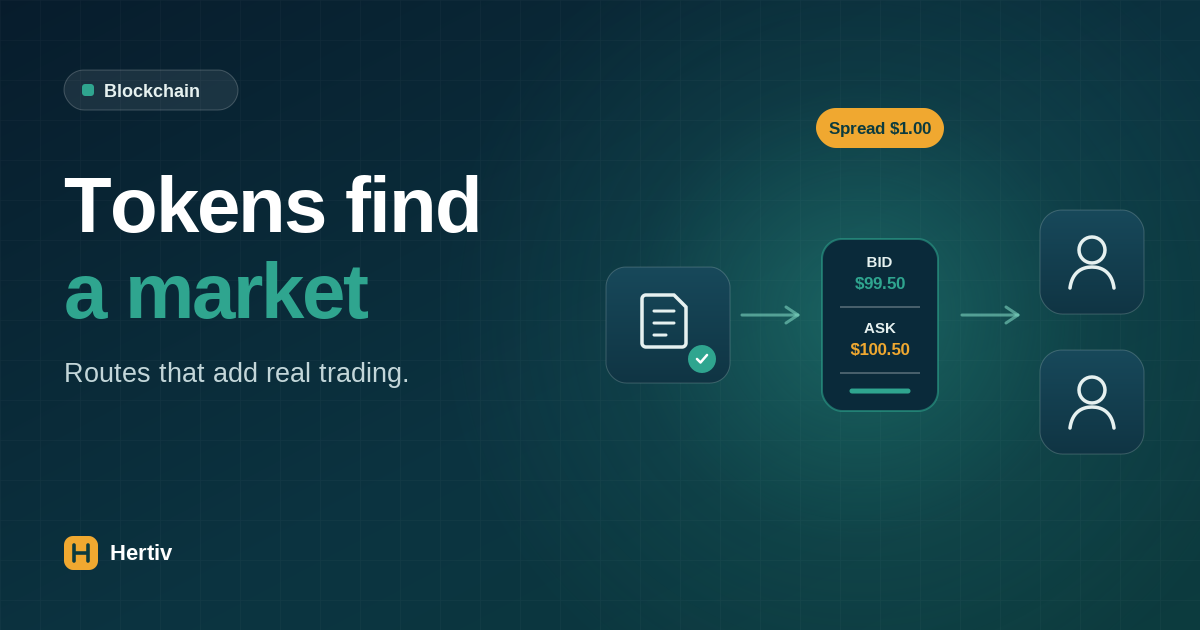
The issuer lists the token on a licensed venue and appoints a market maker that quotes a $99.50 buy price and a $100.50 sell price. Monthly volume rises to 2,000 tokens, or $200,000 at the $100 price, and the spread falls from $4 to $1. A seller now receives $99.50 instead of $96, a gain of $3.50 per token.
The listing cost the issuer a fixed fee plus ongoing reporting, and the market maker charges a monthly retainer. The business case worked because the fund had 1,000 investors who wanted an exit path, and the volume after listing was ten times the volume before it.
What are the common mistakes?
The most common mistakes are launching the token before planning trading, ignoring transfer rules, and promising liquidity that no venue can deliver.
- Launching the token before planning trading. By the time the issuer looks for a venue, the investor base is locked in and hard to move.
- Ignoring transfer rules. A trade that breaks eligibility rules can force a reversal and damage trust.
- Relying on one market maker. If the only quoter stops, the token is illiquid again overnight.
- Promising liquidity that the venue cannot deliver. A listing with no orders is worse than no listing, because it sets a visible price of nothing.
- Forgetting settlement. A trade that cannot settle cleanly creates failed trades and disputes.
How do you choose the right liquidity route?
Choose the route by investor base, not by fashion. A token with a few dozen large investors needs a different answer from one with a thousand small holders.
- Count the investors who would sell in the next year and the size of their holdings.
- Check the rules in each market where those investors sit.
- Compare the routes on cost: venue fees, market maker retainers and reporting.
- Pick the route that gives a visible price and a standing buyer, even if trading is thin at first.
- Review the volume every quarter and change route if the numbers do not improve.
Issuers of tokenized real-world assets face the same choice, and RWA tokenization covers the issuance side that has to be right before liquidity work starts.
Key takeaways
- Liquidity means an investor can sell at a fair price without waiting weeks or taking a large discount
- Most security tokens start illiquid because the buyer pool is small and transfers are restricted
- The four routes are a licensed secondary market, a market maker, fractional units and a regulated listing
- Transfer controls must be built into the token, or ineligible trades will slip through
- Choose by investor base and rules, then review volume every quarter
Frequently asked questions
Can any security token be traded on an exchange?
No. A token can only trade where the venue is licensed for securities and the token's transfer rules allow it. Many exchanges list only utility tokens, so an issuer should confirm the venue's licence and the token's eligibility rules before assuming a listing is possible.
What is the cheapest way to add liquidity?
Fractional units and a private bulletin board are usually the cheapest first steps, because they need no venue licence. A market maker costs a monthly retainer, and a regulated listing adds venue fees and reporting. Cheap routes work best when the investor base is small and known to the issuer.
Do market makers guarantee a price?
No. A market maker quotes buy and sell prices during agreed hours, but it can widen the spread or pause quoting in stressed markets. The agreement should state the hours, the maximum spread and what happens if the market maker stops quoting, so the issuer is not caught out.
How long does it take to list a security token?
A listing on a licensed venue typically takes several months, because the venue reviews the token, the issuer's disclosures and the transfer controls. Private trading arrangements can start faster, but they reach fewer buyers. Issuers should plan the timeline before promising investors an exit date.
Can a security token trade across borders?
It can, but each market has its own rules about who may buy and sell. A token that is compliant in one country may need a different licence or an exemption in another. Issuers usually start in one market and add others once the first venue is trading well.
What happens if a token never becomes liquid?
Investors hold until the issuer buys the tokens back, the asset is sold, or the token matures. The issuer should be honest about this at issuance, because an investor who expected to sell and cannot is the most likely source of complaints and disputes.


