Scrum Master vs Project Manager: What's the Difference?
A scrum master keeps one agile team moving, while a project manager owns the plan, budget and dates for the whole project. Here is how the two roles differ.
On this page
Short answer
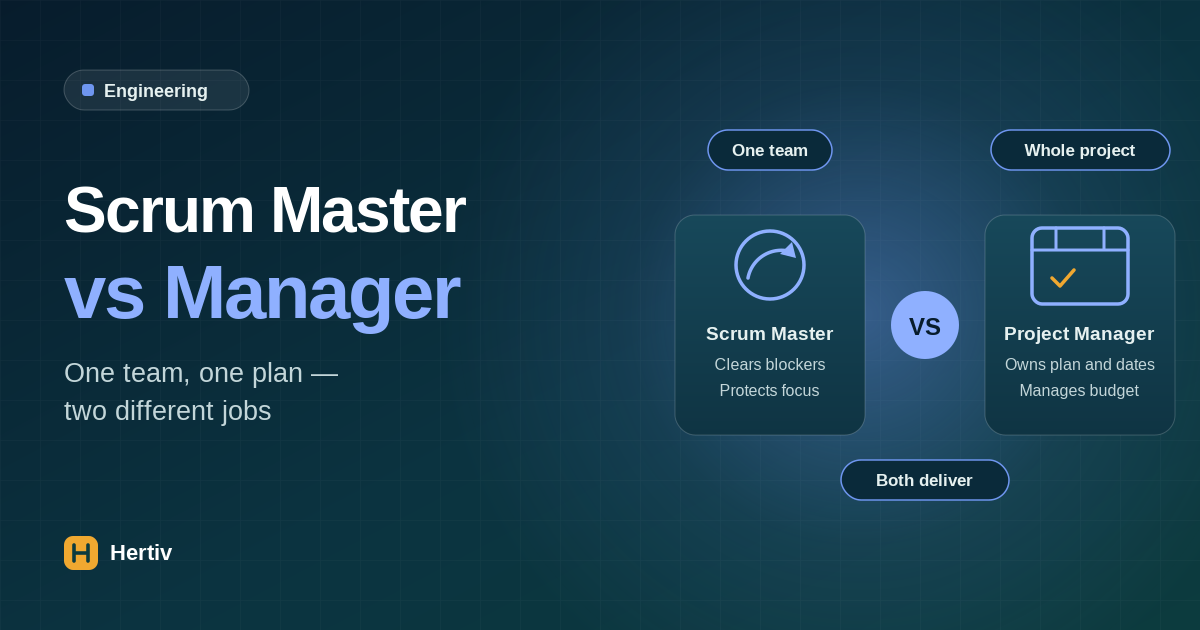
A scrum master and a project manager do different jobs. A scrum master helps one agile team work well together, removes blockers and protects the team's focus. A project manager owns the plan, budget and dates for a whole project, often across several teams. The roles can exist side by side, but they answer different questions.
What is the difference between a scrum master and a project manager?
A scrum master is a servant-leader for one agile team. The role exists to make the team effective: clearing obstacles, running the team's regular meetings, and protecting its focus so it can deliver work in short cycles. A project manager owns the delivery of a project end to end, including scope, budget, dates, risks and communication with people outside the team.
The simplest way to tell them apart is scope. A scrum master works inside one team and its way of working. A project manager works across the project, which may include several teams, vendors and departments. One improves how the team works; the other makes sure the work lands on time and within budget.
| Point | Scrum master | Project manager |
|---|---|---|
| Main focus | One team and its flow | The whole project |
| Owns | Ceremonies, blockers, focus | Plan, budget, dates, risks |
| Authority | Influence, not command | Decides scope and priorities |
| Reports to | The team and its product owner | Sponsors and stakeholders |
| Success looks like | A steady, focused team | A project delivered on plan |
Both roles care about delivery, but they measure it differently. For a wider view of the method they work in, see agile vs scrum project management.
What does a scrum master do?
A scrum master does four things every week: run the team's ceremonies, remove blockers, coach the team, and protect its time. The ceremonies are short and regular — planning, a daily check-in, a review and a retrospective — and the scrum master keeps them useful rather than letting them drift into status meetings.
Removing blockers is the most visible part of the job. When a developer waits on access, a decision or another team, the scrum master chases it down so the team can keep working. The role also coaches: helping the team estimate honestly, limit work in progress and improve one thing at a time after each cycle.
A scrum master does not assign work or tell people how to build things. The team decides that itself. The scrum master's power is influence: asking the right question at the right moment and making sure the team's agreements are kept. The method behind the role is described in the scrum methodology guide.
What does a project manager do?
A project manager turns a goal into a plan and then keeps that plan honest. The work starts before building begins: defining scope, breaking the work into phases, estimating effort and cost, and agreeing dates with the people paying for the work. Once delivery starts, the project manager tracks progress against the plan and reports it in plain language.
Budget and risk sit with this role. The project manager watches spend against the approved budget, flags when a change will cost more or take longer, and keeps a list of risks with a named owner and a response for each. When scope changes, the project manager makes the trade-off visible: what moves, what it costs and who decides.
Communication is a large part of the job. A project manager keeps sponsors, customers and other teams informed, runs steering meetings and writes the short updates that let busy people make decisions. Unlike a scrum master, a project manager usually has the authority to set priorities and reassign work when the plan demands it.
How do the two roles work together?
The two roles work together when a project has several teams or a fixed deadline that one team cannot manage alone. The project manager holds the overall plan and the commitments to the business, while each team's scrum master keeps that team's work flowing. The scrum master reports progress and blockers upward; the project manager turns that into dates, risks and decisions.
A common split is this: the project manager decides what the project must deliver and by when, and the scrum master decides how the team organises its work inside each cycle. The product owner sits between them, owning the order of the work itself. When the three roles respect those lines, teams stay focused and the project stays predictable.
Problems start when the lines blur. A project manager who assigns daily tasks to individuals undermines the team's self-organisation. A scrum master who hides delays from the project manager leaves the plan to fail quietly. The fix is a short weekly meeting where the scrum master shares what is done, what is blocked and what is at risk, and the project manager updates the plan on the back of it.
Which role does your team need?
Your team needs a scrum master when it works in short cycles, owns its own backlog and struggles with focus or blockers rather than with planning. A single team building a product over months benefits most from a scrum master, especially if it is new to agile and needs coaching to keep its habits.
Your project needs a project manager when delivery spans several teams, has a fixed date or budget that others depend on, or involves outside vendors and departments. A single team can often manage without one, but a programme with shared dates and shared money cannot run on team-level ceremonies alone.
Many teams need both. A common shape is one project manager for the programme and one scrum master per team. The mistake to avoid is hiring one person to do both jobs at once: the roles pull in different directions, and one of them will quietly be dropped.
If you must choose, pick the role that matches your biggest pain — focus and flow, or dates and budget. A partner for custom software development can help you staff either role.
Example (hypothetical): a team launching a booking app
Example (hypothetical): a team of eight is building a booking app in two-week cycles. The scrum master runs planning and the daily check-in, and notices that developers lose about 30 minutes a day waiting on design answers. Eight people at 30 minutes a day is four hours a day, or 40 hours in a ten-day cycle — a full week of one person's time lost to waiting.
The scrum master agrees a daily 15-minute slot with the designer, so answers arrive the same day. In the next cycle the team finishes 34 of 40 planned points instead of 26, and the project manager can report a firm date for the first release. The scrum master fixed the flow; the project manager turned the improved flow into a date the business could plan around.
Neither role could have done the other's job. The scrum master could not have set the release date, because the date depended on work in other teams. The project manager could not have fixed the waiting, because the fix needed daily contact with the team. The pair works because each owns a different part of the same delivery.
What are the common mistakes?
The most common mistakes with these two roles are treating them as the same job, giving one person both jobs, and letting the project manager run the team's daily work.
- Hiring a scrum master to manage the project. A scrum master has no authority over budget or scope, so the plan drifts and nobody owns the dates.
- Asking a project manager to run the ceremonies. Ceremonies become status reports, and the team stops raising problems early.
- One person doing both roles. The work pulls in opposite directions, and the team-level coaching is usually what gets dropped.
- Measuring a scrum master by dates. The role improves flow; dates are the project manager's measure.
- No product owner in the middle. Without someone owning the order of the work, the two roles argue about priorities instead of delivery.
Key takeaways
- A scrum master improves how one team works; a project manager owns the plan, budget and dates for the whole project
- The scrum master removes blockers and protects focus, while the project manager manages scope, risk and stakeholders
- Both roles can exist together, with the scrum master inside the team and the project manager across teams
- A single agile team usually needs a scrum master first; a multi-team programme needs a project manager
- Giving both jobs to one person usually means one of them gets dropped
Frequently asked questions
Does a scrum master need a project management certificate?
No. A scrum master is usually certified in scrum, such as a Certified ScrumMaster, while a project manager is more likely to hold a project management certificate. The certificates match the roles: one is about agile team practice, the other about planning, budget and risk across a project.
Can one person be both a scrum master and a project manager?
It is possible on a very small project, but it is hard to do well. The scrum master role asks the person to serve the team and protect its focus, while the project manager role asks the same person to set priorities and enforce dates. On anything larger than one team, the two jobs should be separate.
Who does the scrum master report to?
A scrum master usually reports to the team and its product owner on day-to-day work, and to a delivery lead or agile coach on practice. The role has no line authority over the team, so its influence comes from coaching, clear process and the trust the team places in it.
Is a project manager still needed in agile teams?
Yes, when the work spans several teams or has fixed dates and budgets that others depend on. Agile teams manage their own work, but someone still has to own the overall plan, the spend and the commitments to people outside the team. That is the project manager's job.
What is the difference between a scrum master and a product owner?
A scrum master owns the team's way of working, while a product owner owns what the team builds and in what order. The product owner decides priorities and accepts the work; the scrum master makes sure the team can do the work well. Both roles support the team, from different sides.
Which role pays more?
Pay depends on the market, the size of the project and the person's experience rather than the title alone. Project managers often earn more on large programmes because they carry budget and delivery risk, while experienced scrum masters in large product organisations can earn similar amounts. Compare roles in your own market before deciding.


