Rollup Upgradability: Who Can Change the Rules?
Rollup upgradability decides who can change a layer 2's contracts and how fast. Here is how proxies, timelocks and security councils work, and what to check.
On this page
Short answer
Rollup upgradability is the ability to change the smart contracts that run a layer 2 rollup after it is live. Those contracts hold user funds, verify proofs and control withdrawals to Ethereum, so who can change them, and how fast, decides how much trust the rollup needs.
What is rollup upgradability?
Rollup upgradability is the ability to change the smart contracts that run a layer 2 rollup after it is live. Those contracts hold user funds, verify proofs and control withdrawals to Ethereum, so who can change them, and how fast, decides how much trust the rollup needs.
Rollups need upgrades for the same reason any software does: bugs are found, proof systems improve, and new features are added. But a rollup upgrade is not like a normal software release, because the code being changed guards other people's money. A bad or malicious upgrade can freeze withdrawals, change the rules or take the funds.
That is why upgradability is one of the main things analysts check when they judge a rollup. A rollup whose contracts can be changed instantly by one person needs far more trust than one where changes wait behind a delay and a vote. The difference shows up in the L2BEAT stages framework, covered below.
How do rollup upgrades work?
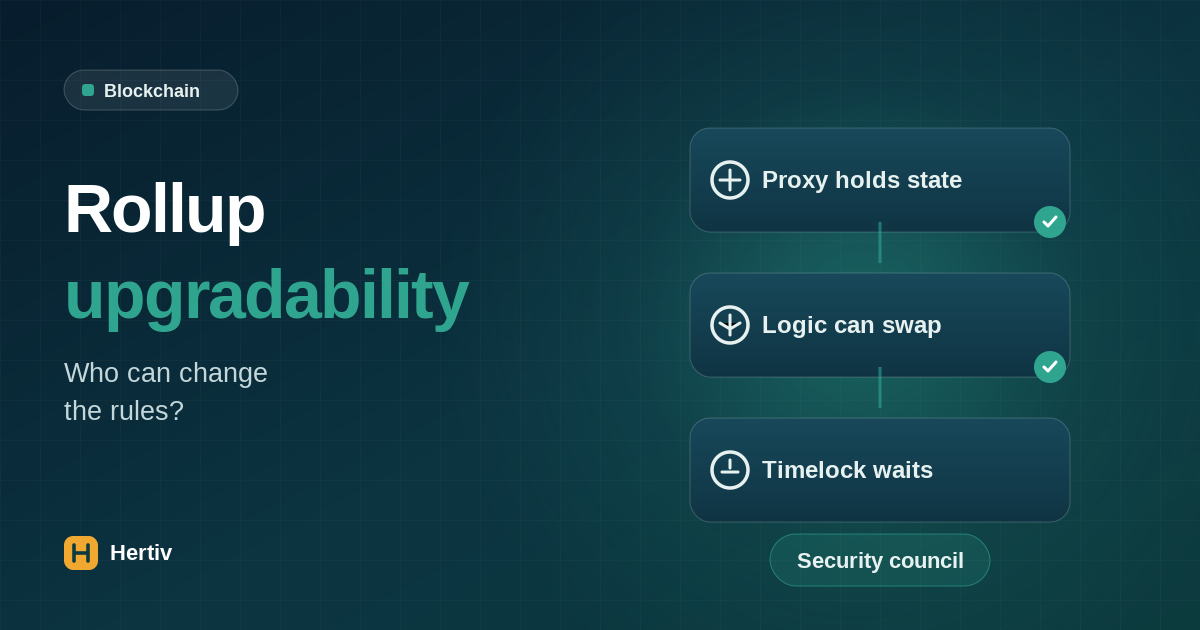
Rollup upgrades work through the proxy pattern, where one contract holds the state and the funds while a second contract holds the logic. The proxy delegates every call to the logic contract, and an upgrade swaps the logic contract for a new one without moving any funds or state.
Three contracts are involved. The proxy contract holds the state and delegates calls. The implementation contract holds the logic that runs. The admin contract controls the upgrade, and it is usually a multi-signature wallet rather than a single account, so several trusted people must approve a change before it happens.
A timelock adds a delay between approval and execution. When the multi-signature approves an upgrade, the transaction sits in a timelock contract for a set period, often several days, before anyone can execute it. That window lets users, developers and monitoring services review the proposed change and exit the rollup if they do not like it. For the layer 2 basics, see what layer 2 is.
What are the L2BEAT stages?
L2BEAT, the main public tracker of layer 2 networks, groups rollups into stages that describe how much control the operator still holds. The stages are a simple way to compare how upgradeable, and therefore how trust-dependent, a rollup is.
| Stage | What it means | Who can upgrade |
|---|---|---|
| Stage 0 | Full training wheels | Operators can upgrade quickly, often with no exit window |
| Stage 1 | Limited training wheels | Upgrades go through a security council with delays |
| Stage 2 | No training wheels | Upgrades are managed by smart contracts, with a 30-day exit window |
Most rollups are still at Stage 0, with only a few, including Arbitrum, OP Mainnet and Base, reaching Stage 1 by 2025. Across the 129 layer 2 projects L2BEAT tracked, about 86 percent allowed instant upgrades without giving users an exit window.
For Stage 2, L2BEAT requires that users have at least 30 days to exit the rollup in case of an unwanted upgrade, and that the security council may act only on errors detected on the chain.
How do Arbitrum and Optimism handle upgrades?
Arbitrum and Optimism take different paths to the same problem, and both show the tension between safety and speed. Arbitrum routes routine upgrades through its DAO, which takes about 17 days and 8 hours in total: an 8-day layer 2 timelock, a challenge period of about 6.4 days for messages moving to layer 1, and a 3-day layer 1 timelock.
Arbitrum's security council, a 9-of-12 multi-signature, can upgrade contracts without any delay in an emergency. That instant path exists so a critical bug can be fixed before it is exploited, but it also means the council can change the rules without warning. The trade-off is explicit: slow, public upgrades for routine changes, and instant upgrades for emergencies.
Optimism takes a similar shape. Upgrades are voted on by Token House governance and then implemented by a security council of 13 voting members and one non-voting lead, operating a multi-signature with a 75% signing threshold. The council carries out governance-approved upgrades, and it can also pause the chain or disable the proof system in an emergency. For the build side, see how to develop a layer 2 wallet.
Why is upgradability a risk for users?
Upgradability is a risk for users because the upgrade key is the master key to the rollup. Whoever controls the admin of the proxy contract can change the logic that guards deposits, proofs and withdrawals. If that key is held by one person, or by a small group with no delay, the rollup's security depends entirely on those people behaving well.
The risk shows up in three ways. First, a malicious upgrade can change the withdrawal rules and take funds. Second, a buggy upgrade can freeze the chain or break withdrawals by accident. Third, a fast upgrade can leave users no time to exit, because the funds are locked behind the same contracts being changed.
Timelocks and exit windows exist to limit these risks, but they only help if the exit path still works. If the upgrade also changes the bridge, or if the proposer can freeze withdrawals, the delay is worth little. That is why analysts check both the delay and the exit mechanism, not just one of them. For how wallets fit into this picture, see advanced layer 2 crypto wallets.
Example (hypothetical): checking an upgrade delay
Example (hypothetical): a team is deciding whether to hold funds on a rollup that announces an upgrade. The rollup's routine upgrade path takes 17 days and 8 hours, from the DAO vote to execution, and the team wants to know whether that is enough time to exit if the upgrade is bad.
L2BEAT's bar for Stage 2 is a 30-day exit window, so the team compares the two figures. 30 days minus 17 days and 8 hours leaves 12 days and 16 hours short of the bar. In other words, the rollup gives users just over half the exit time that the highest stage requires, and its security council can still upgrade instantly in an emergency.
The team then checks the exit path itself. A normal withdrawal needs a challenge period of about 7 days before the funds reach layer 1, so even a user who starts exiting the moment the upgrade is announced waits a week. The team decides to keep only operating funds on the rollup and to hold the rest on layer 1, where no upgrade can change the rules without a hard fork.
What are the common mistakes?
The most common mistakes with rollup upgradability are assuming a rollup is trustless, checking the delay but not the exit path, and ignoring who holds the upgrade keys.
- Assuming trustlessness. Most rollups are still at Stage 0 or Stage 1, so the operator or council can change the rules.
- Checking the delay only. A 30-day timelock helps nothing if withdrawals can be frozen during it.
- Ignoring the council. A security council with instant upgrade power is a single point of trust, whatever the routine path looks like.
- Forgetting the bridge. The canonical bridge is usually the contract being upgraded, so it is the part that matters most.
- Treating stages as permanent. A rollup can move between stages, so check the current stage before depositing, not the one from last year.
Before depositing, read the rollup's L2BEAT page, note the stage, the upgrade delay and the council size, and decide how much you are willing to leave on a chain whose rules can change.
Key takeaways
- Upgrades use the proxy pattern: state stays, logic swaps
- Timelocks give users time to review and exit before a change
- Most rollups are Stage 0 or Stage 1; Stage 2 needs a 30-day exit window
- Arbitrum takes about 17 days for routine upgrades; its council can act instantly
- The upgrade key is root access, so check who holds it
- Check the stage, the delay and the exit path before depositing
Frequently asked questions
What is a rollup upgrade?
It is a change to the smart contracts that run a layer 2 rollup, made by swapping the logic contract behind a proxy while the state and funds stay in place. Upgrades fix bugs, improve proof systems and add features.
Why do rollups need to be upgradeable?
Because the technology is still young. Proof systems improve, bugs are found, and new features are added, so a rollup that could never change would be stuck with its first version's flaws. Upgradability is a trade-off, not a flaw on its own.
What is a security council?
It is a multi-signature group entrusted with powerful permissions, such as upgrading contracts, pausing the chain or vetoing proposals. Arbitrum's council needs 9 of 12 signatures, while Optimism's has 13 voting members with a 75% signing threshold.
What is a timelock?
It is a contract that delays the execution of an approved change for a set period, often several days. The delay lets users, developers and monitoring services review the proposed change and exit the rollup if they do not like it.
What are the L2BEAT stages?
They are a framework that groups rollups by how much control the operator still holds. Stage 0 means full training wheels, Stage 1 means limited training wheels with a security council, and Stage 2 means no training wheels, with upgrades managed by smart contracts.
Is any rollup fully trustless today?
No major rollup has reached Stage 2 yet. Most are at Stage 0 or Stage 1, which means the operator or a security council can still change the contracts, so users should check the stage, the delay and the exit path before depositing.


