What Does RegTech Software Cost to Build in the UK?
RegTech software helps UK firms follow the rules on checks, monitoring and reporting. Here is what drives the build cost and what a first version includes.
On this page
Short answer
RegTech software is software that helps a financial firm meet its duties, such as checking customers, watching transactions for suspicious activity, and filing reports with the regulator. In the UK, the cost of building it depends on which rules it must cover, how much of the work is automated, and how carefully it is tested. This guide breaks down the main cost drivers and what a sensible first version includes.
What is RegTech software?
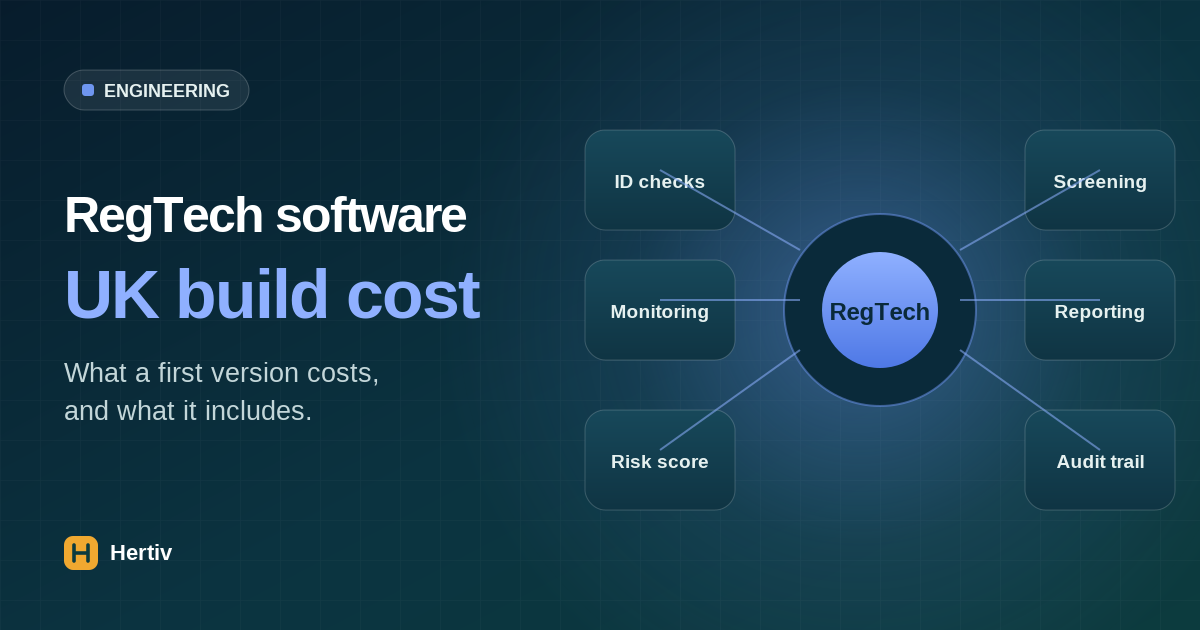
RegTech software is software that helps a regulated firm follow financial rules with less manual work. It covers tasks such as identity checks on new customers, screening against sanctions lists, monitoring transactions for unusual patterns, and producing the reports a regulator expects.
The name comes from regulatory technology. A bank, a payment firm or an investment platform may have hundreds of checks to run every day, and doing them by hand is slow and error-prone. RegTech tools automate the routine parts and flag the cases that need a human decision.
In the UK, the main regulator for financial firms is the Financial Conduct Authority (FCA). Firms that the FCA authorises must show that their controls work, not just that they exist. That is why RegTech software is judged on its audit trail as much as on its features: every check, decision and report must be recorded and explainable.
What drives the cost of RegTech software in the UK?
Five factors drive most of the cost. The rules covered matter most: a tool that only screens names against a sanctions list costs far less than one that also monitors transactions, scores risk and files reports. The number of customers and transactions matters next, because volume drives data and testing work.
| Cost driver | What it changes | Typical effect |
|---|---|---|
| Rules covered | Identity checks, screening, monitoring, reporting | More rules, more build time |
| Data sources | Sanctions lists, company registers, credit data | Each source adds integration work |
| Volume | Customers and transactions per day | Higher volume needs stronger performance |
| Compliance review | Legal checks and audit evidence | More review, more time and cost |
| Team and rates | Size and location of the team | Rates vary by market |
Compliance review is the cost driver teams most often underestimate. A feature that is easy to build can still need weeks of legal review, because a wrong check can mean a missed sanction or a report filed late. Cost of implementing AI follows the same pattern: the controls around the system drive the bill more than the screens do.
Which UK rules shape the build?
The build is shaped by the rules the software must help the firm follow. The Money Laundering Regulations require firms to check who their customers are, understand the risk each customer poses, and report suspicious activity. The software must support each of those steps and keep the evidence.
The FCA also expects firms to treat customers fairly and to show that their systems work in practice. A screening tool that flags every customer is as useless as one that flags nobody, so the software needs tuning, testing and a way to measure how many alerts turn out to be real problems.
Data protection rules add a further layer. Customer data used for checks must be handled lawfully, kept only as long as needed, and protected from unauthorised access. That affects how the software stores data, who can see it, and how long it is kept. Data security and compliance services cover the controls that sit around the software itself.
What does a first version usually include?
A sensible first version covers the checks a firm must run on every customer and the reports it must file. The core is identity verification, screening against sanctions and politically exposed person lists, a risk score for each customer, and a case file where an analyst records decisions.
Transaction monitoring usually follows, because it needs more data and more tuning. A first version can start with simple rules, such as flagging transactions above a limit or to a high-risk country, and add smarter scoring once the team can see how many alerts each rule produces.
Reporting is part of the first version, not an afterthought. The firm must be able to show what was checked, when, and what happened next. A reporting module that produces clean evidence saves the compliance team hours every month and makes audits far less painful.
Example (hypothetical): a first-version budget for a UK payment firm
Example (hypothetical): a small UK payment firm plans a first version with identity checks, sanctions screening, customer risk scoring and case management. The team estimates 2,400 hours of work at 80 pounds an hour, which is 192,000 pounds. Design and testing are included in that estimate.
On top of that, the firm budgets 12,000 pounds for a compliance review by a specialist, 8,000 pounds for data sources and hosting in the first year, and 6,000 pounds for training the compliance team. That brings the total to 218,000 pounds. Adding a 10 percent reserve of 21,800 pounds gives a planning budget of 239,800 pounds.
The reserve is not padding. It covers the things every firm discovers during testing, such as a screening rule that flags too many good customers or a report format the regulator wants changed. A budget without a reserve is a budget that will be exceeded.
How to keep RegTech costs under control
Keeping costs down starts with scope. Build the checks the firm must run by law first, and leave the nice-to-have analytics for later. A firm that tries to automate every control at once will spend its budget before any of them work.
Second, use existing data sources instead of building your own. Sanctions lists, company registers and identity data are available from established providers, and connecting to them is usually cheaper than collecting the data yourself. Third, test with real cases early. A screening rule tuned on made-up data will behave differently on real customers, and finding that out late is expensive.
Finally, involve the compliance team from the first week. They are the people who will use the software and defend it in an audit, so their view of what a good check looks like matters more than any feature list. How to validate an app idea explains how to check which features the first version really needs.
Common mistakes
The most common mistake is building features before understanding the rules. A team that builds a screening tool without reading the regulations will build the wrong checks, and the compliance team will have to redo the work.
Another mistake is ignoring the audit trail. Software that makes the right decision but cannot show how it got there will fail an audit, so logging and evidence must be built in from the start, not added later.
Teams also underestimate tuning. A monitoring rule that produces a thousand alerts a day will be ignored within a week, and a rule that produces none is probably broken. Plan time to tune the rules with real data, and never launch without a human review step for the cases that matter.
Key takeaways
- Cost depends most on the rules covered, the data sources and the compliance review.
- A first version should cover identity checks, screening, risk scoring and case files.
- UK rules, including money laundering regulations and data protection, shape the build.
- Plan a 10 percent reserve and budget for tuning the rules with real data.
- An audit trail is essential: every check and decision must be recorded and explainable.
Frequently asked questions
How much does RegTech software cost to build in the UK?
There is no single price: it depends on the rules covered, the data sources and the team rates. A first version with identity checks, screening and case management is a multi-month project. Use the worked example in this guide as a template and price it with your own team.
What is RegTech software used for?
It helps financial firms follow the rules with less manual work, covering identity checks, sanctions screening, transaction monitoring and regulatory reporting. It automates the routine parts and flags the cases that need a human decision.
Who regulates RegTech in the UK?
The Financial Conduct Authority (FCA) authorises and supervises most financial firms in the UK. RegTech software itself is not usually authorised, but the firm using it must show the regulator that its controls work.
Does RegTech software need an audit trail?
Yes. Every check, decision and report must be recorded so the firm can show the regulator what happened and why. An audit trail is a core requirement, not an optional extra.
Can I buy RegTech software instead of building it?
Yes, many established products cover screening, monitoring and reporting. Building makes sense when the workflow is unusual, when several systems must connect, or when the firm wants to own its data and roadmap.
What features matter most in the first version?
Identity verification, sanctions screening, customer risk scoring and case management cover the checks a firm must run on every customer. Transaction monitoring and advanced reporting usually follow once the core is proven.


