How to Validate Your App Idea Before You Build It
Validating an app idea means checking whether real people want it and will pay for it before you spend on building. Here is a practical sequence of low-cost checks.
On this page
Short answer
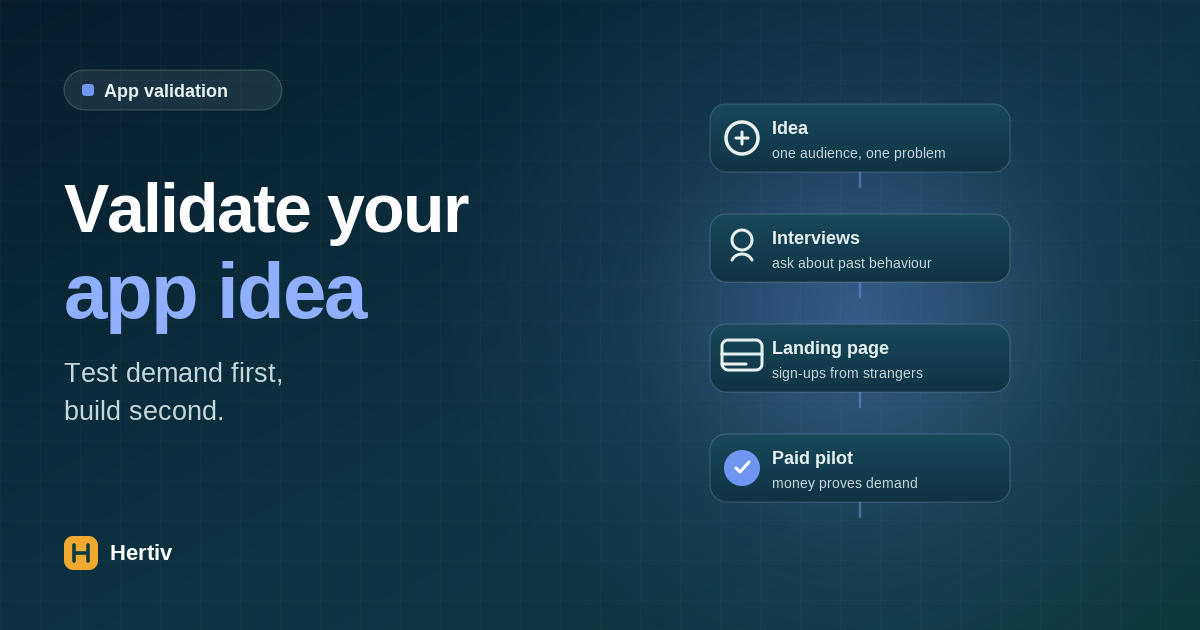
Validating an app idea means gathering evidence that real people have the problem, want your solution, and will pay for it, before you spend serious money building. It is a series of small, cheap tests: define the audience, test demand with a landing page or paid pilot, and act on what strangers do, not what they say.
What does it mean to validate an app idea?
Validating an app idea means gathering evidence that real people have the problem, want the solution, and will pay for it, before you spend serious money building the app. It is a series of small, cheap tests, not a single survey or a pitch to friends.
Validation answers three questions in order. First, does the problem exist and hurt enough that people already try to solve it? Second, does your proposed solution appeal to those people more than what they use today? Third, will they pay, or at least commit time and attention, to use it?
Many founders skip this step because building feels like progress. It is not, if the app solves a problem nobody has. A few weeks of validation can save months of building the wrong product, and the evidence also makes later decisions, such as what to build first, much easier. That first build is usually a minimum viable product, and validation tells you what belongs in it.
Who is the app for, and what problem does it solve?
Validation starts with a named audience and a specific problem, not with features. Write one sentence: who has the problem, what the problem costs them, and how they handle it today. If you cannot name the audience, you cannot test the idea.
Pick a narrow group first. A meal-planning app for busy parents is testable; a food app for everyone is not. A narrow group lets you find people, talk to them, and read their reactions. You can widen the audience later, once the core problem is confirmed.
Check how the problem is solved today. If people already pay for a workaround, a spreadsheet, or a competitor, the problem is real. If nobody does anything about it, ask why. Some problems are real but not painful enough to pay to fix, and that is a result worth knowing early.
How do you test demand before building?
You test demand by asking people to give you something scarce: their email, their time, or their money. A polite compliment costs nothing, so compliments do not count as evidence. A sign-up, a booked call, or a pre-order does.
| Method | What it tests | Good sign |
|---|---|---|
| Landing page | Interest in the promise | Sign-ups from strangers, not friends |
| Waitlist with a price | Willingness to pay | People join after seeing the price |
| Concierge test | Whether the service helps | Users return a second time |
| Paid pilot | Real buying behaviour | A customer pays before launch |
| Search and forum scan | Whether people ask for it | Repeated questions in the same words |
Run the cheapest test first. A landing page with a clear promise and a sign-up form can be live in a day. Drive a small number of visitors to it from a community or search ad, then read the conversion rate. If strangers sign up, you have a signal. If they do not, change the promise or the audience, not the design.
A concierge test goes further: deliver the service by hand, with spreadsheets and messages, to a handful of users. If they come back, the value is real. If they do not, the app would not have fixed it either. These tests are part of the same discipline as ways to test an MVP, applied before the product exists.
How do you run useful interviews?
Useful interviews ask about past behaviour, not future intentions. People are polite about ideas and honest about their own history. Ask what they did last time the problem came up, what it cost them, and what they tried next.
Keep interviews short and structured. Talk to 8 to 12 people from your target group, one at a time, for about 20 minutes each. Ask open questions, then stay quiet and let them talk. Write down their exact words, because those words later become the copy on your landing page.
Watch for patterns, not single quotes. One person loving the idea means little. Five people describing the same problem in the same words means a lot. At the end of each interview, ask for a small commitment, such as joining the waitlist or introducing you to someone with the same problem. A refusal tells you as much as a yes.
What does a small paid test prove?
A small paid test proves that someone values the solution enough to spend money on it. That is the strongest signal short of a launch, and it is the one most founders avoid, because a refusal feels like failure. It is not failure; it is information, and it arrives before you have spent on development.
Offer a simple paid pilot to waitlist members: a fixed price, a clear scope, and a start date. A meal-planning pilot could be four weeks of plans for a set fee. If a handful of people pay, you have both revenue and a group of users to learn from. If nobody pays, revisit the price, the promise, or the audience.
Keep the pilot small and manual. You are testing demand, not building infrastructure. Deliver it by hand, collect feedback each week, and note what people actually use versus what they said they wanted. That gap is normal, and it tells you what the first version should contain.
Example (hypothetical): validating a meal-planning app
Example (hypothetical): a founder has an idea for a meal-planning app for parents who cook at home four nights a week. She writes the problem in one sentence, then interviews 10 parents. Seven of them say planning takes over an hour each week and they repeat the same meals.
She builds a one-page site in a day, promising a weekly plan matched to each family's tastes, and shares it in two parenting groups. In a week, 200 people visit and 60 leave an email address, a 30% sign-up rate. She then offers the first 20 subscribers a four-week paid pilot at $12, and 12 pay, bringing in $144 before any app is built.
The pilot runs by hand: plans sent by email, feedback collected each week. Nine of the 12 finish all four weeks, and six ask to continue. The arithmetic is simple: 200 visitors, 60 sign-ups, 12 payers, 9 finishers. The founder now has evidence of demand, a price that works, and a list of the features those 9 users actually used.
What are the common mistakes?
The most common validation mistakes are asking the wrong people, asking the wrong questions, and counting weak signals as proof.
- Asking friends and family. They will be kind. Strangers in your target group will be honest, so recruit there.
- Asking about the idea, not the problem. "Would you use this?" invites a yes. "What did you do last week when this happened?" gives facts.
- Counting likes as demand. A like, a compliment, or a survey yes costs nothing. A sign-up, a payment, or a repeat visit does.
- Building first, testing later. A working app is the most expensive way to learn that nobody wants it.
- Ignoring a clear no. If three tests in a row show no interest, change the idea or the audience instead of running a fourth test.
Key takeaways
- Validation is evidence from strangers, not praise from friends
- Define one audience and one painful problem before testing anything
- A sign-up, a repeat visit, or a payment counts as evidence; a compliment does not
- Interviews should ask about past behaviour, not future intentions
- A small paid pilot is the strongest signal short of a launch
Frequently asked questions
How long does validation take?
A first round usually takes two to four weeks: a few days to define the audience, a week for interviews, and a week for a landing page or concierge test. If the first tests show no interest, you can change the idea or audience and test again rather than building.
How many people should I interview?
Eight to twelve people from your target group is a good start. You are looking for repeated patterns in their words, not a large sample. If five or more describe the same problem in similar terms, that pattern is worth acting on.
Is a landing page enough to validate an idea?
It tests interest in the promise, but not willingness to pay. Pair it with a price on the page or a paid pilot offer. Sign-ups show curiosity; payments show demand. Both signals together are much stronger than either alone.
What if people say they like the idea but will not pay?
That usually means the problem is real but not painful enough, or the price is wrong for the value offered. Test a lower price, a narrower audience with a sharper pain, or a different promise before deciding the idea is dead.
Should I validate before or after building an MVP?
Validate before building, then keep testing with the MVP itself. Early validation shapes what the first version should contain, and the MVP then tests whether people use it in real life. The two stages answer different questions.
What is a good sign-up rate for a validation page?
There is no fixed number that proves demand, because it depends on traffic quality and the promise. Compare sign-ups from strangers against your own expectations, then test a payment step. A page that converts strangers and leads to payments is a strong signal.


