Real-World Web3 Use Cases: Where It Works Today
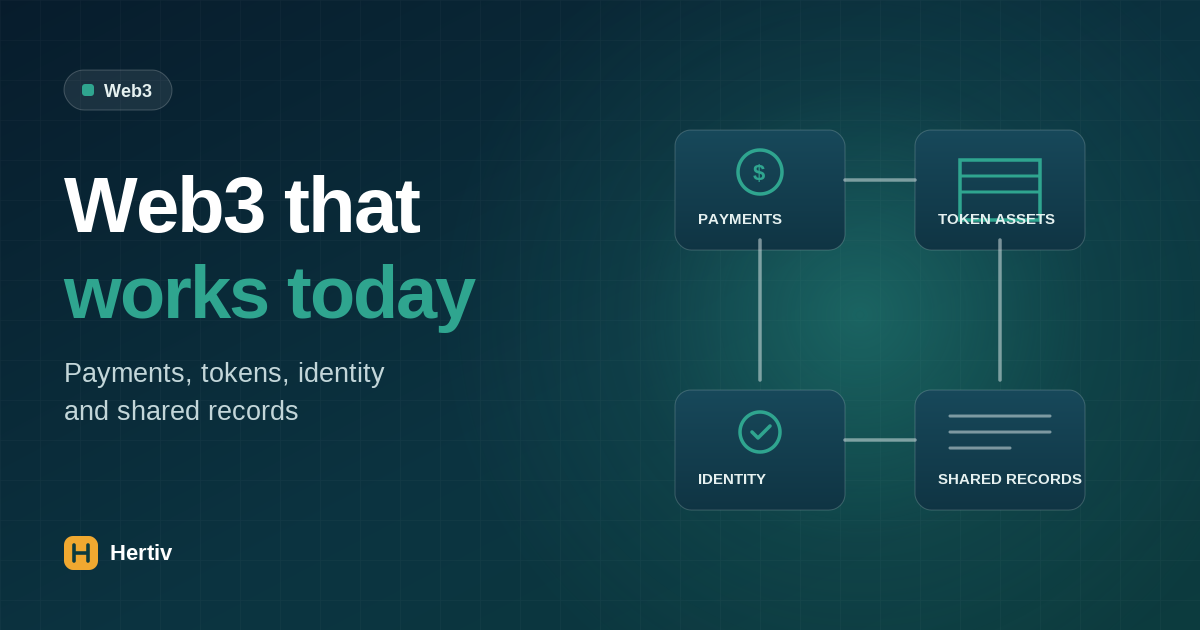
Web3 works in the real world where several parties need a shared record or cross-border value: payments, tokenized assets, identity and supply chains.
On this page
Short answer
Real-world Web3 use cases are places where blockchains and tokens solve a problem that already exists: moving money across borders, proving ownership of an asset, sharing a record between companies, or paying creators without a middleman. They work when the result is faster, cheaper or more open than the old way.
What are real-world Web3 use cases?
Real-world Web3 use cases are places where blockchains and tokens solve a problem that already exists: moving money, proving ownership, sharing records, or paying people without a middleman. The technology matters only when the result is faster, cheaper or more open than the old way.
Web3 is a loose term for applications built on blockchains, smart contracts and tokens. The use cases that have lasted share a pattern: they involve several parties that do not fully trust each other, they need a shared record, or they move value across borders. Use cases that fail usually add a token where a database would do.
| Use case | What it replaces | Who benefits |
|---|---|---|
| Stablecoin payments | Slow cross-border wires | Businesses and freelancers |
| Tokenized assets | Paper shares and slow settlement | Investors and issuers |
| Digital identity | Repeated ID checks | Users and service providers |
| Supply chain records | Separate company databases | Buyers, sellers and auditors |
| Creator royalties | Manual royalty accounting | Artists and rights holders |
The sections below walk through each one, with the limits that matter.
Payments and stablecoins
Stablecoin payments are the most widely used Web3 use case. A stablecoin is a token designed to hold a steady value, usually by being backed by cash or short-term government debt. Businesses use them to pay suppliers abroad, freelancers use them to get paid without waiting days for a wire, and apps use them for in-app balances.
The advantage is speed and cost: a payment that takes days through banks can settle in minutes on a chain. The limits are real too. Regulation varies by country, converting tokens back to local currency still needs a licensed provider, and a stablecoin is only as sound as its reserves and its issuer's reporting.
Before using stablecoins for payments, check the rules in each country involved and the issuer's reserve reports. A payment rail that works in one market may not be legal in another.
Tokenized real-world assets
Tokenization turns a real asset, such as a building, a fund share or a bond, into tokens on a blockchain. Each token represents a share of the asset, and ownership can be transferred without paper certificates or a long settlement process.
This helps in two ways. First, settlement is faster: a transfer that took days can settle in minutes. Second, smaller shares become practical, so more people can invest in assets that were once limited to large buyers. Funds and bonds have been the earliest examples, because their ownership rules are already well defined.
The hard part is not the token but the legal link between the token and the asset. A token is only useful if the law recognises the holder as the owner and if there is a clear process when something goes wrong. That link is why tokenization projects work closely with lawyers and regulators, and why how tokenization works in practice starts with the legal structure, not the code.
Digital identity and records
Digital identity on a blockchain lets a person or organisation prove a fact, such as a qualification, a licence or a membership, without revealing everything about themselves. The proof is stored as a credential that can be checked against the chain, while the underlying details stay with the holder.
Governments and universities have tested this for diplomas and licences, and companies use it for staff credentials and supplier checks. The benefit is fewer repeated checks: once a credential is issued and verified, it can be shown to many parties without a new round of paperwork.
The main limit is adoption. A credential is only useful if the parties that need to check it accept it. That is why identity projects usually start inside one industry or one country, where the issuers and checkers can agree on a common standard.
Supply chains and creator payments
Supply chains use blockchains as a shared record that several companies can read and write to, without any one company owning the database. A shipment, a certificate or a quality check is recorded once, and every party sees the same record. This helps when goods pass through many hands and disputes are common.
Creator payments work in a similar way. A smart contract can split revenue between the people involved in a work each time it is sold or used, without a central accountant. Artists, musicians and game developers use this for royalties, though the amounts depend on the platform and the terms set in the contract.
Both uses share a limit: the chain only knows what someone recorded. If a supplier records the wrong data, the chain preserves the wrong data faithfully. The record is only as good as the inputs, so the checking process off the chain matters as much as the chain itself.
Example (hypothetical): a retailer paying suppliers with stablecoins
Example (hypothetical): a retailer buys goods from three suppliers in different countries. Bank wires take three days and cost $45 each, so a week of payments costs $135 in fees and leaves suppliers waiting.
The retailer switches to stablecoin payments. Each payment now settles in about ten minutes and costs under $1 in network fees. Over a month with 60 payments, fees fall from about $2,700 to under $60, and suppliers are paid the same day the goods ship.
The retailer still needs a licensed provider to convert tokens to local currency, and its finance team checks the stablecoin issuer's reserve reports each month. The saving is real, but it comes with new work: tracking the conversion, keeping records for tax, and watching the rules in each supplier's country.
What are the common mistakes?
The most common mistakes are adding a token where a database would do, ignoring the legal link, and trusting the chain to fix bad data.
- Tokenising for its own sake. If only one company uses the data, a shared database is simpler and cheaper.
- Ignoring the legal link. A token that does not map to a legal right is a record, not an asset.
- Trusting bad inputs. A blockchain preserves what was recorded, including errors.
- Underestimating regulation. Payments, securities and identity rules differ by country and change often.
- No plan for the off-chain parts. Conversion, tax, support and disputes all live outside the chain.
If you are scoping a Web3 product, start from the problem, not the technology. What Web3 is in plain terms helps teams decide whether a blockchain belongs in the design at all.
Once the use case is clear, blockchain development services can build a pilot around one use case before a larger commitment.
How to judge a Web3 use case
You can judge a Web3 use case with four questions, answered before any code is written.
- Who are the parties? There should be several, and they should not fully trust each other.
- What record is shared? The use case should need one record that all parties can read.
- What moves? Value, ownership or credentials should move across borders or between organisations.
- What is the legal link? The token or record should map to a right the law recognises.
If the answers are clear, a small pilot is the next step: one use case, one group of users, and a review after a few weeks. If the answers are vague, the use case is not ready, and a simpler tool is likely the better choice.
Key takeaways
- Web3 use cases work where several parties need a shared record or cross-border value
- Stablecoin payments and tokenized assets are the most widely used cases today
- A token is only useful if the law recognises the holder's right to the asset
- Blockchains preserve what was recorded, including errors, so off-chain checks still matter
- Judge a use case with four questions before writing any code
Frequently asked questions
Is Web3 the same as crypto?
No. Crypto is one part of Web3: tokens and coins that move value. Web3 also covers smart contracts, tokenized assets, digital identity and shared records. A Web3 product can use a blockchain without issuing a coin.
Which Web3 use case is most widely used?
Stablecoin payments are the most widely used, because they solve a clear problem: slow and costly cross-border wires. Tokenized funds and bonds are growing, while identity and supply chain uses are earlier and depend on adoption by the parties involved.
Do I need a token for a Web3 product?
Not always. Many Web3 products use a blockchain for records or settlement without issuing a token. A token is needed only when ownership, access or payment must be represented on the chain itself.
Is Web3 legal?
It depends on the use case and the country. Payments, securities and identity each have their own rules, and those rules differ across jurisdictions. Check the rules in every country involved before launching, and work with a lawyer on the legal structure.
Why do some Web3 projects fail?
Common reasons are adding a token where a database would do, ignoring the legal link between token and asset, and underestimating the off-chain work such as conversion, tax and support. Projects that start from a real problem and run a small pilot do better.
How do I start with a Web3 use case?
Pick one use case, name the parties and the shared record, and run a small pilot with one group of users. Review the results after a few weeks before expanding. Starting narrow keeps the cost low and the lessons clear.


