Real-World Microservices Examples: 6 Companies That Switched
Microservices work best when you can see how real companies use them. These six examples show what each company split apart, why, and what to learn from it.
On this page
Short answer
The best-known microservices examples are Netflix, Amazon, Uber, Spotify, eBay and Airbnb, each of which split a large system into smaller services that teams could change and deploy on their own. The pattern is the same in every case: split along business boundaries, keep each service small, and invest in deployment and monitoring before the split pays off.
Which companies use microservices in the real world?
Real-world microservices examples are useful because they show the pattern in practice, not in theory. Each company below split a large system into smaller services for a different reason: scale, speed of delivery, or the need for teams to work without blocking each other.
| Company | What it split apart | Why it switched | Lesson |
|---|---|---|---|
| Netflix | Monolith into streaming services | Scale and reliability | Split by business area |
| Amazon | Retail platform into services | Team independence | Small teams own services |
| Uber | One app into many services | Growth and new features | Split when the monolith slowed work |
| Spotify | Music platform into squads | Autonomous teams | Align services with teams |
| eBay | Commerce platform into services | Scale and change speed | Split gradually, not at once |
| Airbnb | Booking system into services | Feature speed | Start with the busiest parts |
None of these companies split everything at once. Each one started with the parts that hurt most, kept the rest together, and built the deployment and monitoring tooling as it went. That is the pattern to copy, not the final number of services.
Netflix: best for splitting by business area
1. Netflix: best for splitting by business area
Netflix moved from a single large application to many small services organised around what the business does: sign-up, recommendations, playback, billing and content. Each service has its own team, its own data and its own deployment, so a change to recommendations does not require a release of the whole system.
The move was driven by scale and reliability. A single failure in one area should not take down playback for everyone, and a team should be able to improve its own service without waiting for every other team. That is why the split follows business boundaries rather than technical layers.
Pros:
- Independent releases: teams ship without coordinating a big release
- Fault isolation: one service failing need not break the whole product
- Clear ownership: each service has a team that owns it
Cons:
- More to operate: many services need monitoring and deployment tooling
- Harder debugging: a request crosses several services
Amazon: best for small teams owning services
2. Amazon: best for small teams owning services
Amazon organised its retail platform into services owned by small teams, each responsible for one capability such as search, pricing, orders or payments. The rule was simple: a team should be small enough to be fed by two pizzas, and it should own its service from design to operations.
The benefit is speed. A small team can change, test and release its service without asking permission from a central group, and it feels the effect of its own decisions in production. The cost is coordination: services must agree on how they talk to each other, and that agreement is a real design job.
Pros:
- Team autonomy: small teams move fast on their own service
- Clear accountability: the team that builds it runs it
- Scales with headcount: new teams add new services
Cons:
- Coordination cost: service contracts need care and versioning
- Duplication: teams may rebuild similar things
Uber: best for splitting when the monolith slows work
3. Uber: best for splitting when the monolith slows work
Uber started with a single application and split it into services as the product grew: rider matching, driver location, pricing, payments and trips each became their own service. The trigger was practical: the single codebase had grown so large that changes were slow and risky, and teams kept waiting on each other.
The lesson is timing. Uber did not start with microservices; it started simple and split when the monolith became the bottleneck. Teams that split too early pay the operating cost of many services before they get any benefit from them.
Pros:
- Faster delivery: teams release their own service when ready
- Targeted scaling: busy services scale on their own
- Technology choice: a service can use the right tool for its job
Cons:
- Migration work: splitting a live system takes time and care
- Data complexity: data spread across services is harder to query
Spotify: best for aligning services with teams
4. Spotify: best for aligning services with teams
Spotify organised its music platform around small autonomous squads, each owning a service or a set of services for one part of the product, such as playlists, search or playback. The service boundaries follow the team boundaries, so a squad can change its service without negotiating with ten other teams.
This works because the organisation and the architecture match. When a team and its service have the same boundary, decisions are fast and ownership is clear. When they do not match, every change needs a meeting. The example shows that microservices are as much an organisation choice as a technical one.
Pros:
- Fast decisions: the team that owns the service decides
- Clear boundaries: services match how teams actually work
- Easy onboarding: a new engineer learns one service first
Cons:
- Needs discipline: squads must keep contracts stable
- Shared concerns: logging and auth need a common approach
eBay: best for splitting gradually
5. eBay: best for splitting gradually
eBay moved its commerce platform from a large system toward services over a long period, splitting one area at a time rather than rewriting the whole platform. Search, listings, payments and seller tools were separated in stages, with the old system kept running alongside the new services until each one proved itself.
The gradual approach is the point. A big-bang rewrite of a live marketplace would have been risky and slow, while a staged split let the team learn from each service before starting the next. It also kept the business running throughout, which matters when the platform never closes.
Pros:
- Lower risk: each split is small and reversible
- Learning as you go: later splits benefit from earlier ones
- Business keeps running: no long freeze for a rewrite
Cons:
- Long timeline: a staged split takes years, not months
- Two systems at once: old and new must live side by side
Airbnb: best for starting with the busiest parts
6. Airbnb: best for starting with the busiest parts
Airbnb split its booking system into services starting with the parts under the most pressure: search, booking and payments. Each of those services could then scale and change on its own, while less busy parts of the product stayed in the original system for longer.
The lesson is to split where the pain is. The busiest services are where a monolith hurts first, because they need the most changes and the most capacity. Splitting a quiet corner first gives little benefit and still costs the team the operating overhead of a new service.
Pros:
- Targeted benefit: the split pays off where load is highest
- Focused effort: the team works on the parts that matter
- Measurable result: faster releases where it counts
Cons:
- Partial split: some parts stay monolithic for a while
- Boundary choices: picking the wrong split is costly to undo
How to apply these lessons to your own system
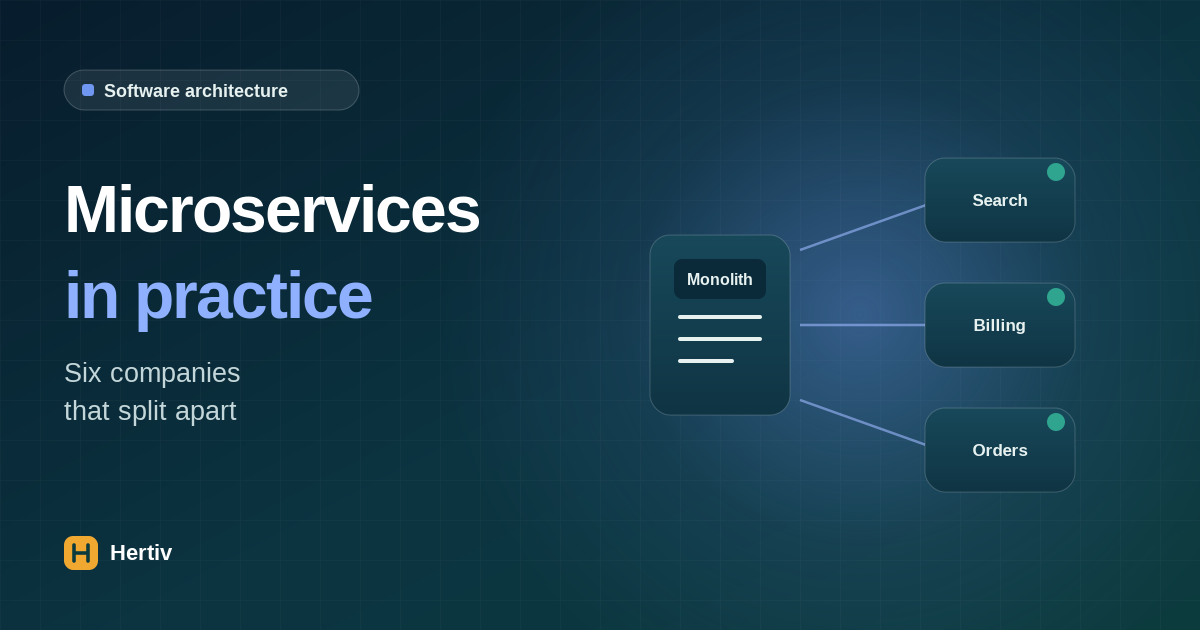
You apply these lessons by copying the pattern, not the final architecture. Every company above started simple, split when the monolith hurt, and invested in deployment and monitoring alongside the split.
- Start with one service. Pick the part that changes most often or scales hardest, and split that first.
- Split along business lines. A service should match one business capability, such as billing or search, not one technical layer.
- Give each service an owner. A service without a team that owns it becomes nobody's problem when it fails.
- Build deployment and monitoring first. Automated releases, logs and alerts must exist before the second service, not after the tenth.
- Keep the rest together. Leave the quiet parts in the monolith until they earn a split of their own.
If you are still deciding whether to split at all, microservices vs monolithic architecture compares the two shapes directly.
For the core idea itself, what microservices are explains how small services work together.
What are the common mistakes?
The common mistakes with microservices are splitting too early, splitting along the wrong lines, and building services without the tooling to run them.
- Splitting too early. A small product with one team gains little from many services and pays the operating cost of all of them.
- Wrong boundaries. Services split by technical layer, such as one for the database, create more coupling than they remove.
- No deployment tooling. Without automated releases and monitoring, each new service adds manual work.
- Shared data. Services that all read one database are not really separate, and changes still ripple across them.
- No owner per service. A service that nobody owns will rot quietly until it fails at the worst moment.
Teams that avoid these mistakes usually keep a DevOps foundation in place: automated pipelines, central logs and alerts that cover every service the same way.
Key takeaways
- Split along business boundaries, not technical layers
- Start with the busiest service and split gradually, like eBay and Airbnb
- Give every service a team that owns it, as Amazon and Spotify do
- Build deployment and monitoring before the split, not after it
- A small product with one team gains little from many services
Frequently asked questions
Which company is the best microservices example?
Netflix is the most cited, because its split follows business areas and each service has a clear owner. Amazon is the best example of team ownership, and eBay is the best example of a gradual split. The right example depends on what you want to learn.
Did Netflix start with microservices?
No. Netflix started with a single large application and split it into services as streaming grew. The split followed the pain: scale, reliability and team independence. Starting simple and splitting later is the normal path, not an exception.
How many microservices does a company need?
There is no right number. It depends on how many business capabilities the product has and how many teams work on it. A small product may need only a few services, while a large platform may need many. Count teams and capabilities, not services.
Do microservices make software faster?
They make teams faster at changing and releasing their own part, but they add work in deployment, monitoring and debugging across services. The net effect depends on whether the team invests in that tooling. Without it, microservices slow a team down.
What is the first microservice a team should build?
The part that changes most often or scales hardest, such as search, billing or payments. Splitting the busiest part gives the clearest benefit, while splitting a quiet part gives little return for the operating cost it adds.
Can a small startup use microservices?
It can, but it usually should not start there. A small team with one product is faster with a single well-built application, and can split later when the monolith slows delivery. Microservices pay off when several teams need to work without blocking each other.


