Microservices vs Monolith: Which Architecture Fits Your Team?
Microservices split an app into small services that deploy alone; a monolith keeps everything in one codebase. Learn how each works and which one fits your team.
On this page
Short answer
Microservices and monolithic architecture are two ways to organise the same application. A monolith keeps all parts in one codebase and deploys them together, while microservices split the application into small services that each own one job, their own data and their own release cycle.
What is microservices architecture?
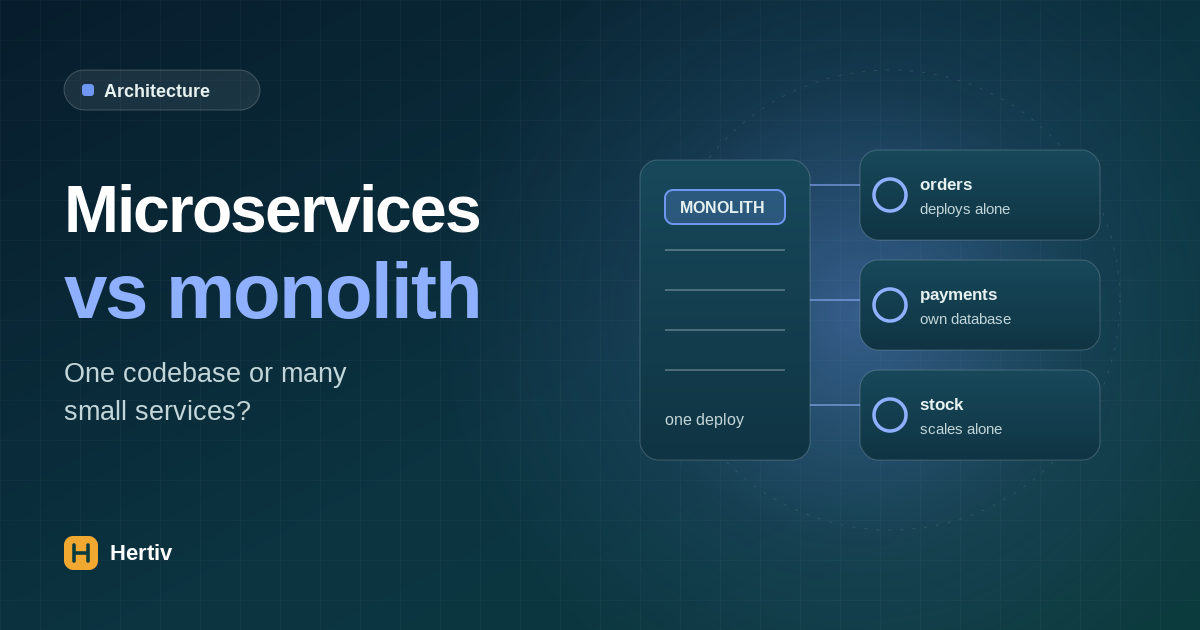
Microservices architecture is a way of building software as a set of small services, each responsible for one part of the product. A shop might have one service for orders, one for payments and one for stock, and each service has its own code, its own data store and its own release cycle.
Services talk to each other through defined interfaces, usually HTTP APIs or message queues. The boundary matters more than the size: a service should be small enough for one team to own, and its interface should change slowly even when the code inside changes often.
Microservices are a good match when different parts of a product change at different speeds and different teams own them. That independence is the main reason teams choose them, and it is also the main cost, because running many services needs more tooling than running one application.
What is monolithic architecture?
Monolithic architecture is a way of building software as one application, where all parts share a codebase, a database and a single deployment. A shop built as a monolith has its catalogue, cart, orders and payments in the same code, and a change to any part means a new release of the whole application.
That sounds limiting, but it has real strengths. Calls between parts are simple function calls, data lives in one place, and testing the whole system is straightforward because there is only one thing to run. A new developer can set up the application and understand the flow without learning a network of services first.
A monolith is often the right start for a new product. One team can move fast, deploy often and change the design as it learns what users need, without paying the cost of operating many services before the product has proved itself.
Microservices vs monolith: the key differences
The main difference between microservices and a monolith is where the complexity sits. A monolith keeps complexity inside one codebase, where calls are simple and data is in one database. Microservices move that complexity into the network, into deployment and into operations, where calls can fail and releases happen at different times.
| Area | Monolith | Microservices |
|---|---|---|
| Codebase | One shared codebase | Many small codebases |
| Deployment | One release for the whole app | Each service releases alone |
| Data | One shared database | Each service owns its data |
| Scaling | Scale the whole app | Scale only the busy service |
| Failure | One fault can stop the app | One service can fail alone |
| Team work | Teams share one codebase | Teams own separate services |
| Running it | Simpler to operate | Needs more tooling and monitoring |
Neither side wins on every row. The table shows a trade-off, and the right answer depends on team size, the number of parts that change at different speeds, and how much operational work the team can carry.
When do microservices make sense?
Microservices make sense when a product has several parts that change at different speeds and several teams that would otherwise block each other. The payments team can release a fix on a Tuesday without waiting for a planned release of the whole shop, and that independence is the main gain.
They also help when parts of the product need to scale on their own. If the search service is busy, the team runs more copies of that service only, which keeps the cost of scaling tied to the part that is actually under load. A fault in one service does not have to take down the rest, so the shop can still take orders while one part is degraded.
A third sign is team ownership. When each service has a clear owner who can change, test and release it alone, the architecture matches the way the organisation works. If no team can own a service end to end, the service will drift and become hard to maintain.
When is a monolith the better choice?
A monolith is the better choice when one small team builds a new product and needs to move fast. The team can change any part, test the whole system in one place and deploy often, without building deployment, logging and monitoring for many services first.
It is also the better choice when the parts of the product change together. If orders, payments and stock are always changed in the same release, splitting them into services adds network calls and failure modes without giving anything back. Two services that always change together are probably one service.
Cost matters too. A monolith needs less infrastructure and fewer operational habits to run well, which suits a team that has no dedicated platform engineers. For many products, a well-structured monolith, sometimes called a modular monolith, stays the right answer for years, and teams that need help shaping that structure often start with custom software development work.
Example (hypothetical): a shop grows from one app to services
Example (hypothetical): a small online shop starts as a monolith with 4 parts: catalogue, cart, orders and payments. One team of 5 developers ships a release every week, and the whole application takes 20 minutes to deploy.
Two years later the shop has 40 developers in 5 teams, and the payments part changes every week while the catalogue changes once a quarter. A payment fix now waits for a planned release, and a bug in one part can delay the whole release. The team decides to split out payments first, because it changes often and has strict rules.
After the split, a payment fix is a release of one service, which takes 20 minutes of preparation instead of 2 hours for a full release. Over 6 payment fixes, that saves 6 times 100 minutes, which is 600 minutes, or 10 hours of preparation time.
The numbers are invented to show the arithmetic, not a real project estimate. The point is that the saving comes from releasing one small service instead of the whole application, and it only holds if the boundary is right.
Common mistakes with microservices and monoliths
Common mistakes with microservices start with splitting too early. A new product with one team and few users gains little from services, because the team pays the cost of running many services before it gains the benefit of independent releases. A monolith is often the right start, with services split out as the product grows.
- Sharing one database between services. If two services read and write the same tables, they are not really separate, and a change to the tables can break both.
- Making services too small. A service that only does one tiny task will be called constantly, and every call is a chance for a delay or a failure.
- Treating a monolith as one big file. A monolith still needs clear modules and boundaries inside, or it becomes hard to change and hard to split later.
- Splitting by technology instead of by business. Services should follow business capabilities such as orders and payments, not layers such as the database or the front end.
Teams that run services in production usually invest in deployment and monitoring early, which is where cloud services and good operational habits make the difference between services that help and services that hurt.
How do you decide between the two?
You decide between microservices and a monolith by looking at team size, change speed and operational capacity, not by following a trend. Start with the product you have and the team you have, and pick the shape that lets that team ship safely.
- Count the teams. One team usually fits a monolith; several teams that block each other point towards services.
- Find the parts that change at different speeds. If two parts always change together, keep them together.
- Check operational capacity. Services need deployment, logging and monitoring for each service, so the team needs someone to own that work.
- Start with a modular monolith. Keep clear modules inside one application, so a later split is a move of a module, not a rewrite.
- Split one service at a time. Pick the part that changes most often, give it a clear boundary, and learn from that split before the next one.
The decision is not permanent. A monolith can grow services as it grows, and a set of services can be merged back together if the boundaries prove wrong. What matters is that the shape matches the team and the product today.
Key takeaways
- A monolith keeps everything in one codebase and one deployment; microservices split the app into small services that release alone
- The trade-off is where complexity sits: inside one codebase, or in the network and operations
- Microservices pay off when parts change at different speeds and teams block each other
- A monolith is often the right start for one small team building a new product
- Split one service at a time, starting with the part that changes most often
Frequently asked questions
What is the main difference between microservices and a monolith?
The main difference is deployment and ownership. A monolith deploys as one application with one shared codebase and database, while microservices deploy as separate services that each own one job, their own data and their own release cycle. The choice moves complexity between the codebase and the network.
Are microservices faster than a monolith?
Not at the start. Microservices are usually slower to build at first, because the team must build deployment, logging and monitoring for many services. They can become faster later, when teams release on their own without waiting for a full application release.
Can a monolith scale?
Yes. A monolith can run on many machines behind a load balancer, and its database can be scaled or replicated. What a monolith cannot do is scale one part alone, so a busy part means scaling the whole application, which costs more than scaling one service.
When should you move from a monolith to microservices?
Move when parts of the product change at different speeds and teams start blocking each other on releases. The usual first step is to split out one part that changes often and has a clear owner, then learn from that split before moving the next part.
Do microservices need containers?
No, containers are a common way to run microservices, but they are not required. A service is defined by its boundary and its own deployment, not by the tool used to run it. Many teams run services as separate processes on their own machines.
Is a modular monolith a real option?
Yes. A modular monolith keeps clear modules with strict boundaries inside one application, which gives much of the structure of microservices without the network cost. It is a common choice for teams that want clean boundaries but are not ready to operate many services.


