How Much Does Real Estate Tokenization Cost?
Tokenizing a property means paying for legal work, valuation, a holding company, smart contracts and an audit, plus platform fees and ongoing compliance.
On this page
Short answer
Real estate tokenization cost is the total spend to turn a property into blockchain tokens and keep them trading: legal structuring, valuation, a special purpose vehicle, smart contract development, a security audit, platform fees and ongoing compliance. For a single commercial property, planning ranges usually run from tens of thousands to a few hundred thousand dollars, with the legal and compliance work taking the largest share.
What is real estate tokenization cost?
Real estate tokenization cost is the total amount you pay to turn a property into blockchain tokens and keep the token system running. It covers legal structuring, valuation, setting up a holding company, smart contract development, a security audit, platform fees and ongoing compliance.
The cost is not one invoice. Different firms handle the legal work, the smart contracts and the platform, and each charges separately. That is why two tokenizations of similar properties can end up with very different totals: the legal structure, the jurisdiction and the number of investors change the work involved.
| Cost part | What it covers | Who charges for it |
|---|---|---|
| Legal and structuring | Offering documents, investor rules, filings | Law firm |
| Valuation | Independent value of the property | Licensed valuer |
| Holding company | Special purpose vehicle that owns the property | Law firm and registrar |
| Smart contract | Token minting, transfers, payouts | Blockchain developer |
| Security audit | Independent review of the contract code | Audit firm |
| Platform setup | Investor portal, signing, token delivery | Tokenization platform |
| Ongoing compliance | Filings, investor records, reporting | Service provider or in-house team |
Use the table as a checklist when you collect quotes. If a quote leaves out the audit or the ongoing compliance, the total will look smaller than it really is. A tokenization platform cost guide gives a wider view of platform pricing.
What does the legal and structuring work cost?
Legal and structuring work is usually the largest single cost, because a tokenized property is a regulated security in most jurisdictions. A lawyer sets up the holding company, drafts the offering documents, checks the investor rules and files what the regulator requires.
The bill grows with the number of investors and the number of jurisdictions involved. A single-country offering to a small group of known investors needs less paperwork than a public offering across several countries. Ask for a fixed fee for the standard documents and an hourly rate for regulator questions, so the bill does not drift.
In some jurisdictions the regulator also requires a licensed custodian to hold the tokens, which adds a further annual fee. Check this early, because a custodian requirement changes both the launch budget and the ongoing costs.
Keep the property documents ready before the lawyer starts: title deeds, valuation reports, existing loan terms and the ownership structure. Missing papers are a common reason legal bills grow. For the wider picture, see what real estate tokenization is and how the structure fits together.
What do the smart contract and audit cost?
Smart contract development turns the legal structure into code: minting, transfers, investor limits and payouts. A standard token contract with common features costs less than a custom one with lock-ups, voting or staged payouts.
The security audit is a separate line and should never be skipped. An auditor reads the contract code, tests it against known attack patterns and reports the issues to fix. Audit firms usually charge by the size and complexity of the code, and a second review after fixes is normal.
Budget for fixes after the audit, not just the audit itself. Most audits find issues that need developer time to resolve. A smart contract audit explains what the review covers and why it matters for investor trust.
What do platform and listing fees add?
The platform is where investors see the offering, sign documents and receive tokens. Some platforms charge a setup fee, some take a share of the amount raised, and some charge a monthly fee for hosting the offering.
Listing on a secondary market, where investors can trade tokens after the sale, adds another fee and its own compliance checks. Not every property needs secondary trading, so weigh the fee against the benefit for your investors.
Compare platform fees on the same basis: ask each platform for its setup fee, its share of the raise and its monthly charge. The cheapest setup fee can be the most expensive option once the share of the raise is counted. See platform development cost if you plan to build rather than rent.
What are the ongoing costs after launch?
Ongoing costs start the day tokens are issued. The holding company needs annual filings, the token registry needs maintenance, investors need regular reports, and payouts need to be processed and recorded.
Compliance is the largest ongoing item. Investor records must stay current, transfers must respect the rules set at issue, and tax reporting must match the jurisdiction. Some teams handle this in-house; others pay a service provider a monthly fee.
Insurance for the holding company is another recurring item, and it is often required before a platform will list the offering. Add it to the first-year budget alongside compliance and reporting, so the launch total is not understated.
Plan for at least the first year of running costs before you launch. A tokenized property that runs out of budget for compliance creates legal risk for everyone involved. The general guide to how much tokenization costs covers the same running costs across asset types.
Example (hypothetical): tokenizing a small office building
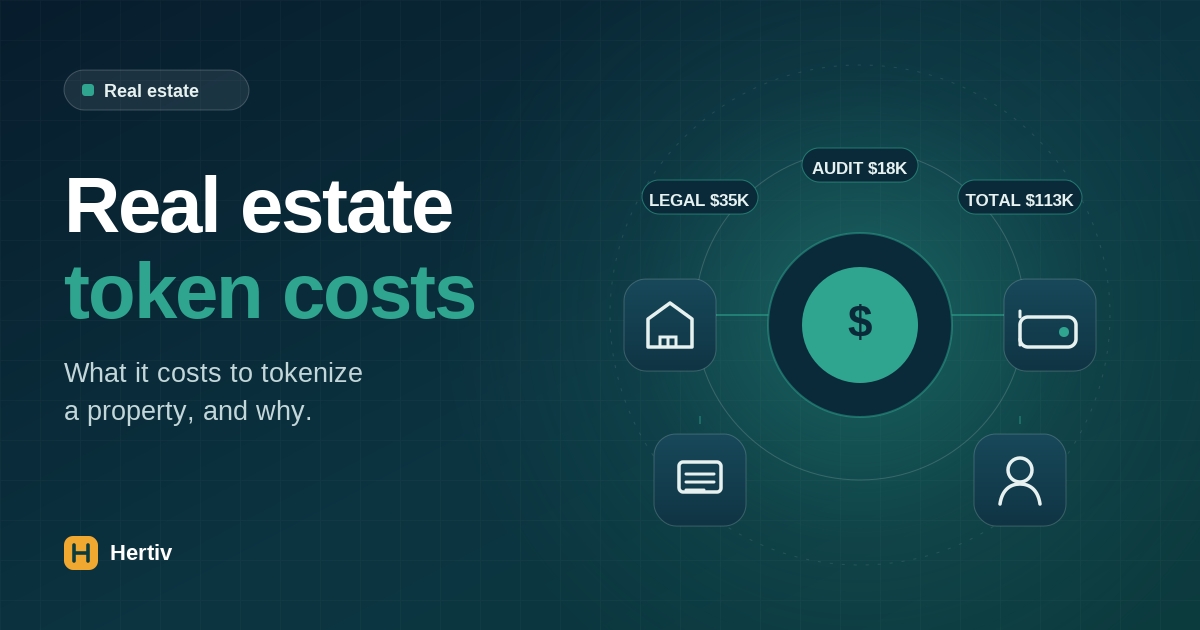
Example (hypothetical): an owner tokenizes an office building valued at $2,000,000 for 40 investors. Legal structuring costs $35,000, valuation $8,000, setting up the holding company $12,000, smart contract development $25,000, the security audit $18,000 and platform setup $15,000.
The launch total is $35,000 + $8,000 + $12,000 + $25,000 + $18,000 + $15,000 = $113,000, which is 5.65% of the property value. Ongoing costs are $12,000 a year for compliance, $6,000 for the platform and $9,000 for reporting, a total of $27,000 a year.
The numbers change with the property and the jurisdiction, but the pattern holds: legal work takes the largest share, and running costs are a steady annual bill. Budget both before you start, and keep a reserve for regulator questions.
What are the common mistakes?
The most common mistakes are budgeting only for the launch, skipping the audit, and choosing a platform on its setup fee alone.
- Starting without a legal opinion on whether the tokens are securities. The answer shapes every other cost.
- Skipping the security audit to save money. Investors will ask about it, and you will have no answer.
- Forgetting ongoing compliance and reporting costs in the first-year budget. They start on day one.
- Picking a platform by its setup fee. Its share of the raise can cost far more.
- Promising investors secondary trading before checking whether it is allowed. Some jurisdictions restrict it.
Key takeaways
- Legal and structuring work is usually the largest single cost
- A tokenized property is a regulated security in most places, so legal advice comes first
- The audit is a separate line and should never be skipped
- Compare platform fees on setup fee, share of the raise and monthly charge together
- Ongoing compliance is a steady annual bill that starts on day one
- A $2,000,000 property can cost about $113,000 to tokenize, plus $27,000 a year to run
Frequently asked questions
Is real estate tokenization cost the same as platform development cost?
No. Tokenization cost is what an owner pays to tokenize one property, including legal work, valuation and platform fees. Platform development cost is what a company pays to build its own tokenization platform from scratch, which is a software project with a much larger budget.
Do tokenization costs depend on the property value?
Partly. Legal and platform fees often scale with the size of the offering, while valuation, smart contract development and the audit depend more on complexity than on value. A small property can still carry a large fixed legal bill, which is why costs are often quoted as a share of value.
Can I tokenize a property without a security audit?
You can, but you should not. The audit checks the contract code for flaws that could freeze funds or let tokens move in ways the legal documents do not allow. Investors and platforms usually expect an audit report before they take part.
What is a special purpose vehicle in tokenization?
It is a separate company set up to own the property, so the tokens represent shares in that company rather than direct ownership of the building. The vehicle holds the title, collects rent and pays investors, which keeps the property's legal and tax affairs separate from the owner's other business.
Are there ongoing costs after the tokens are sold?
Yes. The holding company needs annual filings, the token registry needs maintenance, investors need regular reports and payouts must be processed and recorded. Compliance work is usually the largest ongoing item and should be budgeted for at least the first year before launch.
How long does a real estate tokenization take?
A straightforward single-property tokenization often takes several months, with legal structuring and regulator checks taking the most time. The smart contract and platform work is usually faster than the legal work, so start the legal process first and do not promise investors a launch date until the documents are ready.


