Publishing Tokenization Platforms: How Books and Rights Become Tokens
A publishing tokenization platform turns books, rights and royalties into digital tokens that can be owned, licensed and traded. Here is how it works.
On this page
Short answer
A publishing tokenization platform is a system that represents books, publishing rights and royalty streams as tokens on a blockchain, so they can be owned in fractions, licensed automatically and traded without a central intermediary. Authors and publishers keep a single record of who owns what, and smart contracts split each sale or licence payment between the rights holders named in the token.
What is a publishing tokenization platform?
A publishing tokenization platform is a system that turns a book, a set of rights or a royalty stream into digital tokens recorded on a blockchain. Each token stands for a defined share or right: part ownership of a book, the right to publish it in one language, or a slice of the royalties it earns.
The platform is the software around the tokens. It issues them, keeps the record of who holds what, runs the smart contracts that split payments, and gives authors, publishers and readers a place to buy, sell and licence them. Without the platform, the tokens would be records with no way to use them.
It matters because publishing rights are normally tracked in contracts, spreadsheets and emails spread across many parties. That makes it slow to check who owns a right, slow to pay royalties, and hard for a small author to raise money against a book. A shared token record makes ownership visible to everyone who needs to see it.
What can be tokenized in publishing?
Almost any right or asset in publishing can be tokenized, but the useful ones are those that earn money or need clear ownership. The table shows the common cases and who gains from each.
| Asset | Token represents | Who benefits |
|---|---|---|
| A novel or book | Ownership share in the work | Readers who fund it, authors who keep control |
| Translation rights | Right to publish in one language | Publishers buying specific markets |
| Film and audio rights | Right to adapt the work | Producers licensing one format |
| Royalty stream | Share of future sales income | Investors and co-authors |
| First-edition copies | A signed digital edition | Collectors and fans |
| Manuscript access | Early or exclusive access | Patrons and editors |
The strongest cases are rights that are sold separately today. Translation, film and audio rights already change hands in separate deals, so turning them into tokens is a small step. Tokenizing a whole book is a bigger change, and it only makes sense when the author wants to share ownership or funding.
How does tokenization change royalties?
Tokenization changes royalties by making the split automatic and visible. Today a royalty statement arrives months after a sale, passes through an agent and a publisher, and the author checks it against sales reports they cannot verify. With tokens, the smart contract that holds the royalty rules pays each holder their share when a sale is recorded.
The speed matters more than the automation. An author who sells a book in January should not wait until July to see the money. If each sale triggers a payment split at once, the author, the translator and the co-author each see their share within days, and each can check the arithmetic on the shared record.
It does not remove disputes. A token can only pay out according to the rules written into it, so the hard work is agreeing those rules before the token is issued: who gets what share, what counts as a sale, and who can change the rules later. Get that wrong and the automation just pays the wrong people faster. For the wider picture, see how tokenization works.
How do rights and licensing work on-chain?
Rights and licensing work on-chain by writing the licence terms into the token or its smart contract. A translation-rights token can state the language, the territory, the term and the fee, so a buyer knows exactly what they are buying without reading a paper contract.
The token is the proof of the right, but the law still sits underneath it. A token does not replace copyright; it records who holds a licence to use the copyrighted work. The platform must link each token to a legal agreement, or the buyer holds a token with no enforceable right behind it.
Licensing also needs an off-ramp. A film producer who buys an adaptation token still needs a signed agreement with the author, and a court still needs paper to enforce it. The best platforms treat the token as the record and the payment rail, and keep the legal agreement alongside it. See RWA tokenization for how other asset classes handle the same problem.
What does the platform stack look like?
A publishing tokenization platform has five layers, and each one has a job. The layers are simple on their own; the work is in making them agree with each other.
- Content and rights registry. A record of each work, its author, and which rights exist and who holds them.
- Token and contract layer. The blockchain and smart contracts that issue tokens, enforce splits and record transfers.
- Payment layer. The way sales money arrives and is split, usually in stablecoins or fiat through a payment provider.
- Marketplace. The place where tokens are listed, bought and sold, with prices and trade history visible.
- Compliance and identity. Checks that buyers are who they claim to be and that sales follow the rules for each market.
Most failures happen at the joins: the registry says one thing, the contract says another, or the payment layer cannot reach the country the buyer is in. A platform that works end to end on one book is worth more than a platform that promises every feature and works on none.
Example: a tokenised novel and its royalty split
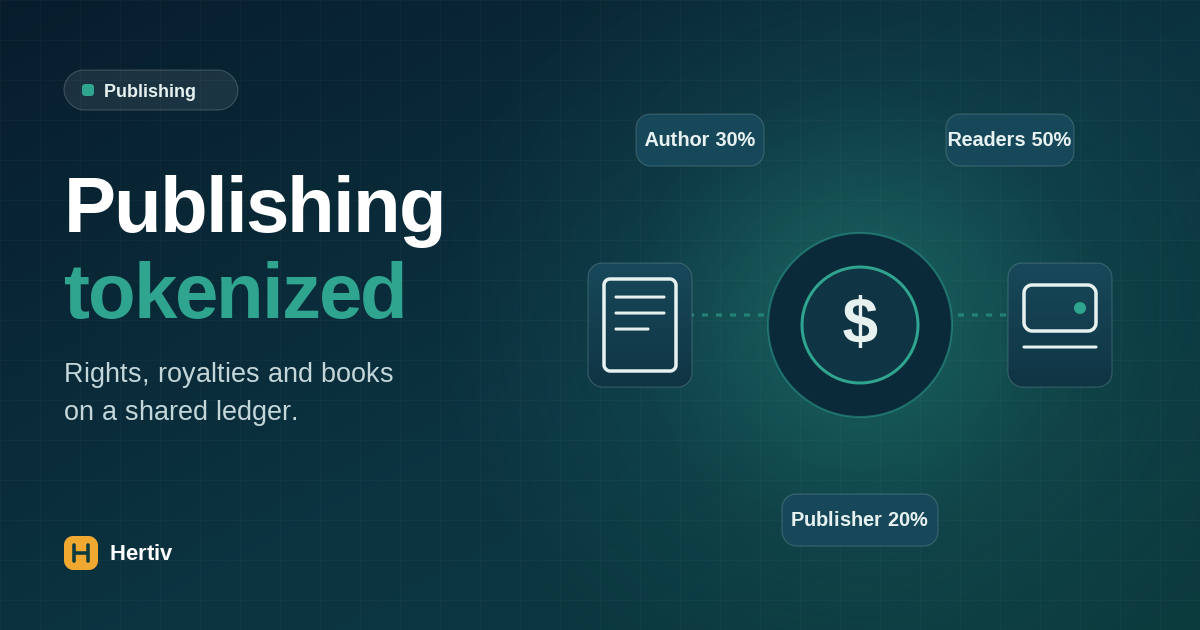
Example (hypothetical): a novel is tokenised into 10,000 tokens priced at $10 each, raising $100,000. Of those, 5,000 tokens go to readers who funded the book, 3,000 stay with the author, and 2,000 go to the publisher.
In the first year the book earns $60,000 in sales. The royalty rate is 10%, so the royalty pool is $6,000. Each token receives $0.60, so a reader holding 100 tokens gets $60, the author holding 3,000 tokens gets $1,800, and the publisher holding 2,000 tokens gets $1,200. The readers as a group receive $3,000.
The split adds up: $1,800 plus $1,200 plus $3,000 equals the $6,000 pool. The remaining $54,000 of sales covers printing, distribution and the platform fee, which are agreed before the tokens are issued so no holder is surprised by what is taken first.
What are the common mistakes?
The most common publishing tokenization mistakes are tokenizing a book nobody wants, writing royalty rules that nobody checked, and treating the token as a substitute for a legal agreement.
- Tokenizing before there is demand. A token does not create readers; it only changes how ownership is recorded.
- Vague royalty rules. If the split, the sale definition and the fee order are not written down, holders will disagree later.
- No legal agreement behind the token. A token with no enforceable right is a collectible, not a licence.
- Ignoring securities rules. Tokens that promise a share of income can count as securities in many markets, and that brings registration and disclosure duties.
- Promising a liquid market. A marketplace with no buyers leaves holders unable to sell, however good the book is.
Key takeaways
- A publishing tokenization platform turns books, rights and royalty streams into tokens on a shared ledger
- Tokenized rights work best where rights are already sold separately, such as translation, film and audio
- Smart contracts can split royalties automatically, but only if the split rules are agreed before issue
- A token records a licence; the legal agreement behind it is still what makes the right enforceable
- Tokens that promise income can count as securities, so the platform must handle compliance from the start
Frequently asked questions
Do I need a blockchain to tokenize a book?
No, but a blockchain gives every party the same record of who owns what, which is the part paper contracts handle badly. A shared database run by one publisher can do the same job, but then holders must trust that publisher alone to keep the record honest.
How do authors earn from tokenized books?
Authors earn in two ways: from selling tokens that represent a share of the work, and from royalties that the smart contract splits automatically on each sale. The exact shares are written into the token rules before issue, so the author knows what they keep.
Can readers really own part of a book?
Yes, in the sense that a token can represent a defined share of the book or its royalty stream. What that share means depends on the legal agreement behind the token, so readers should read it before buying, just as they would read any investment document.
What happens if the platform shuts down?
The tokens live on the blockchain, so the ownership record survives, but the marketplace, the payment splits and the support may not. Authors should check whether the platform stores the legal agreements and the registry somewhere independent before they commit a book to it.
Is tokenizing a book the same as selling an NFT?
Not quite. An NFT usually represents one unique copy or item. A publishing token can represent a share of a right, a royalty stream or a licence, and many tokens can stand for the same work. The two ideas overlap, but the rights model is the part that matters for publishing.
Which books suit tokenization best?
Books with an existing audience suit it best, because the tokens need buyers. A well-known author, a series with loyal readers, or a book with clear adaptation potential are stronger candidates than an unknown first novel with no readers yet.


