7 Post-Quantum Crypto Security Technologies to Know
Quantum computers could one day break today's public-key encryption. These seven post-quantum technologies are the replacements teams are testing and adopting now.
On this page
Short answer
Post-quantum cryptography is a set of encryption and signature methods designed to resist attacks from quantum computers. The main technologies are lattice-based algorithms, hash-based signatures, code-based encryption and hybrid schemes that combine old and new methods, plus quantum key distribution for dedicated links. Teams are adopting them now so data encrypted today stays safe later.
Which post-quantum technologies matter most?
The post-quantum technologies that matter most are the ones with published standards, working libraries and a clear migration path. A quantum computer that can break today's public-key encryption does not exist yet, but data encrypted today could be stored and decrypted later, which is why teams are moving now rather than waiting.
Use the comparison below to shortlist. Maturity reflects whether a standard exists and whether libraries and hardware support are available.
| Technology | What it protects | Best for | Maturity |
|---|---|---|---|
| ML-KEM | Key exchange | TLS and VPNs | Standard |
| ML-DSA | Signatures | General signing | Standard |
| SLH-DSA | Signatures | Long-lived signatures | Standard |
| Classic McEliece | Key exchange | High-assurance encryption | Evaluation |
| Falcon | Signatures | Compact signatures | Evaluation |
| Hybrid schemes | Key exchange, signatures | Transition period | Deploying now |
| Quantum key distribution | Key exchange | Dedicated fibre links | Niche |
Start with the standardised algorithms. They have the widest library support and the clearest guidance, so a team can migrate one system at a time without betting on an unproven design.
ML-KEM and ML-DSA: the lattice-based standards
1. ML-KEM: best for replacing key exchange
ML-KEM is a lattice-based key encapsulation method standardised by NIST, built on the Kyber design. It replaces the key exchange step in protocols such as TLS, so two parties can agree a shared secret that a quantum computer cannot easily recover from the public values.
It is the first post-quantum algorithm most teams deploy, because key exchange is where the harvest-now-decrypt-later risk sits. Libraries and TLS implementations already support it, and the keys and ciphertexts are small enough for normal network use.
Pros: published standard; fast in software; supported in major libraries. Cons: larger keys than elliptic-curve methods; needs protocol updates to deploy.
2. ML-DSA: best for general-purpose signing
ML-DSA is a lattice-based signature scheme standardised by NIST, built on the Dilithium design. It signs software, documents and certificates, replacing RSA and elliptic-curve signatures where a quantum-resistant signature is needed.
It is the default signing choice for most migrations because it is fast, well studied and already in libraries. The signatures are larger than elliptic-curve ones, so systems that store many signatures need to plan for the extra size.
Pros: published standard; fast signing and verification; broad library support. Cons: signatures are larger than elliptic-curve signatures; public keys take more storage.
SLH-DSA and Classic McEliece: the conservative options
3. SLH-DSA: best for long-lived signatures
SLH-DSA is a hash-based signature scheme standardised by NIST, built on the SPHINCS+ design. Its security rests on hash functions rather than on lattice mathematics, so it stays safe even if a weakness is found in lattice methods.
It is slower and produces larger signatures than ML-DSA, which is why teams use it where signatures are rare but must last for years, such as firmware signing or long-term document archives.
Pros: security rests on well-understood hash functions; a hedge against lattice breaks. Cons: slower signing; large signatures; stateful key handling in some forms.
4. Classic McEliece: best for high-assurance encryption
Classic McEliece is a code-based key encapsulation method built on error-correcting codes, studied since the late 1970s. It is one of the oldest post-quantum designs and has survived decades of analysis without a practical break.
Its drawback is size: public keys are large, often close to a megabyte, which rules it out for many network protocols. Teams use it where key size does not matter, such as encrypting stored data or long-term archives.
Pros: decades of analysis; fast encryption once keys exist. Cons: very large public keys; limited protocol support.
Falcon and hybrid schemes: the practical middle ground
5. Falcon: best for compact signatures
Falcon is a lattice-based signature scheme known for small signatures, which makes it useful where bandwidth or storage is tight, such as embedded devices or certificate chains. It is further along in standardisation than most alternatives and already appears in some libraries.
It is harder to implement correctly than ML-DSA, because it needs careful floating-point arithmetic, so teams should use a vetted library rather than writing their own implementation.
Pros: small signatures; fast verification. Cons: harder to implement safely; standardisation still in progress.
6. Hybrid schemes: best for the transition period
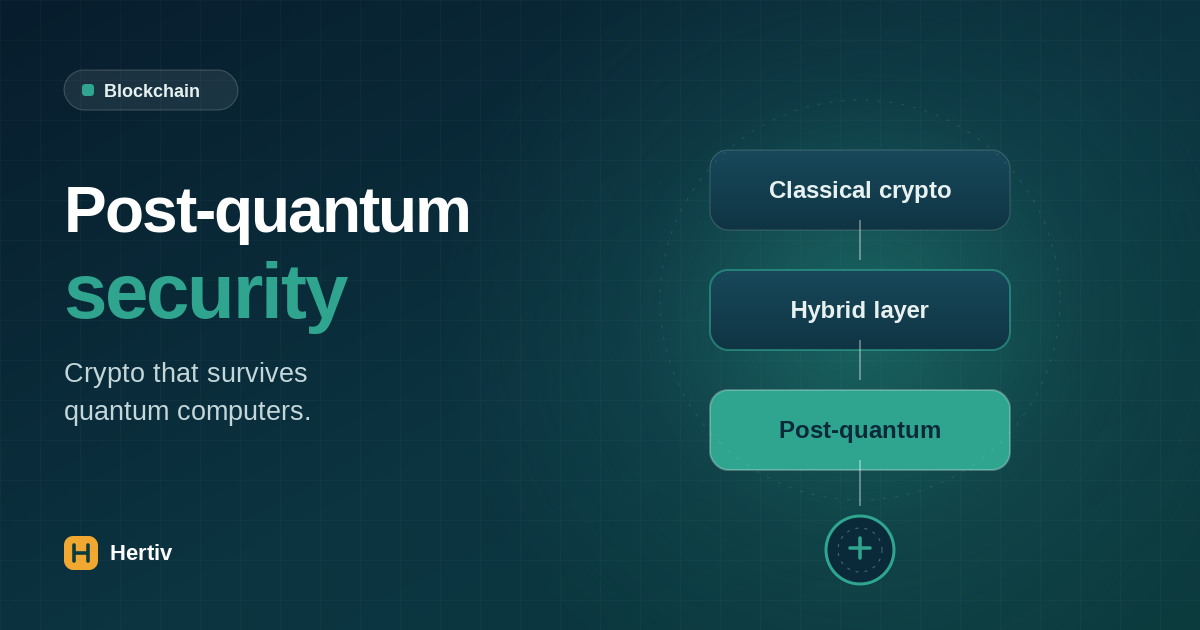
A hybrid scheme combines a classical algorithm with a post-quantum one, so the connection stays safe if either one fails. A typical hybrid TLS handshake runs both elliptic-curve and ML-KEM key exchange and mixes the results.
Hybrids are the practical choice for most teams today, because they add quantum resistance without removing the classical protection that auditors and regulators already accept. They cost some extra bandwidth and a protocol update, but the risk of a single-algorithm failure drops.
Pros: safe if either algorithm fails; accepted by auditors; deployable now. Cons: larger handshakes; needs protocol support on both ends.
Quantum key distribution: physics instead of maths
7. Quantum key distribution: best for dedicated fibre links
Quantum key distribution, or QKD, uses photons sent over fibre to share a key between two points, and the laws of physics reveal any attempt to listen in. It does not rely on hard maths problems, which is why it attracts teams protecting very sensitive links.
It is a niche technology, not a general replacement for encryption. It needs dedicated fibre, special hardware and a short distance between endpoints, and it protects the key exchange only, not the data itself. Most teams will never need it, but for a link between two data centres it is a real option.
Pros: eavesdropping is detectable by physics; no reliance on unproven maths. Cons: needs dedicated fibre and hardware; short range; high cost.
For most organisations, the migration path is simpler: start with hybrid schemes on the public-facing systems, then move to pure post-quantum algorithms as standards and libraries mature. QKD is for the few links where that is not enough.
How to choose the right post-quantum approach
You choose a post-quantum approach by data lifetime, not by hype. Data that must stay secret for ten years matters more than data that expires next week, because stored ciphertext can be decrypted later once a capable quantum computer exists.
- List the data and systems that must stay secret longest, and rank them by lifetime.
- Find every place public-key encryption is used: TLS, VPNs, email, file encryption, code signing and backups.
- Start with hybrid key exchange on the public-facing systems, where the risk is highest and the standards are ready.
- Move signatures next, starting with code signing and certificates, where ML-DSA fits well.
- Test in a staging environment first, measure the size and speed impact, and then roll out one system at a time.
Keep an inventory of every algorithm in use. A migration without an inventory is guesswork, and the systems you forget are the ones that stay vulnerable. If your team needs help planning the move, cybersecurity services covers the assessment and rollout.
Common mistakes in post-quantum migration
Most post-quantum migration mistakes come from treating it as a single upgrade instead of a multi-year programme. Teams buy a product, declare the job done, and miss the systems that still use old algorithms.
- Waiting for a quantum computer. The risk is data harvested today and decrypted later, so waiting is the riskiest choice for long-lived data.
- No crypto inventory. Without a list of every algorithm in use, the migration misses systems.
- Rolling your own implementation. Post-quantum algorithms are easy to get wrong. Use vetted libraries.
- Ignoring signature size. Larger keys and signatures break assumptions in protocols, storage and embedded devices.
- Forgetting backups and archives. Old backups encrypted with old algorithms are still at risk.
- Treating QKD as a general fix. It protects one link, not a whole network, and it needs special hardware.
For the broader access model around these systems, zero trust security explains how to verify every request.
The same rollout thinking applies to post-quantum migration: verify every system, log every change, and move one system at a time.
Key takeaways
- ML-KEM and ML-DSA are the standardised lattice algorithms to start with
- Hybrid schemes protect you if either the classical or the post-quantum algorithm fails
- Hash-based and code-based options are the conservative hedge against lattice breaks
- Quantum key distribution suits dedicated fibre links, not general use
- Migrate by data lifetime: longest-lived secrets first, one system at a time
Frequently asked questions
What is post-quantum cryptography?
Post-quantum cryptography is encryption and signing designed to resist attacks from quantum computers. Today's public-key methods rely on maths problems a quantum computer could solve, so post-quantum methods use different problems, such as lattices, hash functions and error-correcting codes, that are believed to stay hard.
When will quantum computers break today's encryption?
Nobody knows the date, and that is the point. A capable quantum computer may be years away, but data encrypted today can be stored and decrypted later, so teams protect long-lived data now rather than waiting for a deadline they cannot predict.
What is the difference between ML-KEM and ML-DSA?
ML-KEM is a key encapsulation method used to agree a shared secret, for example in a TLS handshake. ML-DSA is a signature scheme used to sign software, documents and certificates. Most systems need both: one to exchange keys and one to prove who signed what.
Are post-quantum algorithms already standardised?
Yes, the first set is. NIST published ML-KEM, ML-DSA and SLH-DSA as standards, and libraries and TLS implementations already support them. Other designs, such as Falcon and Classic McEliece, are still being evaluated, and hybrid schemes are already in use.
Do I need quantum key distribution?
Almost certainly not. Quantum key distribution needs dedicated fibre, special hardware and short distances, and it protects one link at a time. For most organisations, standardised post-quantum algorithms, deployed as hybrid schemes, cover the risk at far lower cost.
How do I start a post-quantum migration?
Start with an inventory of every place public-key encryption is used, rank systems by how long their data must stay secret, and deploy hybrid key exchange on the public-facing systems first. Test in staging, measure the size and speed impact, and roll out one system at a time.


