Permissioned DeFi Lending Platforms Explained
Permissioned DeFi lending platforms gate lending pools to verified borrowers and lenders. Learn how they work, who uses them and how they differ from open lending.
On this page
Short answer
A permissioned DeFi lending platform is a lending protocol that only admits borrowers and lenders who pass identity checks. Smart contracts still run the loans, set the rates and hold the collateral, but access is gated by an allowlist. That design suits institutions that need to know their counterparties, and it trades some of DeFi's openness for compliance with anti-money-laundering rules.
What is a permissioned DeFi lending platform?
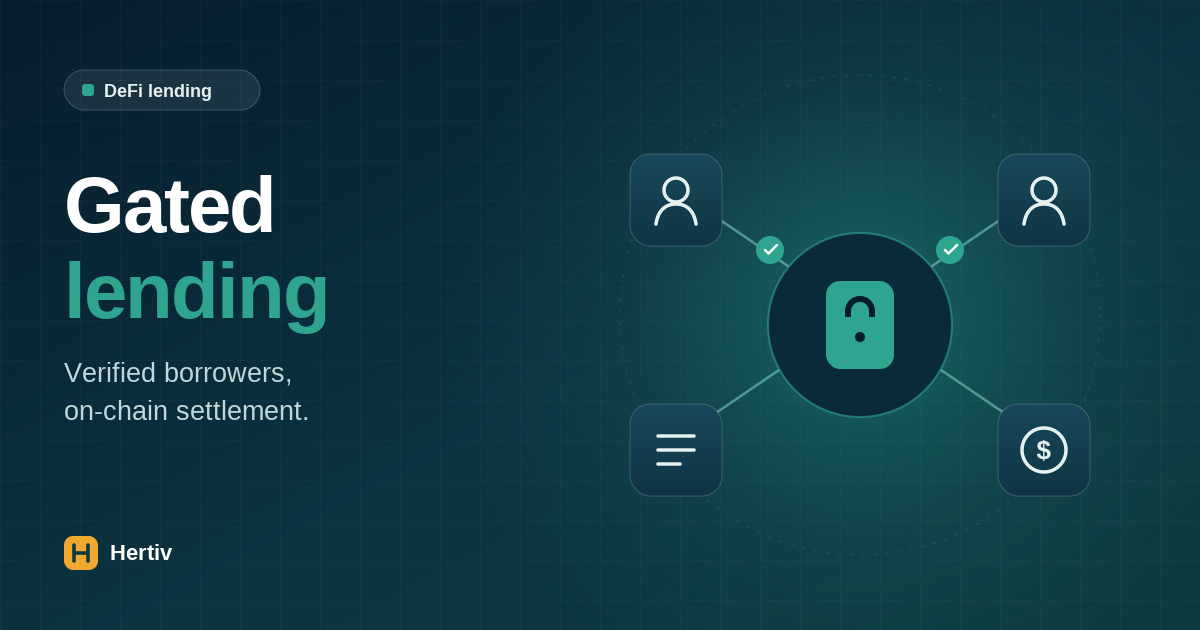
A permissioned DeFi lending platform is a lending protocol where only verified participants can borrow or lend. The smart contracts work the same way as in open DeFi: they hold collateral, calculate interest and liquidate loans that fall below their safety limits. The difference is the gate at the front door. A wallet must be on an allowlist, usually after passing identity checks, before it can touch a pool.
The point is to keep the useful parts of DeFi, such as automated settlement and transparent loan terms, while meeting the rules that institutions already follow. A bank or a fund cannot lend to an anonymous wallet, because it must know who its counterparty is and be able to report the activity. Permissioned pools give it that answer without giving up on-chain settlement.
| Feature | Permissioned lending | Open lending |
|---|---|---|
| Who can join | Verified wallets only | Anyone with a wallet |
| Identity checks | Required before access | None |
| Counterparty | Known and screened | Anonymous |
| Typical collateral | Tokens and real-world assets | Tokens only |
| Typical users | Institutions and funds | Anyone, including individuals |
| Main trade-off | Less open, more compliant | More open, less compliant |
Permissioned lending is a middle ground, not a replacement for open lending. It exists because some lenders want DeFi's automation but cannot use a protocol that accepts anonymous counterparties.
How does access control work in permissioned lending?
Access control in permissioned lending works through an allowlist that the protocol checks before any deposit or borrow. A participant completes identity checks with a verification provider, and their wallet address is added to the list. Smart contracts then refuse transactions from any address that is not on it.
The checks usually cover identity documents and screening against sanctions lists, the same checks a bank runs when it opens an account. Some platforms add ongoing monitoring, so a wallet can be removed from the allowlist if its owner's status changes. The rules are written into the contracts, which means they apply the same way to every participant and cannot be skipped by a staff member.
Pools are often split by purpose. One pool might serve short-term loans to trading firms, another might fund invoices for a logistics company. Each pool has its own allowlist, its own interest rate model and its own collateral rules, so a lender can pick the risk profile that fits rather than joining one giant pool.
This structure is why permissioned blockchains and permissioned lending are often discussed together: both use the same idea of a verified participant set, applied at different layers of the stack.
Who uses permissioned DeFi lending platforms?
Permissioned DeFi lending platforms are used by institutions that want on-chain lending without anonymous counterparties. The main groups are investment funds, trading firms, fintech companies and corporate treasuries, each with a different reason for being there.
Funds use these platforms to earn yield on stablecoins or to borrow against token holdings, with the comfort of knowing the other side of the trade has been screened. Trading firms borrow short-term working capital for market making and arbitrage, where the speed of on-chain settlement matters more than the loan size. Fintech companies use permissioned pools to fund real-world lending, such as invoices or small-business loans, and pass the yield to their own customers.
Corporate treasuries are a newer group. A company holding stablecoins can lend them through a permissioned pool instead of leaving them idle, and it can show its auditors exactly who borrowed the funds and on what terms. That audit trail is often the deciding factor, since a treasurer must explain every counterparty to the board.
Individuals rarely use these platforms directly, because the identity checks and minimums are aimed at professional participants. That is a deliberate design choice, not an accident.
Which permissioned DeFi lending platforms exist?
Several permissioned DeFi lending platforms are already operating, each with a different focus. Aave Arc is the permissioned deployment of the Aave lending protocol, built for institutions that want to borrow and lend inside a verified participant set. It uses the same pool model as Aave, with the allowlist added as the gate.
Maple Finance runs permissioned lending pools where a pool delegate vets borrowers and sets terms. The delegate model suits lenders who want a professional manager choosing the borrowers, rather than an open market where anyone can borrow. Centrifuge takes a different route: it finances real-world assets such as invoices and property by turning them into tokens that can be used as collateral in a pool.
Goldfinch focuses on loans to real-world businesses in markets where traditional credit is scarce, with borrowers assessed by auditors rather than by token collateral alone. TrueFi offers uncollateralised lending where borrowers are scored on creditworthiness, with the loans still settled on chain. Each platform answers the same question, how to lend on chain to a known counterparty, with a different mix of collateral, screening and management.
None of these platforms removes risk. They change its shape, from anonymous smart-contract risk to a mix of smart-contract risk and credit risk on a known borrower, which is the trade institutions are willing to make. For teams considering this space, DeFi development covers the protocol design choices behind these models.
What are the risks of permissioned DeFi lending?
The risks of permissioned DeFi lending start with smart contracts. A bug in the lending contract can lock or lose funds, and an allowlist does not fix code. Audits reduce the risk but do not remove it, and the history of DeFi includes well-audited protocols that still lost funds to exploits.
Credit risk is the second risk, and it is larger here than in open lending. Open lending usually demands over-collateralisation with tokens that can be sold instantly. Permissioned pools often lend against real-world assets or on the strength of a borrower's credit, which means a default can take months to resolve and may recover less than the loan.
There are also concentration and governance risks. A small number of pool delegates or borrowers can dominate a pool, so one failure hits many lenders. And the allowlist itself is a point of control: whoever manages it decides who can participate, which reintroduces a central decision that open DeFi avoids.
Regulatory change is a further risk. The rules for on-chain lending to institutions are still forming in many countries, and a platform that is compliant today may need to change its screening or reporting tomorrow. Lenders should treat these platforms as an evolving market, not a settled one.
Example (hypothetical): a fund lends through a permissioned pool
Example (hypothetical): a fund holds $500,000 in stablecoins and lends the full amount through a permissioned pool for six months at an annual rate of 8%. The interest for six months is $500,000 times 8% times one half, which is $20,000.
The pool delegate takes a fee of 1% of the amount lent, which is $5,000, and the platform takes no further fee in this example. The fund's net return is $20,000 minus $5,000, which is $15,000 for six months, or 3% on the amount lent.
Compare that with leaving the same $500,000 idle, which earns nothing, and with open DeFi lending, where the rate might be higher but the borrowers are anonymous. The fund accepts a lower headline rate in exchange for knowing its borrower and having a delegate assess the credit. The arithmetic is simple; the judgement is whether the borrower's credit and the contract's safety are worth the 3%.
This example also shows why lenders read the pool terms before depositing. The delegate fee, the loan duration and the collateral rules all change the net return, and they differ from pool to pool.
What are the common mistakes?
The most common mistakes in permissioned DeFi lending are treating verification as a guarantee, ignoring the collateral, and assuming the pool will stay liquid.
- Treating identity checks as credit checks. Knowing who a borrower is does not mean they can repay. Read the credit assessment, not just the allowlist.
- Ignoring what secures the loan. Real-world collateral is harder to sell than tokens. Ask how it would be recovered if the borrower defaults.
- Assuming instant exit. Some pools lock funds for the loan term. Check the withdrawal terms before depositing.
- Skipping the contract review. An allowlist does not fix a bug. Check the audit history and whether the code is public.
- Concentrating in one pool. A single pool delegate or borrower is a single point of failure. Spread across pools and platforms.
Key takeaways
- Permissioned lending keeps DeFi's automation but gates access to verified participants
- Identity checks satisfy compliance, but they do not remove smart-contract or credit risk
- Aave Arc, Maple, Centrifuge, Goldfinch and TrueFi each solve the same problem differently
- Real-world collateral is harder to recover than token collateral, so read the terms
- Check delegate fees, loan duration and exit rules before depositing, since they change the net return
Frequently asked questions
What is the difference between permissioned and open DeFi lending?
Open DeFi lending accepts anyone with a wallet and no identity checks, while permissioned lending only admits wallets that have passed identity screening and sit on an allowlist. The smart contracts work the same way in both, but permissioned pools know their counterparties and can meet compliance rules that open pools cannot.
Do permissioned DeFi platforms still use smart contracts?
Yes. The loans, interest calculations, collateral rules and liquidations are still run by smart contracts. The permissioned part is the access gate: the contract checks whether a wallet is on the allowlist before it lets that wallet deposit or borrow.
Who can borrow on a permissioned DeFi platform?
Verified institutions, funds, trading firms and businesses that have passed identity checks. Some platforms also admit accredited individuals. The exact rules depend on the platform and the pool, and each pool can set its own borrower criteria.
Is permissioned DeFi lending safer than open DeFi lending?
Not automatically. Knowing the borrower reduces counterparty uncertainty, but smart-contract bugs, credit defaults and regulatory change still apply. Permissioned pools often lend against real-world assets, which can be slower to recover than token collateral, so the risk is different rather than smaller.
What is a pool delegate in permissioned lending?
A pool delegate is a professional manager who vets borrowers, sets loan terms and monitors repayment for one lending pool. Lenders deposit into the pool and rely on the delegate's judgement, and the delegate usually earns a fee on the amount lent.
Can individuals use permissioned DeFi lending platforms?
Rarely as direct participants. Most permissioned platforms are built for institutions and professional investors, with identity checks and minimums aimed at that audience. Individuals usually access the yield indirectly, through a fund or a fintech product built on top of a permissioned pool.


