P2P Lending Apps: How They Work and What to Check
P2P lending apps match borrowers with individual lenders and handle the loan, payments and collections. Check licences, fees and default handling first.
On this page
Short answer
A P2P lending app is a platform that matches people who want to borrow money with people who want to lend it, without a bank in the middle. The app checks borrowers, sets a risk grade, collects repayments and passes the money to lenders, taking a fee for the service. Lenders earn interest, borrowers get a loan, and the platform carries the risk that a borrower stops paying.
What is a P2P lending app?
A P2P lending app is a platform where individuals lend money directly to other individuals or small businesses, with the app handling the matching, the paperwork and the repayments.
Unlike a bank, the platform does not lend its own money. It takes a fee from borrowers, lenders or both, and its job is to check borrowers, grade risk, collect monthly payments and chase late ones. The lender takes the credit risk, and the platform takes the operational risk of running the service.
P2P lending apps sit inside fintech, where software replaces parts of what banks used to do. They work best for small personal loans and small business loans, where the amounts are modest and the process can be standardised. For the build side, how to launch a P2P lending platform covers the steps behind the app.
How does a P2P lending app work?
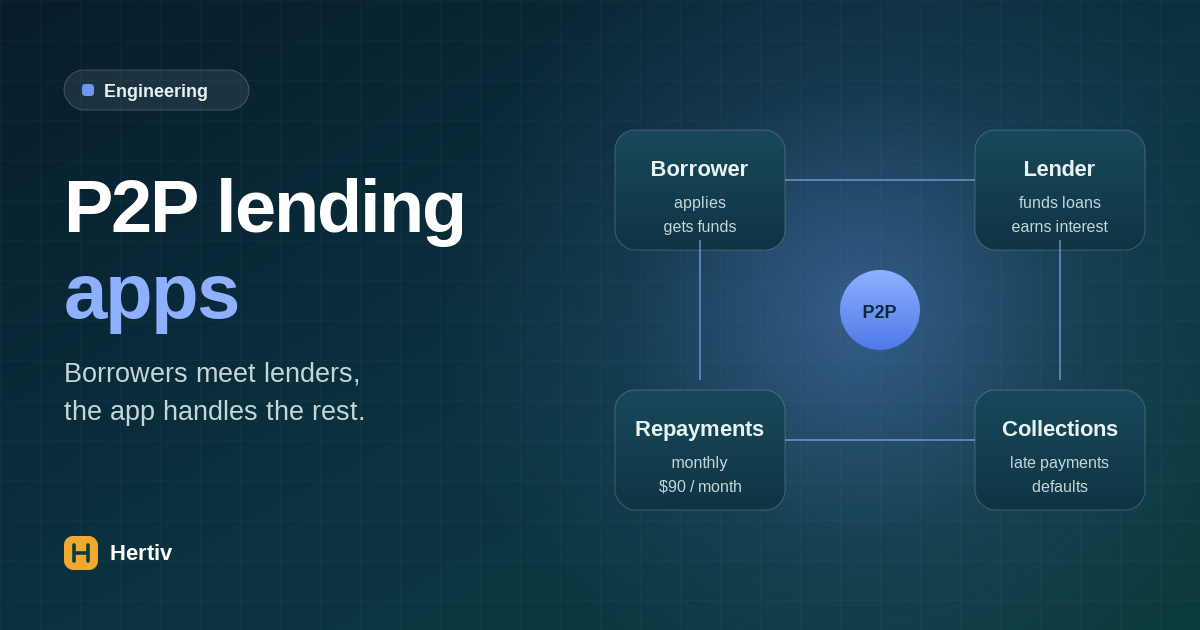
A P2P lending app works by listing a loan request, matching it with lenders, moving the money, and then collecting repayments and passing them back to the lenders.
| Party | Role | What they do |
|---|---|---|
| Borrower | Requests the loan | Applies, shares income and credit data |
| Lender | Funds the loan | Chooses loans, earns interest |
| Platform | Runs the marketplace | Checks, grades, collects, reports |
| Payment partner | Moves the money | Holds and transfers funds securely |
The flow is simple on the surface. A borrower applies and the platform checks identity, income and credit history, then assigns a risk grade and an interest rate. Lenders see the listing and fund part or all of it, often spreading small amounts across many loans to reduce risk.
Once funded, the money moves to the borrower and repayments start, usually monthly. The platform deducts its fee, passes the rest to lenders and handles late payments. If a borrower stops paying, the platform follows its collections process, which varies by platform and by country.
What do borrowers get from a P2P lending app?
Borrowers get a loan that can be faster to arrange and easier to apply for than a bank loan, with a rate that reflects their risk grade rather than a single bank rate.
The application is usually fully online: identity checks, bank statements and credit data are gathered in the app, and a decision can come in hours rather than days. The rate depends on the risk grade, so a borrower with a strong record pays less than one with a weak record.
Borrowers should compare the total cost, not just the headline rate. Platform fees, late fees and the repayment schedule all change what the loan really costs, and a short loan with a high fee can cost more than a longer loan with a lower rate. Read the full fee schedule before accepting an offer.
What do lenders get, and what are the risks?
Lenders get interest income by funding loans, usually spread across many borrowers, but they carry the risk that some borrowers stop paying and the money is not recovered.
The main risk is default: a borrower who cannot repay. Lenders reduce it by spreading money across many loans, so one default is a small loss rather than a total loss. Some platforms offer a provision fund that covers part of defaults, but the fund is limited and does not guarantee repayment.
Other risks matter too. The platform itself can fail, and lender money may not be protected the same way bank deposits are. Loans are also hard to sell quickly, so money lent for two years is usually locked in for two years. Lenders should only lend money they can afford to lose, and they should check how the platform handles defaults before funding a loan.
What rules apply to P2P lending apps?
P2P lending apps are regulated in most markets, but the rules differ by country: some require a licence, some cap interest rates, and some require lender money to be kept separate from the platform's own money.
Common rules include:
- Licensing. The platform must hold a lending or financial services licence in each market where it operates.
- Segregated funds. Lender money is held in a separate account, so it is not mixed with the platform's operating cash.
- Disclosure. The platform must show fees, risks and past default rates clearly, not buried in small print.
- Borrower checks. Identity, income and affordability checks are required before a loan is listed.
- Complaints and redress. Borrowers and lenders need a clear path to complain and to escalate if the platform does not resolve it.
Before using an app, check that it is licensed in your country and that lender money is held separately. A platform that cannot show its licence or its fund segregation is one to avoid. For cost context, fintech super app development cost shows what building this kind of platform usually involves.
Example (hypothetical): a small loan through the app
Example (hypothetical): a lender funds a $1,000 loan to a borrower who repays $90 a month for 12 months.
Twelve payments of $90 add up to $1,080, so the borrower pays $80 in interest over the year. The platform takes a 1% fee on the loan, which is $10, and passes the remaining $1,070 to the lender.
The lender therefore receives $70 on $1,000 over a year, which is a 7% return before any defaults. If one loan in twenty defaults and nothing is recovered, the lender loses $50 on every $1,000 lent on average, which cuts the return to about 2%. This is why spreading money across many loans matters more than picking a single high-rate loan.
The numbers show the trade-off clearly: the return looks attractive next to a savings account, but it comes with real default risk that the lender carries, not the platform.
What are the common mistakes?
The most common mistakes with P2P lending apps are chasing the highest rate, lending to one borrower, and trusting a platform without checking its licence or its default record.
- Chasing the highest rate. The highest rate usually means the highest default risk, and the return after defaults is often lower.
- Lending to one borrower. One default wipes out the whole return, so spread money across many loans.
- Ignoring the platform's default record. Past default rates and how the platform handles them tell you more than the marketing page.
- Assuming deposits are protected. P2P lending is not a bank deposit, and the money is not covered by deposit protection in most markets.
- Borrowing more than needed. A loan that is easy to get is still a loan, and the monthly payment must fit the budget.
- Skipping the fee schedule. Platform fees, late fees and early repayment fees change the real cost of the loan.
Key takeaways
- A P2P lending app matches borrowers with lenders; the platform does not lend its own money
- Borrowers get faster online decisions; lenders earn interest and carry the default risk
- Spreading money across many loans matters more than chasing the highest rate
- Check the licence, segregated funds and past default rates before using an app
- P2P lending is not a bank deposit and is not covered by deposit protection
Frequently asked questions
How is a P2P lending app different from a bank loan?
A bank lends its own money and takes the credit risk, while a P2P platform matches borrowers with individual lenders and takes a fee. The lender carries the default risk on a P2P platform, and the platform handles checks, grading, collection and reporting.
Can lenders lose money on P2P lending apps?
Yes. If a borrower stops paying and the platform cannot recover the money, the lender loses part or all of that loan. Spreading money across many loans and checking the platform's default record are the main ways lenders reduce this risk.
Are P2P lending apps regulated?
In most markets, yes, but the rules differ by country. Common requirements are a licence, segregated client money, clear fee and risk disclosure, and borrower affordability checks. Check that the app is licensed in your country before using it.
How much can a lender earn on a P2P lending app?
Returns depend on the interest rate, the platform fee and the default rate. A loan paying 7% interest with a 1% fee and some defaults can end up returning far less, so look at returns after defaults, not the headline rate.
What happens if the P2P platform fails?
If the platform fails, existing loans usually keep running through an administrator, but the process is slow and uncertain. Lender money held in a segregated account is separate from the platform's own cash, which is why segregation matters.
Should borrowers use a P2P lending app instead of a bank?
It depends on the total cost and the borrower's record. A P2P loan can be faster and cheaper for a borrower with a strong record, but the total cost, including fees, is what matters. Compare the full cost against a bank loan before deciding.


