Fintech Super App Costs: What to Budget For
One app covering payments, accounts, lending and investing needs a shared wallet, a ledger and serious compliance work. Here is what drives the cost.
On this page
Short answer
A fintech super app is one mobile app that combines payments, accounts, cards, lending, investing and rewards under a single login and wallet. The cost comes from building the shared base, integrating banking and payment partners, and meeting compliance rules for every service it offers.
What is a fintech super app?
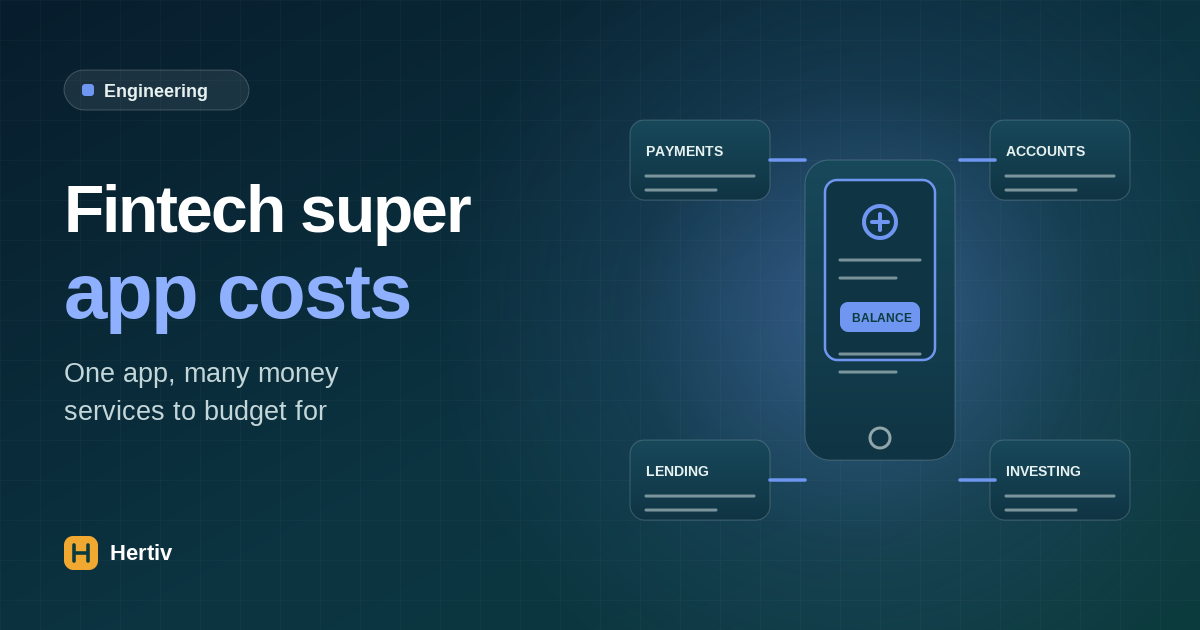
A fintech super app is one mobile app that combines several money services in a single place: payments, bank accounts, cards, lending, investing, insurance and rewards. Instead of opening a separate app for each job, the user opens one app and moves between services without signing in again.
The idea started in Asia, where apps such as WeChat Pay and Grab grew from one service into a bundle. A user might pay a friend, split a restaurant bill, buy a train ticket and check an investment balance in the same session. The app becomes the default place for money tasks, which is why banks, payment firms and startups all want to build one.
A super app is not a single feature. It is a platform with a shared login, a shared wallet, one set of compliance checks and many small services on top. That shared base is what makes the build expensive: every service adds its own rules, partners and licence requirements. Teams planning a narrower product often start with a single service, as the mobile banking app cost guide shows.
What services go into a fintech super app?
The services in a fintech super app fall into four groups: moving money, holding money, borrowing and investing, and the extras that keep users coming back.
| Group | Typical services | What makes it costly |
|---|---|---|
| Payments | Peer transfers, QR payments, bill pay, merchant checkout | Payment partners, fraud checks, settlement rules |
| Accounts and cards | Wallets, savings, virtual and physical cards | Banking partner, card scheme rules, KYC checks |
| Lending and credit | Personal loans, buy now pay later, credit scoring | Lending licence, credit data, default risk |
| Investing | Stocks, funds, gold, crypto | Broker partner, market data, suitability checks |
| Extras | Insurance, rewards, tickets, shopping | Third-party integrations, support load |
Most teams do not build all five groups at launch. A common first version covers payments and accounts, then adds lending or investing once the user base and the compliance team are ready. Each new group adds weeks of partner work and testing, not just code.
What drives the cost of a fintech super app?
The cost of a fintech super app is driven by scope, compliance, partners and the number of platforms, in that order.
Scope is the biggest driver. A payments-only app is a fraction of the work of an app with payments, lending, investing and insurance. Each service needs its own screens, its own back-end logic, its own partner integration and its own test cases. A team that tries to launch five services at once is really launching five products.
Compliance is the second driver. Money apps must check who the user is, watch for fraud, keep records and report suspicious activity. These checks are not optional extras; they shape the data model, the sign-up flow and the audit trail. A team that skips them early pays for rework later, when a partner or regulator asks for proof.
Partners are the third driver. A super app usually plugs into a bank, a card scheme, a payment processor and one or more data providers. Each integration has its own documentation, sandbox and approval process, and each one can stall the build for weeks if the partner is slow to answer.
Platforms are the fourth driver. Building for iOS and Android doubles the testing surface, even with a shared codebase. A web version adds a third. Teams that start on one platform and add the second later usually spend less in the first year.
How do you build a fintech super app?
You build a fintech super app in stages, starting with one service that proves people want the app, then adding services one at a time.
- Pick the first service. Choose the job users already do most often, such as sending money or paying bills. The first service is the reason to download the app.
- Sort out the licence and partners. Decide whether to hold a licence, work under a partner bank, or use a banking-as-a-service provider. Sign the partners before writing the payment code.
- Build the shared base. Login, wallet, user profile, compliance checks and the ledger are shared by every service, so they come first.
- Ship the first service. Release payments or accounts, measure real use, and fix the sign-up and payment flows before adding more.
- Add one service at a time. Lending, investing or insurance each get their own release, their own tests and their own compliance review.
- Harden fraud and support. Add transaction monitoring, dispute handling and a support flow that can freeze an account fast.
- Scale the platform. Add the second mobile platform, improve performance, and open the app to partners through documented interfaces.
The shared base is the part teams underestimate. A wallet and a ledger that work for payments will also serve lending and investing, but only if they were designed for more than one service. Rebuilding the ledger after launch is one of the most expensive jobs in fintech, so it pays to design it early. The neobank app cost guide covers a similar staged approach for a narrower product.
Example (hypothetical): a first version for one market
Example (hypothetical): a startup in one market plans a super app with payments, wallets and a simple savings product. The team sizes the first version at 2,000 hours of engineering at $85 an hour, which is $170,000. Design adds $12,000 and testing plus compliance review adds $14,000, so the build total is $196,000.
The team then adds the running costs for the first year: a banking-as-a-service partner charges about $2,000 a month, card and payment fees depend on volume, and one compliance officer costs about $4,000 a month. That is roughly $72,000 a year in partner and staff costs before any marketing.
After six months live, the app has 8,000 users and 3,000 of them use payments every week. The team adds a lending service next, because the payment history gives it data to price small loans. The lending build is sized at 600 hours, which is $51,000 at the same rate, plus $5,000 for the credit partner integration, so the second release costs $56,000. The staged plan keeps each release fundable and each service measurable.
What are the common mistakes?
The most common fintech super app mistakes are launching too many services at once, treating compliance as an afterthought, and underestimating partner timelines.
- Launching five services at once. Each service multiplies testing and compliance work. Start with one and prove the app is wanted.
- Treating compliance as a checkbox. Identity checks, fraud monitoring and record keeping shape the whole product. Build them into the base, not on top.
- Trusting partner timelines. Bank and card approvals can take months. Start partner talks before the build, not during it.
- Skipping the ledger design. A ledger built for one service will break when lending or investing is added. Design it for many services from the start.
- No dispute flow. Money apps get disputes from day one. If users cannot report a problem and get an answer fast, they leave.
- Ignoring fraud costs. Fraud losses and chargebacks are real costs. Budget for monitoring tools and a fraud review process.
How can a team keep the cost under control?
A team keeps the cost of a fintech super app under control by cutting scope, reusing partner services and releasing in stages.
- Cut the first version hard. One service, one market, one platform. Every extra item in the first version adds cost in four places: code, testing, compliance and support.
- Use a banking-as-a-service partner. Renting accounts, cards and compliance from a licensed partner is usually cheaper than building them, and it is faster to launch.
- Reuse the shared base. Login, wallet, ledger and compliance checks should serve every service. If a new service needs a new base, the design was wrong.
- Release and measure. Each release should answer one question: do users want this service enough to pay for it? If not, stop and rethink.
- Budget for running costs. Partner fees, compliance staff and support are monthly costs, not one-off build costs. Plan for at least a year of them.
A realistic way to plan is to cost the first service on its own, then add each later service as a separate line. If the total is more than the budget, cut a service, not the compliance work. A good first check before committing is to size the work against a minimum viable product plan, so the team knows what the smallest shippable version really is.
Key takeaways
- A super app is a platform, not a feature: one login, one wallet, one ledger, many services
- Scope is the biggest cost driver, followed by compliance, partners and the number of platforms
- Launch one service first, then add lending, investing or insurance one release at a time
- Use a banking-as-a-service partner to rent licences and compliance instead of building them
- Budget for running costs too: partner fees, compliance staff and support run every month
Frequently asked questions
What is a fintech super app?
A fintech super app is one mobile app that brings several money services together: payments, accounts, cards, lending, investing and rewards. Users sign in once and move between services without opening another app. The app shares one wallet, one ledger and one set of compliance checks across all of its services.
How much does a fintech super app cost to build?
It depends on scope. A first version with payments and accounts for one market can cost well under $250,000 to build, while a full app with lending, investing and insurance can run several times that. The honest way to price it is to cost the first service, then add each later service as its own line.
Do you need a banking licence to build one?
Not always. Many teams work under a partner bank or use a banking-as-a-service provider that holds the licence and handles accounts, cards and compliance. Holding your own licence gives more control but takes far longer and costs far more to set up and maintain.
What is the first service to launch?
The service your target users already do most often, usually sending money or paying bills. That service is the reason to download the app. Lending, investing and insurance work better later, once you have users and transaction history to price them with.
How long does a fintech super app take to build?
A first version with one service typically takes three to six months with a small team, once partners are signed. Each extra service adds weeks of partner work, testing and compliance review. Partner approvals are often the slowest part, so start those talks before the build.
What are the running costs after launch?
Partner fees, compliance staff, fraud monitoring tools and support are monthly costs that continue after launch. A small team should plan for at least a year of these costs before the app covers them from revenue, because user growth is usually slower than the first forecast.


