Outsourcing Digital Transformation: How to Do It Well
Outsourcing digital transformation means hiring a partner to modernise systems and processes. Here is how to choose one and keep control.
On this page
Short answer
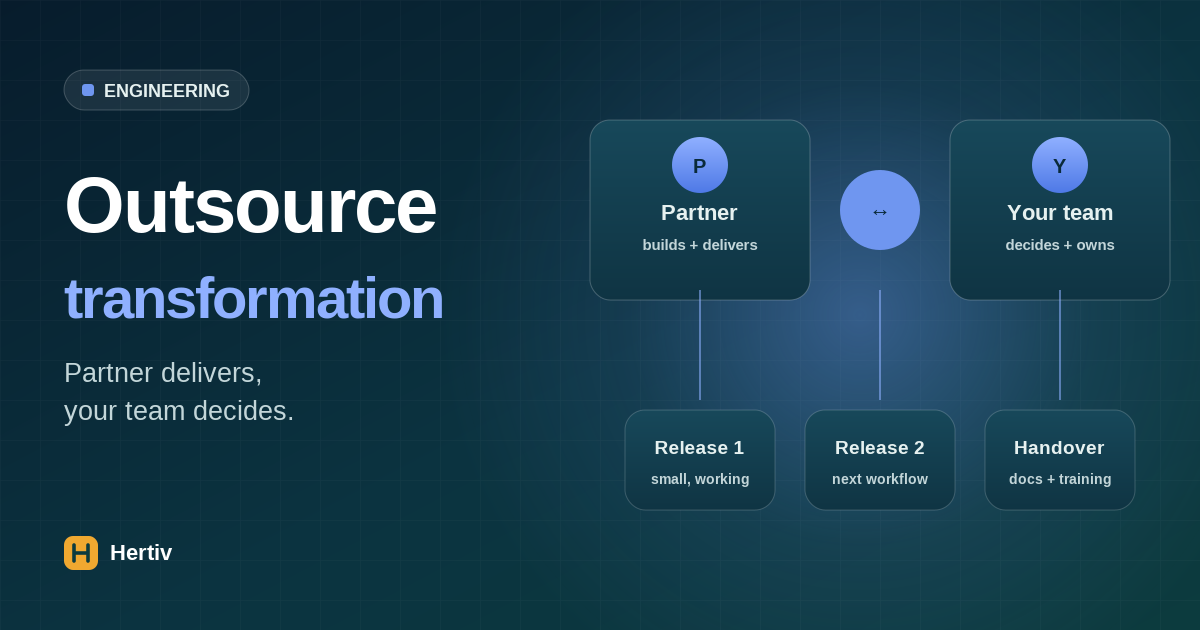
Outsourcing digital transformation means hiring an outside partner to modernise your systems, data and ways of working, instead of building everything with your own team. It works when the partner owns delivery and your team owns decisions. This guide explains when to outsource, what to check, and how to keep control.
What is outsourcing digital transformation?
Outsourcing digital transformation is hiring an external partner to plan and deliver the changes that modernise how a business works: new software, better data, automated processes and new ways for teams to work. The partner brings skills and capacity your team may not have, while your team keeps the business knowledge and the final decisions.
It is not the same as hiring a contractor for one task. Transformation covers several projects over months: replacing old systems, connecting data, automating manual work and training staff. The partner usually owns delivery across those projects, while you own the goals, the budget and the acceptance of each release.
Companies outsource for three reasons: speed, skills and focus. A partner can start faster than hiring, brings experience from similar projects, and lets your team keep running the business. The risk is losing control: if the partner owns the knowledge and the code, you can end up dependent on them.
The rest of this guide explains how to choose a partner, how to structure the work, and how to keep ownership of the things that matter most.
When should you outsource, and when should you build in-house?
Outsource when the work needs skills you do not have, when speed matters more than building internal capability, or when the project is a one-off change rather than an ongoing product. Build in-house when the system is core to your business and you need to change it often.
| Situation | Best approach | Why |
|---|---|---|
| One-off modernisation | Outsource | Skills needed once, not forever |
| Core product you change weekly | Build in-house | You need control and speed |
| Urgent deadline | Outsource | A partner can start faster than hiring |
| Data and process cleanup | Mixed | Partner does the work, your team owns the rules |
| Long-term platform | Mixed | Partner builds, your team takes over |
A mixed model is the most common: the partner builds the first version and trains your team to run it, with a handover plan and a date. That way you get speed now and independence later.
Before you decide, check whether the problem is technology or process. If the process is broken, new software will copy the broken process faster. Fix the steps first, then decide who builds the system. A guide to digital transformation trends that change teams shows how the people side of change matters as much as the tools.
How to choose a digital transformation partner
Choosing a partner is the decision that matters most, because a bad partner costs more than a bad tool. Look for evidence, not promises.
- Ask for a similar project. A partner should describe a project like yours: what it changed, what went wrong, and what it cost.
- Check the team, not just the company. Ask who will actually work on your project and how long they have been with the firm.
- Test the discovery phase. A short paid discovery that maps your systems and produces a plan is the best test of a partner.
- Ask about handover. A good partner plans from day one how your team will take over, including documentation and training.
- Check the contract. Ownership of code, data and documentation should be yours, with clear exit terms.
Compare at least two partners on the same brief. If one is far cheaper, ask what is missing: usually it is discovery, testing, documentation or support. A guide to the cost of digital transformation explains the line items a complete quote should contain.
References matter, but ask the right questions: did the project finish on time, what changed during it, and would they hire the partner again? A reference that only praises the partner tells you little.
How to structure the work and keep control
Structure the work in small releases with clear acceptance, so you can stop or change direction if a release fails. A transformation that delivers nothing for a year is a risk; one that delivers a small working change every month is easy to steer.
Agree the scope in writing for each release: what it includes, what it does not, who approves it, and how you will test it. Keep a shared list of decisions, so nothing is decided in a meeting and forgotten. Review progress every week with a demo of working software, not a slide deck.
Keep ownership of three things: the code and data, the decisions, and the knowledge. Code should live in your repositories, data in your systems, and decisions in a shared record. Insist on documentation and training from the start, not as an afterthought at the end.
Put one person on your side in charge of the programme. That person approves scope, resolves conflicts and owns the relationship with the partner. Without a single owner, decisions stall and the partner fills the gap with its own guesses.
Validate the idea before committing to a large programme, as a guide to how to validate an app idea explains. A small pilot on one workflow tests the partner, the technology and the team at low cost.
Example (hypothetical): a manufacturer modernises order handling
Example (hypothetical): a manufacturer with 200 staff takes orders by phone and email, and staff retype them into three systems. Orders take a day to enter, and mistakes are common. The company hires a partner to modernise order handling.
The partner starts with a four-week discovery: mapping the order flow, the three systems and the data. The plan is three releases over six months. Release one connects the order form to the main system and removes retyping. Release two adds stock checks and automatic confirmations. Release three adds a customer portal.
The budget is 2,400 hours at $80 an hour, which is $192,000, plus $12,000 for tools and licences, giving $204,000. A 10% reserve of $20,400 brings the total to $224,400. The company keeps the code in its own repository and two staff join the project to learn the system.
After release one, order entry drops from a day to two hours, and errors fall from 12 in 100 orders to 3 in 100. The company continues because the first release proved the value, not because the contract forced it to.
Common mistakes
The most common mistakes in outsourcing transformation are choosing on price, signing a vague contract, and handing over all knowledge. Each one is avoidable.
- Choosing on price alone. The cheapest partner often leaves out discovery, testing, documentation or support.
- Vague scope. Without a written scope per release, every change becomes a dispute.
- No owner on your side. Without a single decision-maker, the partner guesses and you pay for the rework.
- Handing over knowledge. If only the partner understands the system, you cannot leave or change it.
- Big-bang delivery. A year with no working release is a risk; small monthly releases are easier to steer.
- Skipping training. Without training, your team cannot run the new system after the partner leaves.
If you are planning a transformation and want a partner who builds with handover in mind, custom software development is the right place to start the conversation.
Key takeaways
- Outsourcing works when the partner owns delivery and your team owns decisions.
- Outsource one-off changes and urgent work; build core systems in-house.
- Choose a partner on evidence, a paid discovery and a clear handover plan.
- Structure the work in small monthly releases with written acceptance.
- Keep ownership of code, data, decisions and knowledge from day one.
Frequently asked questions
What is digital transformation outsourcing?
Digital transformation outsourcing is hiring an external partner to modernise your systems, data and ways of working. The partner plans and delivers the changes, while your team keeps the business knowledge and the final decisions. It covers several projects over months, not a single task.
How much does outsourcing digital transformation cost?
It depends on scope, systems and team size. A small pilot on one workflow costs far less than a multi-year programme. Ask for a breakdown by release, including discovery, build, testing, documentation and support, plus a 10% reserve for changes found during the work.
How do I avoid becoming dependent on the partner?
Keep code in your own repositories, data in your own systems, and decisions in a shared record. Insist on documentation and training from the start, and plan a handover date. A good partner designs for handover; a partner that resists it is a warning sign.
Should I outsource the whole transformation or part of it?
Most companies outsource the build and keep strategy, decisions and ownership in-house. A mixed model is common: the partner builds the first version and trains your team to run it. Outsource the parts that need skills you do not have, and keep the parts that define your business.
How long does a digital transformation take?
A pilot on one workflow usually takes a few weeks to a few months. A full programme across several systems takes six months to two years, depending on scope. Small monthly releases make the timeline easier to manage than one large delivery at the end.
What should be in the contract?
The contract should cover scope per release, ownership of code and data, documentation and training, exit terms, and how changes are priced. It should also name the people on both sides and how decisions are made. Get the exit terms agreed before the work starts, not when you want to leave.


