What Digital Transformation Actually Costs (and Why Budgets Slip)
Digital transformation cost is driven by legacy integration, data cleanup, change management and ongoing operations, not licence fees. Here is how to budget realistically.
On this page
Short answer
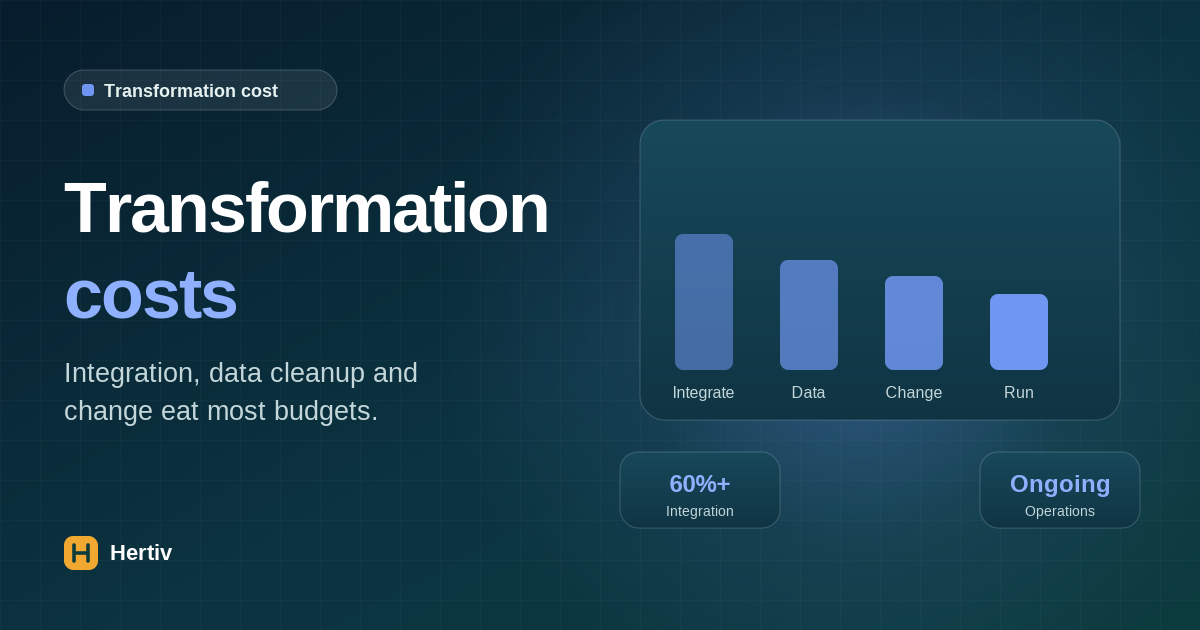
The cost of digital transformation is the total spend to move a business process onto new software, data and ways of working. Most of the budget goes to integration, data cleanup, change management and ongoing operations, not to licences.
What does digital transformation actually cost?
Digital transformation cost is the total spend to move a business process onto new software, data and working practices, measured over several years rather than as a one-off purchase. Two programmes with the same software can differ in cost by a factor of several because of legacy systems, data quality and how much the organisation has to change.
The useful way to think about it is by category rather than a single number:
- Software and licences — subscriptions, cloud usage, third-party APIs.
- Integration — connecting new tools to ERP, CRM, billing and legacy systems.
- Data work — cleaning, mapping, migration and governance.
- Custom build — the parts no product covers, which is where custom software development usually enters.
- Change management and training — the time your own staff spend adapting.
- Run costs — support, monitoring, security patching, iteration.
A rough rule of thumb for enterprise programmes: for every unit spent on licences, expect a comparable or larger amount on integration and data, and a further share on internal staff time. The exact split varies by scope and industry, so treat any published percentage as a starting hypothesis to test, not a budget.
Which cost drivers matter most?
Legacy integration and data quality are the two drivers that most often blow budgets. Both are hard to see before work starts, which is why early discovery matters more than early purchasing.
Legacy integration. Older systems rarely have clean APIs. Workarounds — middleware, scheduled file transfers, screen-level automation — are normal and each one carries build and maintenance cost.
Data quality. Records that are duplicated, incomplete or inconsistently formatted have to be fixed before they can be trusted by a new system or a model. This is slow, unglamorous work, and it is usually underestimated.
Process redesign. If you automate a broken process, you get a faster broken process. Time spent deciding what the process should be is part of the cost.
Change management. Training, documentation and the productivity dip during rollout are real costs, even when no invoice is raised.
Compliance and security. Access control, audit trails, data residency and vendor review add scope in regulated sectors. Cybersecurity services are often cheaper to design in than to retrofit.
How do you build a realistic budget?
Build the budget bottom-up by workstream, then add a contingency that reflects how well you understand your own systems. Top-down estimates from a percentage of revenue tend to be either too vague to manage or too optimistic to survive contact with legacy data.
- Define the process outcome. Name the process, the people who run it and the measurable change you expect, for example fewer manual steps or faster cycle time.
- Inventory systems and data. List every system the process touches, who owns it, and whether it has an API. Flag the ones with no owner.
- Estimate by workstream. Get separate estimates for integration, data migration, custom build, change management and run costs. Do not merge them into one number yet.
- Add contingency. Use a wider band where discovery is thin. A short paid discovery phase usually reduces total risk more than it adds cost.
- Cost the run phase for three years. Support, cloud usage, security updates and small iterations are continuous.
- Map funding to releases. Tie each funding round to a deliverable that produces value, so the programme can stop or pause without waste.
Example (hypothetical figures): a mid-market programme might plan $300k for licences, $250k for integration, $150k for data work, $200k for build, $100k for change management and $150k per year for run, giving roughly $1M in year one and $150k a year after. Those numbers are illustrative only.
Custom build vs buying: how does the choice change cost?
Buying lowers the initial build cost but raises integration and licence cost over time; building lowers long-term licence cost but front-loads engineering. The right answer depends on whether the process is a source of advantage or a commodity.
Buy when the process is standard — payroll, accounting, ticketing, HR records — and a product already covers most of it. Budget for configuration, integration and per-seat growth.
Build when the process is specific to how you compete, or when no product fits without heavy workarounds. Budget for discovery, engineering, testing and a maintenance team. Cost guides for adjacent work, such as an MVP or an AI agent, show the shape of these estimates.
Hybrid is common. A bought platform plus a thin custom layer for the parts that differentiate you. This usually keeps licence spend predictable while limiting bespoke code to what earns its keep.
What does AI add to a transformation budget?
AI adds data preparation, evaluation and governance costs on top of normal software costs. The model API bill is usually small compared with the work of making your data usable and proving the output is reliable.
Expect to fund:
- Data engineering to assemble, clean and serve the inputs the system needs. Data engineering services are often the largest new line item.
- Evaluation — a test set, human review and a way to catch regressions when models or prompts change.
- Guardrails and monitoring — logging, access control, fallback behaviour and cost controls per request.
- Change management for a second time — staff need to learn when to trust the output and when to override it.
Inference cost is variable, so model it per transaction and per user rather than as a fixed monthly fee. A LLM API cost calculator helps sanity-check assumptions before committing.
Where do transformation budgets usually go wrong?
Budgets slip most often because of scope, data and run costs, not because of vendor pricing. Each of these is predictable and each has a cheap early countermeasure.
- Scope creep through addition. Every stakeholder adds one more integration. Fix: a written scope with an explicit change process.
- Data discovered late. The migration meets records nobody expected. Fix: profile the data during discovery, not during build.
- Run costs omitted. Support and cloud spend appear in year two with no owner. Fix: include a three-year run estimate in the business case.
- Pilot purgatory. A proof of concept succeeds but has no path to production. Fix: define production criteria before the pilot starts.
- No internal capacity. The vendor delivers, but your staff have no time to test or adopt. Fix: name the internal owners and ring-fence their time.
- Benefits not measured. Nobody can prove the value, so funding stops. Fix: baseline the metric before rollout.
How do you keep the programme under control?
Control comes from small releases, visible metrics and a funding model that can pause. Long programmes with a single big-bang launch concentrate risk and hide problems until late.
- Release in slices. Each slice should deliver a usable outcome to a real group of users.
- Track a small set of metrics. Cycle time, error rate, manual touchpoints and adoption, baselined before the change.
- Review the run cost monthly. Cloud and API spend drift; catching that early is cheaper than a redesign.
- Keep an architecture owner. Someone accountable for how systems fit together, whether that is an internal lead or a virtual CTO.
- Decide the stop condition. Agree in advance what evidence would justify pausing or ending the programme.
For the underlying build disciplines, the engineering practice and the cost guides give a starting structure you can adapt to your own systems.
Key takeaways
- Licence and platform fees are usually the smallest line; integration and data work dominate
- Phase the programme so each release pays for itself before the next funding round
- Budget ongoing run costs from day one, not as an afterthought
- Data quality work is the most commonly underfunded item and the most common cause of delay
- Scope by process outcome, not by number of systems replaced
Frequently asked questions
Is digital transformation mostly a technology cost?
No. Technology is usually a minority of the total. Integration, data cleanup, staff time and change management typically account for more of the real cost than software licences or cloud fees.
How long should a transformation budget cover?
Plan for at least three years: delivery plus run. Year one carries most build and migration cost, while later years carry support, cloud usage and iteration. Budgeting only for delivery hides the ongoing commitment.
What is the cheapest way to start?
Start with a short paid discovery on one process: inventory systems, profile the data and estimate by workstream. It is a small spend that replaces guesswork with a defensible budget before any platform commitment.
Why do transformation programmes overrun so often?
Mainly late data problems, added scope and missing run costs. Each is foreseeable, so a discovery phase, a written change process and a three-year run estimate remove most of the common causes.
Does AI make transformation cheaper?
It can reduce manual effort in specific processes, but it adds data preparation, evaluation and governance work. Treat AI as a new workstream with its own costs rather than as a discount on existing ones.
Should we buy a platform or build custom software?
Buy for standard processes where a product already fits, and build where the process is how you compete. Many teams combine a bought platform with a thin custom layer for the differentiating parts.


