Open Source Vertex AI Alternatives: 6 Worth Comparing
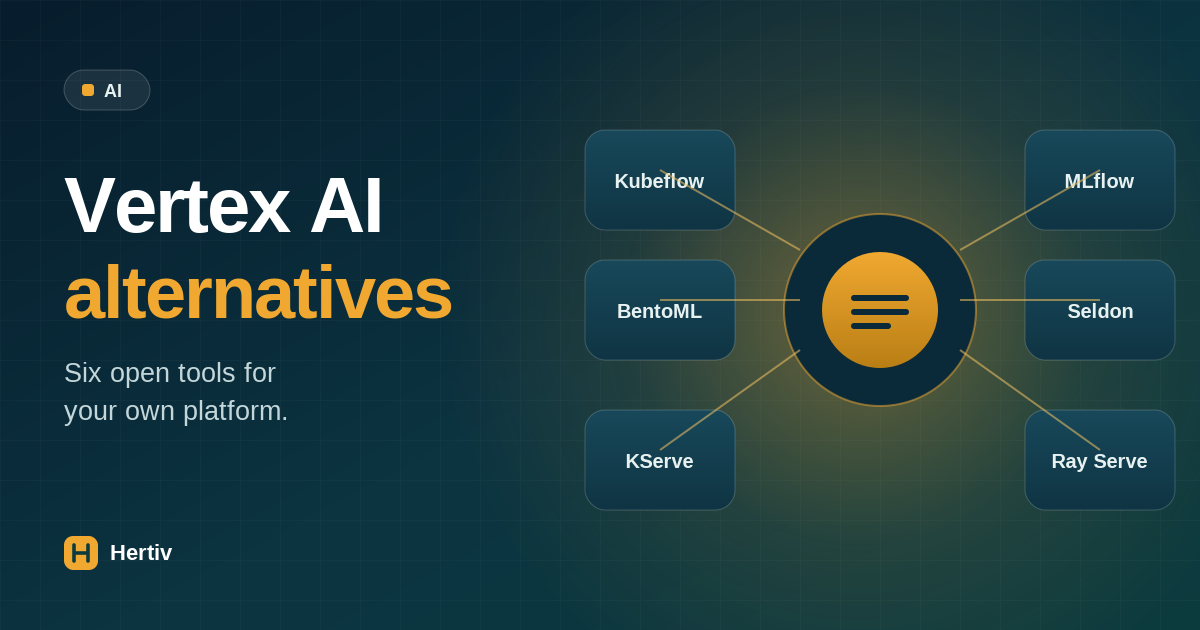
Open source Vertex AI alternatives for teams that run their own ML platform: Kubeflow, MLflow, BentoML, Seldon Core, KServe and Ray Serve, compared on hosting.
On this page
Short answer
Open source Vertex AI alternatives are tools that let a team train, serve and track machine learning models on its own infrastructure instead of on Google's managed platform. The six below are the most widely used open source options, and each one covers a different slice of the platform: some handle the full training pipeline, while others focus on serving models or tracking experiments.
Which open source Vertex AI alternatives are worth comparing?
The open source Vertex AI alternatives worth comparing first are the ones that match the part of the platform you actually need. Vertex AI bundles training, serving, pipelines and experiment tracking, so no single open source tool replaces all of it. Most teams pick two or three tools and run them together.
Use this comparison to shortlist. Hosting assumes a team that already runs Kubernetes or a small server fleet.
| Tool | Main job | Runs on | Best for |
|---|---|---|---|
| Kubeflow | Full ML pipelines | Kubernetes | Teams replacing the whole platform |
| MLflow | Experiment tracking and registry | Any server | Tracking runs and model versions |
| BentoML | Model serving | Containers, Kubernetes | Shipping models as APIs fast |
| Seldon Core | Model serving | Kubernetes | Serving with monitoring built in |
| KServe | Model serving | Kubernetes | Standard serving on Kubernetes |
| Ray Serve | Model serving | Ray clusters | Serving alongside Ray workloads |
Start from the job, not the tool. If you only need to serve a model behind an API, a serving tool is enough. If you need pipelines, tracking and serving together, plan for two or three tools and one clear owner for the platform.
1. Kubeflow: best for replacing the whole platform
1. Kubeflow: best for replacing the whole platform
Kubeflow is the closest open source match for Vertex AI as a whole, because it bundles pipelines, notebooks, training jobs and serving on Kubernetes. A team can define a training pipeline once and run it on a schedule, with each step in its own container.
The price of that breadth is setup and upkeep. Kubeflow is a large system with several parts to install, upgrade and watch, so it suits teams that already run Kubernetes in production and have someone to own the platform. Small teams often find it heavier than they need.
Pros: covers pipelines, training and serving in one system; runs on any Kubernetes cluster; large community and many examples.
Cons: heavy to install and upgrade; needs Kubernetes skills in house; overkill if you only need serving or tracking.
2. MLflow: best for tracking experiments and model versions
2. MLflow: best for tracking experiments and model versions
MLflow tracks experiments, stores model versions and packages models for deployment. A team logs each training run with its parameters and results, then compares runs in one place instead of in spreadsheets and chat messages.
MLflow is not a full platform on its own: it does not schedule pipelines or serve models at scale without help. Teams usually pair it with a serving tool, and use its registry as the single record of which model version is live.
Pros: simple to set up; the registry gives one source of truth for model versions; works with most training frameworks.
Cons: no pipeline scheduling or serving on its own; needs a separate tool for production serving; access control is basic without extra work.
3. BentoML: best for shipping models as APIs fast
3. BentoML: best for shipping models as APIs fast
BentoML turns a trained model into a containerised API with a small amount of code. A developer writes a service file that says how the model loads and how requests are handled, and BentoML builds a Docker image that runs anywhere containers run.
It suits teams that want to ship a model quickly without learning a whole platform. The trade-off is that BentoML focuses on serving, so pipelines and experiment tracking still need other tools, and scaling to many models needs a container platform behind it.
Pros: fast path from model to API; runs on any container host; good support for common model types.
Cons: serving only, so pipelines and tracking need other tools; large deployments need a platform behind it.
4. Seldon Core: best for serving with monitoring built in
4. Seldon Core: best for serving with monitoring built in
Seldon Core serves machine learning models on Kubernetes with monitoring, logging and drift detection built in. It is built for teams that need to watch models in production, not just deploy them, and it supports canary rollouts and A/B tests between model versions.
It is a Kubernetes-native tool, so it fits teams that already run their workloads there. Teams without Kubernetes experience will spend more time on the platform than on the model, which is the wrong trade for a first deployment.
Pros: monitoring and drift detection included; canary and A/B rollout support; strong fit for regulated teams that need audit trails.
Cons: needs Kubernetes; more setup than a simple API server; smaller community than the general-purpose tools.
5. KServe: best for standard serving on Kubernetes
5. KServe: best for standard serving on Kubernetes
KServe is a Kubernetes-native serving layer that deploys models behind a standard inference API. It handles scaling to zero when idle, rolling out new versions, and serving common model types such as scikit-learn, XGBoost, TensorFlow and PyTorch without custom server code.
Because it is a standard part of the Kubeflow ecosystem, it works well for teams that already use Kubernetes and want serving that follows a common interface. It does less than Seldon Core on monitoring, so teams that need drift detection add their own tooling.
Pros: standard inference API across model types; scales to zero when idle; fits neatly into a Kubernetes setup.
Cons: Kubernetes only; monitoring is lighter than Seldon Core; needs other tools for pipelines and tracking.
6. Ray Serve: best for serving alongside Ray workloads
6. Ray Serve: best for serving alongside Ray workloads
Ray Serve is the serving layer of Ray, the distributed computing framework. It suits teams that already use Ray for training or data work, because the same cluster can serve models, run preprocessing and scale each part on its own.
Its strength is handling models that need more than a single request handler, such as a pipeline that calls a retriever, then a language model, then a checker. Teams that do not already use Ray will find the learning curve steeper than a single-purpose serving tool.
Pros: one cluster for training, data and serving; handles multi-step model pipelines well; scales each part on its own.
Cons: needs Ray knowledge; heavier than a simple API server; less useful if nothing else runs on Ray.
How to choose an open source Vertex AI alternative
Choose an open source Vertex AI alternative by the job you need done and the platform you already run, not by the feature list. The tools above overlap, and the wrong pick costs more in upkeep than it saves in licence fees.
- List the Vertex AI features you actually use, such as pipelines, serving or tracking, and ignore the rest.
- Check what your team already runs: Kubernetes teams have more options than teams on plain servers.
- Pick one serving tool first, since serving is the part users feel first, then add tracking and pipelines.
- Run a pilot with one model and one team, and measure the time spent on platform upkeep each week.
- Decide who owns the platform before launch, because an open source platform without an owner drifts and breaks.
For the cost side of the decision, see self-hosting LLMs cost to compare running models yourself against a managed service.
For how teams test a model before it goes live, see how to test AI models.
What are the common mistakes?
The most common mistakes when moving off Vertex AI are replacing everything at once, and forgetting the cost of running the platform.
- Replacing the whole platform at once. Migrate serving first, then tracking, then pipelines, so one failure does not stop everything.
- Ignoring upkeep time. An open source platform needs upgrades, backups and monitoring, and that time comes from the same team.
- No model registry. Without a registry, nobody knows which model version is live or how to roll it back.
- Skipping monitoring. Models drift as data changes, so serving without monitoring is a quiet failure waiting to happen.
- Choosing by hype. The best-known tool is not always the best fit for your team size and infrastructure.
Key takeaways
- No single open source tool replaces all of Vertex AI, so most teams combine two or three
- Kubeflow is the closest full-platform match, but it needs Kubernetes skills
- MLflow is the simplest way to track runs and keep one model registry
- For serving alone, BentoML is the fastest path to a working API
- Budget for platform upkeep, or the move costs more than the licence saved
Frequently asked questions
What is Vertex AI?
Vertex AI is Google Cloud's managed machine learning platform. It bundles model training, deployment, pipelines and experiment tracking in one service, so teams can build and run models without managing the underlying infrastructure. Open source alternatives replace those pieces on infrastructure the team runs itself.
Is Kubeflow a full replacement for Vertex AI?
Kubeflow is the closest open source match, because it covers pipelines, training and serving on Kubernetes. It is not a drop-in replacement: it needs setup, upgrades and an owner, and some managed features, such as built-in monitoring, need extra tooling.
Which open source Vertex AI alternative is easiest to start with?
MLflow is usually the easiest first step, because it installs quickly and only needs a server to run on. For serving a single model, BentoML is similarly quick. Both can be tried in a day, while Kubeflow takes longer to set up properly.
Can I run these tools without Kubernetes?
MLflow and BentoML run without Kubernetes, on a plain server or in containers. Kubeflow, Seldon Core and KServe need Kubernetes, while Ray Serve needs a Ray cluster. Check the hosting requirement before choosing, not after.
Do open source alternatives cost less than Vertex AI?
They remove the platform licence fee, but they add the cost of servers and the time spent running the platform. For a small team the total can be higher than a managed service, so compare the full cost, including upkeep, before deciding. See the vendor site for current pricing.
How do I move a model from Vertex AI to an open source tool?
Export the trained model in a standard format, load it into the new serving tool, and test it on the same inputs before switching traffic. Move one model at a time, keep the old endpoint running during the pilot, and switch over only when the new one matches on accuracy and latency.


