8 Open Source Tether Alternatives Worth Comparing
Tether (USDT) is the largest stablecoin, but alternatives such as DAI, Frax and LUSD offer different backing and transparency for teams that read the code.
On this page
Short answer
Open-source Tether alternatives are stablecoins whose code and collateral rules anyone can inspect, such as DAI, Frax, Liquity USD, GHO, crvUSD, USDD, sUSD and DOLA. They differ in what backs the peg, who governs the protocol and which chains they run on, so the right choice depends on your use case and risk tolerance.
Which open source Tether alternatives are worth comparing?
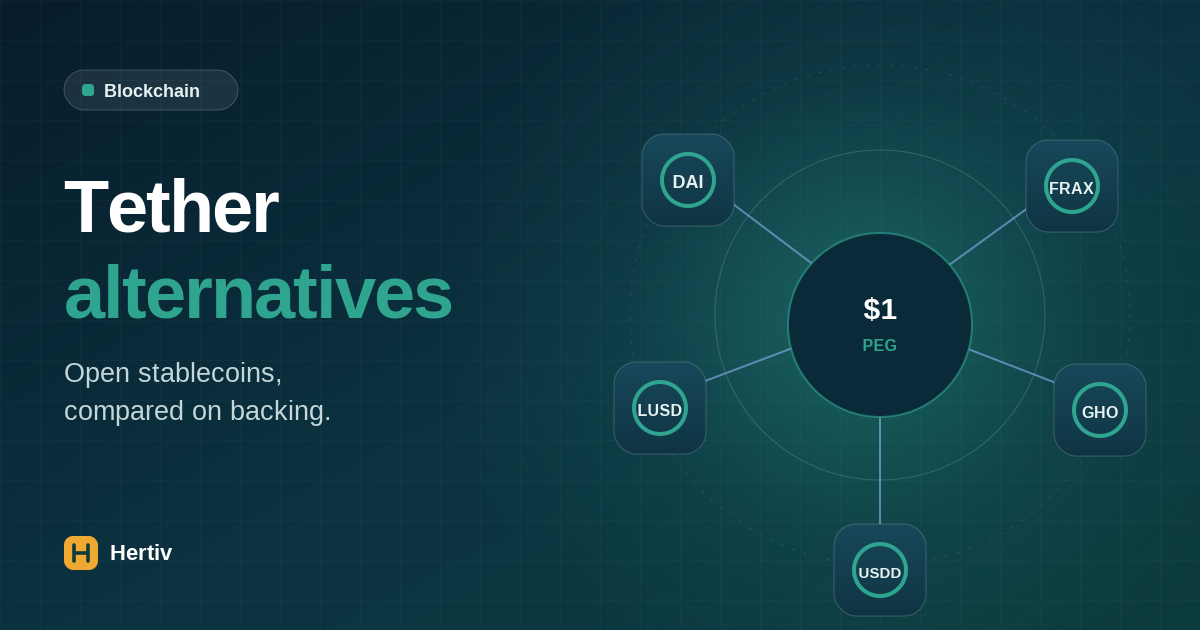
The alternatives worth comparing are the stablecoins with open code, live use and clear backing rules. The table gives the shortlist at a glance; the sections below explain each one.
| Stablecoin | Backing | Governance | Best for |
|---|---|---|---|
| DAI | Crypto collateral | MakerDAO token holders | DeFi use |
| FRAX | Crypto collateral | Frax DAO | DeFi and payments |
| LUSD | Ether collateral | Liquity protocol rules | Borrowing against ether |
| GHO | Over-collateralised loans | Aave DAO | Aave users |
| crvUSD | Crypto collateral | Curve DAO | Curve traders |
| USDD | Crypto reserves | Tron DAO Reserve | Tron users |
| sUSD | SNX collateral | Synthetix DAO | Synthetix trading |
| DOLA | Collateralised loans | Inverse Finance DAO | Lending users |
None of these is a drop-in copy of Tether. Tether is a centrally issued stablecoin backed by company reserves, while these alternatives are issued by protocols with rules anyone can read. That openness is the point, but it also means the peg depends on collateral and incentives, not on a company promise. Check the backing and the audit history of any stablecoin before you hold it; for the basics, see what a stablecoin is.
DAI and Frax: the established decentralised options
1. DAI: best for DeFi use
DAI is the oldest decentralised stablecoin, issued by the Maker protocol against crypto collateral locked in vaults. Anyone can inspect the collateral, the stability rules and the governance votes that change them, which is why DAI is the usual first pick for teams that want an open alternative to Tether.
DAI is accepted across most DeFi applications, from lending to decentralised exchanges, so it is easy to use and easy to exit. The trade-off is complexity: the collateral mix and the governance process take time to understand, and the peg has wobbled during sharp market moves.
Pros: long track record, wide DeFi acceptance, open collateral and governance.
Cons: complex system to understand, peg can drift in volatile markets.
2. Frax: best for DeFi and payments
Frax started as a partly algorithmic stablecoin and later moved to full crypto collateral. It is issued by the Frax protocol and governed by its DAO, with the code and the collateral rules public. It is used in DeFi lending, liquidity pools and some payment flows.
Frax is smaller than DAI and less widely accepted, so check whether your application or exchange supports it before building around it. The protocol's history includes a change in its backing model, which is worth reading about before you commit.
Pros: fully collateralised now, open governance, active DeFi use.
Cons: smaller than DAI, backing model has changed over time.
LUSD and GHO: borrowing-focused stablecoins
3. LUSD: best for borrowing against ether
LUSD is issued by the Liquity protocol when users borrow against ether. It is backed only by ether, with a minimum collateral ratio, and the protocol is designed to run with minimal governance, so the rules change rarely. That simplicity appeals to users who want a stablecoin with as few moving parts as possible.
LUSD is mainly a borrowing tool rather than a general payment coin, and its liquidity is thinner than DAI's. It fits best when you already hold ether and want to borrow against it without selling.
Pros: simple design, ether-only backing, minimal governance.
Cons: thinner liquidity, mainly a borrowing tool.
4. GHO: best for Aave users
GHO is the stablecoin of the Aave lending protocol, minted when users borrow against collateral they have supplied to Aave. It is governed by the Aave DAO, which sets the borrow rate and the collateral rules. Because it lives inside Aave, it is convenient for anyone already lending or borrowing there.
GHO is tied to Aave, so its usefulness depends on how much you use that protocol. Outside Aave it is less widely accepted than DAI, and its borrow rate is set by governance rather than by a market.
Pros: deep integration with Aave, DAO governance, clear borrow terms.
Cons: tied to Aave, less accepted elsewhere.
crvUSD and USDD: exchange and chain-native options
5. crvUSD: best for Curve traders
crvUSD is issued by the Curve protocol, best known for its stablecoin exchange pools. It is backed by crypto collateral and uses an automated liquidation design that sells collateral gradually as prices fall, rather than in one step. It is most useful for traders and liquidity providers already active on Curve.
Outside Curve, crvUSD is less widely accepted than the larger stablecoins, so check exchange and wallet support before using it for payments. Its design is newer than DAI's, which means a shorter track record in a market crash.
Pros: gradual liquidation design, strong Curve integration.
Cons: newer design, less accepted outside Curve.
6. USDD: best for Tron users
USDD is a stablecoin on the Tron network, managed by the Tron DAO Reserve. It is backed by crypto reserves and is widely used inside the Tron ecosystem for trading, payments and lending. If your users are already on Tron, USDD is the natural open alternative to Tether on that chain.
USDD's history includes a period when its peg came under pressure, and its backing model has been adjusted since. Read the current reserve disclosures and the DAO's published rules before holding it in size.
Pros: widely used on Tron, DAO-managed reserves.
Cons: peg has been tested before, backing model has changed.
sUSD and DOLA: protocol-native stablecoins
7. sUSD: best for Synthetix trading
sUSD is the stablecoin of the Synthetix protocol, backed by SNX tokens staked as collateral. It is used to trade synthetic assets inside Synthetix, from tokenised stocks to commodities. It is open code with DAO governance, and its role is tightly tied to that one protocol.
sUSD is a specialist tool rather than a general stablecoin. Outside Synthetix it has limited acceptance, and its peg depends on the SNX staking system working as designed. Use it for Synthetix trading, not as a general cash substitute.
Pros: core to Synthetix trading, open governance.
Cons: limited use outside Synthetix, peg tied to SNX staking.
8. DOLA: best for lending users
DOLA is issued by the Inverse Finance protocol through fixed-rate lending markets. Borrowers lock collateral and mint DOLA, and the protocol's DAO sets the terms. It is a smaller stablecoin, used mainly inside Inverse Finance lending and by a handful of DeFi applications.
DOLA's small size means thinner liquidity and fewer places to spend or swap it. It suits users already borrowing on Inverse Finance, and anyone else should check acceptance before relying on it.
Pros: fixed-rate borrowing, open code and DAO governance.
Cons: small and thinly traded, limited acceptance.
How to choose
Choose by use case first, then by backing and acceptance. A stablecoin that works well in one protocol can be hard to use anywhere else, so match the coin to where the money actually moves.
- Define the use. Payments, DeFi lending, borrowing or holding each favour a different coin.
- Check the backing. Read what collateral backs the peg and how it is verified.
- Check acceptance. Confirm the exchanges, wallets and applications you use support the coin.
- Read the governance. See who can change the rules and how quickly they can do it.
- Start small. Test with a small amount and watch the peg and liquidity for a few weeks before moving more.
For teams building stablecoin features into a product, stablecoin development covers the design and compliance questions that matter before launch.
Common mistakes
The most common mistakes are treating all stablecoins as equal, ignoring liquidity, and skipping the backing check.
- Assuming every stablecoin holds its peg the same way. Backing, incentives and governance differ widely.
- Ignoring liquidity. A coin that is hard to sell is a poor store of value, however sound its design.
- Skipping the backing check. Read the collateral rules and the latest disclosures before holding a coin in size.
- Using a specialist coin for general payments. Protocol-native coins fit their own protocol first.
- Trusting the name. A stablecoin's name says nothing about its reserves; the published rules do.
- Forgetting the exit. Check how you would convert back to fiat or to another stablecoin before you need to.
Key takeaways
- DAI is the most widely accepted open alternative to Tether
- Backing, governance and acceptance differ across all eight coins
- Match the coin to the use case, not to the brand
- Check liquidity and the exit path before holding a coin in size
- Read the collateral rules and latest disclosures first
Frequently asked questions
Is DAI safer than Tether?
They carry different risks. DAI is backed by crypto collateral with open rules and DAO governance, while Tether is backed by company reserves with central management. Neither is risk-free: DAI depends on collateral and incentives, while Tether depends on the issuer's reserves and reporting. Compare the backing and the track record for your own use.
Which open source stablecoin is best for payments?
For general payments, DAI and Frax are usually the practical picks because they are widely accepted and easy to swap. Specialist coins such as LUSD, GHO or sUSD fit their own protocols better than general payments. Check that the coin is accepted where you need to spend it.
Are these stablecoins regulated?
Most decentralised stablecoins are not issued by a regulated company, and the rules vary by country. Some jurisdictions are bringing stablecoins into regulation, and the treatment differs for centralised and decentralised issuers. Take legal advice before using a stablecoin in a regulated product.
What does open source mean for a stablecoin?
It means anyone can read the smart contract code, the collateral rules and the governance decisions. That transparency lets users and auditors check how the peg is maintained, rather than trusting a company's word. It does not guarantee the peg holds.
Can an open source stablecoin lose its peg?
Yes. A sharp fall in collateral value, a governance failure or a liquidity crunch can push a stablecoin off its peg, and it has happened to several coins on this list. That is why the backing, the liquidation design and the track record matter more than the name.
Where can I buy these stablecoins?
Most are available on decentralised exchanges and some centralised exchanges, with availability varying by coin and by country. Check that your exchange lists the coin, confirm the contract address from the protocol's own site, and start with a small amount.


