On-Chain vs Off-Chain Asset Tokenization: What Differs?
On-chain tokenization records ownership on the blockchain; off-chain tokenization keeps it in a registry. Compare the two and see which fits your asset.
On this page
Short answer
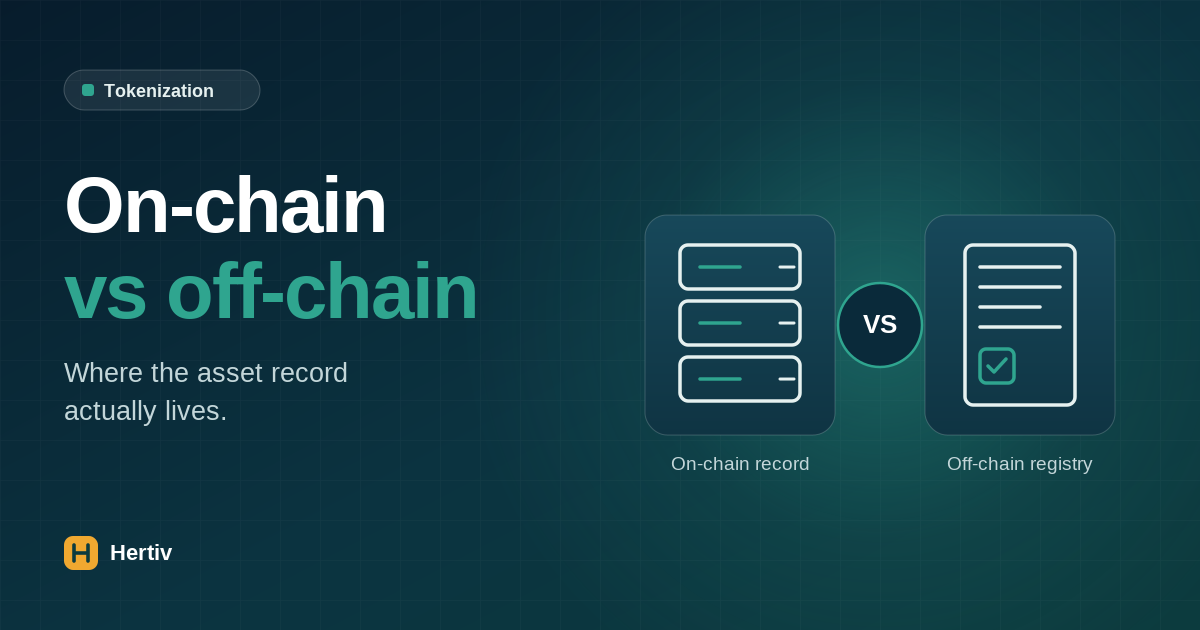
On-chain asset tokenization records ownership as a token on a blockchain, so the token is the record and transfers settle on the chain. Off-chain tokenization records ownership in a traditional registry or database, and any token is only a reference to that record. The choice decides who settles a transfer, what it costs and what a court recognises.
What is on-chain asset tokenization?
On-chain asset tokenization is the process of recording ownership of a real asset as a token on a blockchain, so the token itself is the record of who owns what. When the token moves to another wallet, ownership moves with it, and the transfer is recorded on the chain for anyone to check.
The asset itself stays off the chain: a building, a fund share or a loan still exists in the real world. What moves on-chain is the ownership record, plus the rules that say who can hold the token and when it can move. A smart contract can enforce those rules automatically, for example by blocking a transfer to a wallet that has not passed identity checks.
On-chain tokenization fits assets where the parties want a shared, checkable record and fast settlement. It needs a legal link between the token and the asset, because the token alone does not change who owns the building or the fund share in law.
What is off-chain asset tokenization?
Off-chain asset tokenization records ownership in a traditional database or registry, and the token, if one exists, is a reference to that record rather than the record itself. A transfer is only complete when the registry is updated, even if a token changed hands first.
This is how most tokenized assets work today, because the law in most places still treats the registry, the fund administrator or the custodian as the source of truth. The token can make the asset easier to split, track and trade, but the legal ownership sits in the registry.
Off-chain tokenization fits assets where the existing legal and settlement systems already work and the goal is better record-keeping or easier fractional ownership. It is also the safer choice when the rules about token ownership are still unclear in a market.
On-chain vs off-chain: side by side
The two models differ in where the truth lives, who settles a transfer and what happens when something goes wrong. Use the table to see the trade-offs before choosing.
| Factor | On-chain | Off-chain |
|---|---|---|
| Record of ownership | The token on the blockchain | A registry or database |
| How a transfer settles | On the chain, in minutes | When the registry is updated |
| Who can check it | Anyone with chain access | Only those with registry access |
| Legal standing | Depends on local law and the token terms | Clear where registries are the legal record |
| Transfer cost | Network fees per transfer | Admin and registry fees |
| Reversing a mistake | Hard; needs a new transaction | Possible through the registry |
| Best for | Fast settlement, shared records | Regulated assets, existing systems |
Many real projects mix the two: the token moves on-chain for speed, while a registry holds the legal record and the identity checks. That hybrid is common in fund and real estate tokenization, where the law still points to a registry. For the wider picture, how RWA tokenization works walks through the full process step by step.
When on-chain fits best
On-chain fits best when the parties want a shared record they can all check without asking a central party, and when transfers need to settle fast. A fund that issues tokens to many small investors, for example, can let those investors trade with each other on-chain instead of waiting for an administrator to update a list.
It also fits when the asset already lives in a digital system, such as a loan book or a fund with digital records, because the jump from a database to a token is smaller. And it fits when the project wants the token rules, such as transfer limits and lock-up periods, enforced by code rather than by manual checks.
The conditions matter: the market needs clear rules about token ownership, the identity checks need to work on-chain, and the team needs a way to fix a mistake when a token goes to the wrong wallet. Without those, on-chain settlement creates risk instead of removing it.
When off-chain fits best
Off-chain fits best when the existing registry is already the legal record and the goal is better access, not a new settlement system. Real estate in many markets, for example, is recorded in a land registry, and a token cannot replace that record until the law says so.
It also fits when transfers are rare and the admin cost of a registry update is low. A private fund with ten investors and one transfer a year gains little from on-chain settlement, and the registry already gives the investors a clear, enforceable record.
Off-chain is also the safer choice when the project is new and the rules are still being written. The team can issue tokens for tracking and fractional ownership while keeping the legal record where the courts already look. If the rules change later, the record is still intact.
Example (hypothetical): a $5 million property fund
Example (hypothetical): a fund holds one commercial property worth $5,000,000 and wants to offer it to smaller investors. The fund issues 50,000 tokens at $100 each, so 50,000 x $100 = $5,000,000.
An investor buys 500 tokens for $50,000. That is 500 / 50,000 = 1 percent of the fund. In the on-chain model, the investor receives the tokens in a wallet and can transfer them to another investor, with the chain recording the move.
In the off-chain model, the same investor buys 500 units, but the fund administrator records the holding in the registry. A transfer needs the administrator to update the registry, so it takes longer but the legal record is clear. The fund chooses a hybrid: tokens move on-chain for speed, while the administrator keeps the registry as the legal record and checks the identity of each new holder.
The choice changes the cost too. On-chain transfers pay a network fee per transfer, while off-chain transfers pay the administrator. For a fund with many small trades, the network fees add up, so the team checks both before choosing.
Common mistakes
The most common mistakes in asset tokenization are treating the token as the legal title, skipping the identity checks, and choosing a model before checking what the law recognises.
- Assuming the token is the title. In most markets the registry, the fund administrator or the custodian is the legal record. The token must link to it.
- Skipping identity checks. A token that anyone can hold will fail the first compliance review. Build the checks into the token rules or the registry.
- Choosing on-chain for every asset. Fast settlement helps only when transfers are frequent. For rare transfers, a registry is cheaper and clearer.
- No plan for mistakes. A token sent to the wrong wallet is hard to reverse on-chain. Decide the fix before launch, not after.
- Forgetting the asset itself. Tokenization does not change the building, the loan or the fund. The asset quality still decides the return.
If the asset is real estate, RWA tokenization covers the models and the legal links that make a tokenization project work.
Key takeaways
- On-chain tokenization makes the token the ownership record; off-chain keeps it in a registry
- On-chain settles fast, but mistakes are hard to reverse
- Off-chain is clearer where a registry is already the legal record
- Many real projects use a hybrid: tokens on-chain, legal record in a registry
- The token must link to the asset in law, or it is only a tracking tool
Frequently asked questions
What is the difference between on-chain and off-chain tokenization?
On-chain tokenization records ownership as a token on a blockchain, so the token is the record and transfers settle on the chain. Off-chain tokenization records ownership in a registry or database, and any token is only a reference to that record.
Is on-chain tokenization legally valid?
It depends on the market and the asset. Some places recognise token records, but in most markets the registry, fund administrator or custodian is still the legal record. Check the law for your asset and market before choosing a model.
Which is cheaper, on-chain or off-chain?
It depends on transfer volume. On-chain transfers pay a network fee each time, so frequent small trades add up. Off-chain transfers pay registry and admin fees, which suit rare transfers. Compare both for your expected volume before deciding.
Can a project use both models?
Yes, and many do. Tokens move on-chain for speed while a registry holds the legal record and the identity checks. This hybrid gives fast transfers without giving up the legal clarity of the registry.
What happens if a token is sent to the wrong wallet?
On-chain, a mistaken transfer is hard to reverse, because the chain does not have an undo button. The fix usually needs a new transaction, a token freeze, or a legal process. Decide the recovery plan before launch.
Do I need a smart contract for off-chain tokenization?
Not always. If the registry is the record and transfers are rare, a database and an admin process can be enough. A smart contract helps when you want transfer rules, such as identity checks or lock-up periods, enforced automatically.


