NLP vs LLM: What Is the Difference, and When to Use Each?
NLP is the field of teaching computers to work with language, and an LLM is one model inside it. Pick rules for fixed tasks and an LLM when language varies.
On this page
Short answer
NLP, or natural language processing, is the field of getting computers to read, sort and understand human language. An LLM, or large language model, is one kind of NLP model, trained on huge amounts of text to predict and generate language. The difference is scope: NLP covers everything from simple keyword rules to full models, while an LLM is a single powerful tool inside that field.
What is the difference between NLP and an LLM?
Natural language processing (NLP) is the field of teaching computers to work with human language, and a large language model (LLM) is one type of model used inside that field. NLP is the whole discipline. An LLM is one tool in it, alongside rules, classifiers and smaller trained models.
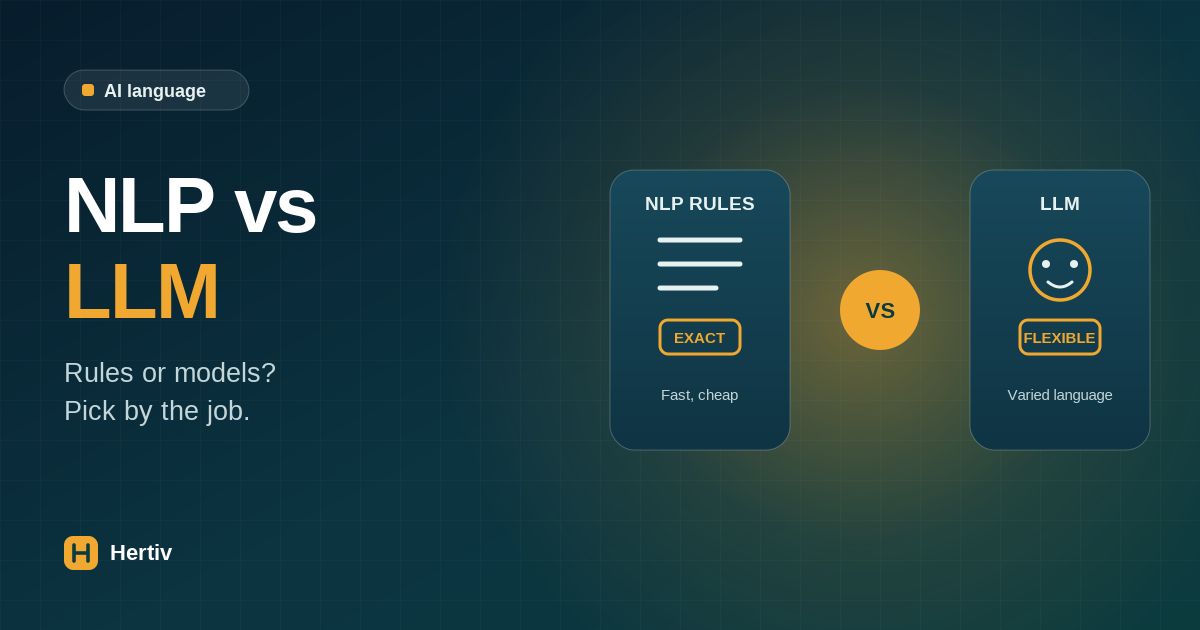
The confusion comes from the fact that LLMs now do many NLP jobs, such as summarising, translating and answering questions. But NLP also covers jobs where an LLM is the wrong tool, such as sorting messages by keyword or checking a form field. The table below sets out the difference.
| Aspect | NLP | LLM |
|---|---|---|
| What it is | The whole field of language technology | One kind of large trained model |
| Typical tools | Rules, classifiers, small models | Chat and generation models |
| Best for | Fixed, repeated language tasks | Varied, open-ended language |
| Cost pattern | Low, often runs on your own servers | Paid per token or per request |
| Control | Exact and predictable | Flexible but less predictable |
Think of it this way: NLP is the kitchen, and an LLM is one very capable chef. You would not ask the chef to peel a potato when a peeler does it faster and cheaper.
What can classic NLP do well?
Classic NLP does fixed, repeated language jobs well. Sorting messages into categories, extracting dates and names from forms, spotting keywords, checking spelling and matching phrases are all jobs where rules or small models are fast, cheap and exact. They give the same answer every time, which matters when the result feeds another system.
These tools also work well on small data. A classifier trained on a few thousand labelled examples can sort support tickets accurately, and a rule set can route invoices without any model at all. They run on ordinary servers, cost almost nothing per request, and do not send your data to an outside provider.
Classic NLP also fails in clear ways. When a rule is wrong, you can read it and fix it. That predictability is why regulated work, such as checking documents against a fixed list, still uses rules and small models rather than a large model.
What can an LLM do that classic NLP cannot?
An LLM handles language that varies. It can draft a reply in the right tone, summarise a long document, answer a question phrased in a new way, or turn messy notes into a structured report. Classic NLP needs the input to look like something it has seen before. An LLM copes with new wording.
It also works without labelled training data for each new task. Instead of collecting thousands of examples, you describe the task in a prompt and give a few examples. That makes it fast to try new ideas, and it is why teams use LLMs for drafting, brainstorming and first versions.
The trade-off is cost and control. Each request costs money, answers vary between runs, and the model can invent details. For jobs where a wrong answer is costly, an LLM needs checks around it. For help choosing, see how to test AI models before relying on one.
When should you use NLP rules instead of an LLM?
Use rules or small models when the task is fixed, the input is predictable and the answer must be exact. Sorting by category, extracting a field, checking a format or matching a known phrase are all rule jobs. They are cheaper, faster and easier to explain to an auditor.
Use them when volume is high and the task is simple. A classifier that sorts a million messages a month for almost nothing beats an LLM that charges per token for the same job. The saving grows with volume, and the accuracy is often higher because the task is narrow.
Use them when you need a guaranteed answer. A rule either matches or it does not, and you can test every case. An LLM gives a likely answer, which is fine for a draft but risky for a decision that cannot be undone.
When should you use an LLM?
Use an LLM when the language varies and the job needs understanding, not just matching. Drafting replies, summarising documents, answering open questions and turning rough notes into clean text are LLM jobs. The input is messy, the output needs to read naturally, and no rule set covers the range.
Use it when you need to move fast. Building a classifier takes labelled data and training time. An LLM with a good prompt can start the same day, which makes it the right choice for a pilot or a feature you are still shaping. You can replace it with a smaller model later, once the task is stable.
Use it with retrieval when answers must be grounded in your own documents. Pairing an LLM with search over your knowledge base keeps answers tied to facts you control. For the details, see what retrieval augmented generation is and how it works.
Example (hypothetical): sorting 10,000 support tickets
Example (hypothetical): a support team receives 10,000 tickets a month and wants them sorted into billing, technical and account teams. A rule-based router gets 6,500 tickets right, or 65 percent, and costs almost nothing to run. The remaining 3,500 tickets need a person to read and route them.
An LLM router gets 9,200 tickets right, or 92 percent, at $0.002 per ticket, which is $20 a month. Only 800 tickets need a person. Each manual ticket takes 2 minutes, so the rule router needs 3,500 times 2 minutes, or 7,000 minutes, while the LLM router needs 800 times 2 minutes, or 1,600 minutes.
The difference is 5,400 minutes, or 90 hours a month. At $25 an hour, that is $2,250 of staff time saved for a $20 model bill. The LLM wins here because the language varies and the volume makes manual routing expensive.
What are the common mistakes?
The most common mistake is using an LLM for a job a rule does better. Teams pay per token to classify messages that a keyword list would sort for free. Before reaching for a model, ask whether the input is predictable enough for a rule.
The second mistake is using rules for a job that needs understanding. A keyword list cannot tell the difference between a customer asking for a refund and a customer praising a refund policy. When the wording varies, a model earns its cost.
The third mistake is skipping evaluation. Whichever tool you pick, test it on real examples from your own product and write down the error rate. A good prompt can hide a bad model choice, so test the whole setup, not just the prompt. For prompt technique, see what prompt engineering is and when it helps.
Key takeaways
- NLP is the whole field of language technology; an LLM is one tool inside it.
- Rules and small models win on fixed, repeated tasks: they are cheap, fast and exact.
- LLMs win when language varies and the job needs drafting or understanding.
- Test both on your own examples before choosing.
- Pair an LLM with retrieval when answers must be grounded in your documents.
- Revisit the choice when the task becomes stable and narrow.
Frequently asked questions
Is an LLM a type of NLP?
Yes. An LLM is one kind of model used inside natural language processing. NLP is the field that covers all ways computers work with language, from simple keyword rules to large trained models. Saying you use NLP does not say which tool you use.
Can NLP work without an LLM?
Yes, and it often should. Rules, classifiers and small trained models handle sorting, extraction and matching without any large model. They are cheaper, faster and more predictable, and they are the right choice when the task is fixed and the input is predictable.
When is an LLM better than classic NLP?
An LLM is better when the language varies and the job needs understanding or generation, such as drafting replies, summarising documents or answering open questions. Classic NLP needs the input to look like something it has seen before, while an LLM copes with new wording.
Do LLMs replace NLP engineers?
No. Someone still has to choose the tool, write the prompts, test the output and build the checks around it. LLMs change which tasks need a model, but the work of deciding, measuring and fixing remains.
Is an LLM more expensive than classic NLP?
Usually yes, per request. An LLM charges per token, while rules and small models often run for almost nothing on your own servers. The LLM can still be cheaper overall when it saves enough staff time, so compare the full cost, not just the model bill.
Can you use NLP and an LLM together?
Yes, and many products do. A common setup uses rules to handle the easy cases, a small classifier for the middle, and an LLM only for the hard or varied cases. This keeps costs low while keeping the flexible tool where it matters.


