How Much Does an NFT Marketplace Like OpenSea Cost to Build?
An NFT marketplace like OpenSea costs what its features cost: contracts, web app, wallets, storage and audit. Use this breakdown to estimate your build first.
On this page
Short answer
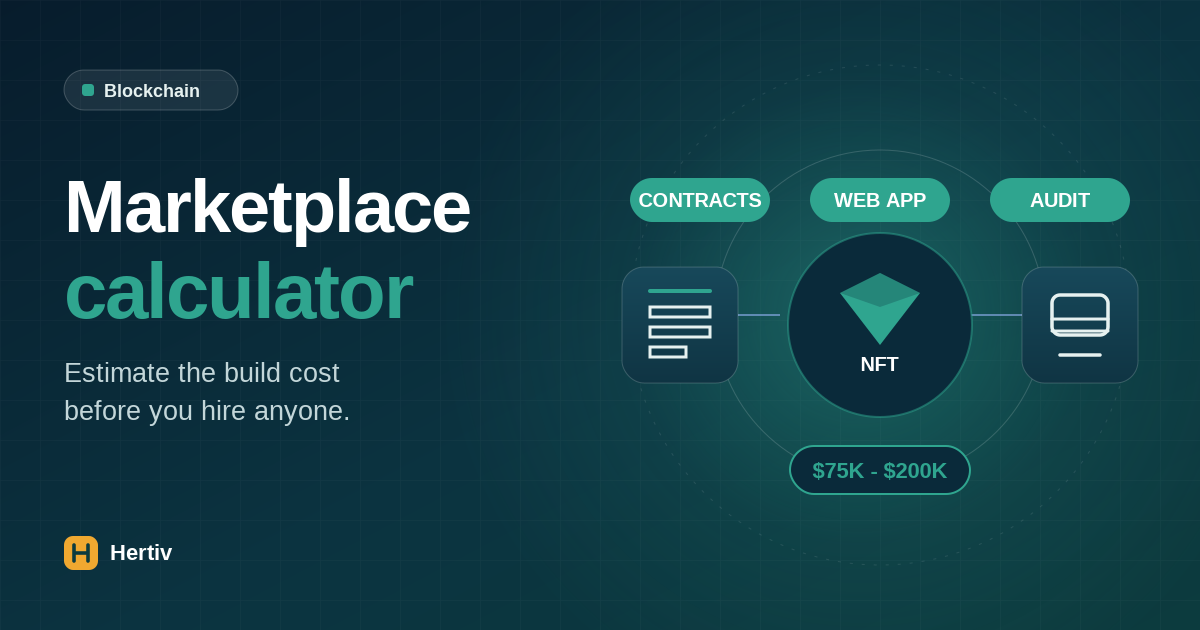
An NFT marketplace like OpenSea usually costs between $75,000 and $200,000 to build, depending on features, chain and polish. The biggest costs are the web application, smart contracts and security audit, plus a year of hosting and support. Estimate each part separately before you hire anyone.
What does an NFT marketplace like OpenSea cost?
An NFT marketplace like OpenSea is a trading platform where users list, buy and sell non-fungible tokens, and its cost is the sum of the smart contracts, the web application, wallet connections, storage, search and the security audit. Most builds land in a wide range because the feature list, the chain and the level of polish change the bill.
The table below shows the planning ranges teams usually work with. Treat them as a starting point for your own estimate, not as a quote.
| Build part | What it covers | Planning range |
|---|---|---|
| Smart contracts | Listing, buying, auctions, royalties | $15,000 - $40,000 |
| Web application | Browsing, profiles, checkout, admin | $25,000 - $70,000 |
| Wallet and payments | Wallet connect, fiat on-ramp, gas handling | $8,000 - $20,000 |
| Storage and search | Metadata, media hosting, indexing | $5,000 - $15,000 |
| Security audit | Contract audit and fixes | $10,000 - $30,000 |
| Launch and running costs | Hosting, support, first-year operations | $12,000 - $30,000 |
Add the low ends and you get roughly $75,000 for a basic marketplace. Add the high ends and you pass $200,000 for a polished one with auctions, bundles and a mobile app. The rest of this article shows how to work out where your idea sits in that range.
What drives the cost of an NFT marketplace up or down?
Four choices drive most of the cost: the feature list, the chain, whether you build from scratch or start from existing code, and how much you spend on security. Cut features and the bill falls fast; add auctions, offers and a mobile app and it climbs just as fast.
The chain matters because gas fees, tooling and developer rates differ. Ethereum has the deepest tooling and the largest audience, but its gas fees push teams toward a layer 2. A marketplace on a lower-fee chain can be cheaper to run, though it may reach a smaller buyer pool.
Starting from an existing codebase or a white-label product can cut the build time by months, but it limits how far you can change the design. Building from scratch costs more and takes longer, yet it gives you full control over the contracts and the user experience.
Security is the item teams most often under-budget. A marketplace holds user funds and valuable assets, so an audit is not optional. Budget for the audit and for the fixes it finds, because a clean audit report on the first pass is rare. For a deeper look at the build itself, see how to build an NFT marketplace like OpenSea.
How do you estimate the cost, step by step?
You estimate the cost by listing every feature, pricing each one, and adding the running costs for the first year. The method is simple; the discipline is in not skipping the parts that are easy to forget.
- List the features. Write down everything the marketplace must do on day one: listing, buying, auctions, offers, profiles, search, royalties and admin tools. Put nice-to-haves in a second list.
- Price each feature. Ask your team or vendor for a range per feature, not a single number. Ranges keep the estimate honest.
- Add the contracts and audit. Price the smart contracts separately from the web application, then add the audit and a fix budget of at least 20% of the audit price.
- Add infrastructure. Include hosting, media storage, indexing, monitoring and the fiat on-ramp fees for the first year.
- Add a contingency. Add 15% to 20% on top of the total for the things you have not thought of yet. Most builds use it.
Run the estimate twice: once for the minimum version you could launch, and once for the full version. The gap between the two is your roadmap, and it stops the project from growing quietly after work starts.
What does each part of an NFT marketplace cost?
Each part of the marketplace has its own cost drivers, and knowing them helps you trade features against budget instead of cutting blindly.
Smart contracts are the core. A simple fixed-price sale contract is cheap to write and test. Auctions, timed offers, bundles and royalty splits each add logic, tests and audit time. If your marketplace needs all four, expect the contract work to cost roughly twice as much as a fixed-price-only version.
The web application is usually the largest single line. Browsing and search look simple, but fast search over thousands of collections needs indexing and caching. Wallet connection, transaction status and error handling take more time than teams expect, because every wallet behaves slightly differently.
Storage is often underestimated. NFT media lives off chain, so you pay for hosting and for a content delivery network as traffic grows. A marketplace with large image and video files can see storage and bandwidth costs rise quickly after launch.
Finally, remember the costs that are not build costs at all: customer support, community moderation, legal review and marketing. A marketplace with no buyers earns nothing, so the launch budget deserves its own line. The tokenization platform cost guide shows how similar platform budgets are put together.
Example (hypothetical): a marketplace for game items
Example (hypothetical): a team wants a marketplace for game items with fixed-price sales, offers and a royalty of 5% to the game studio. They choose a low-fee chain and a small team of four developers for four months.
The estimate comes out like this. Smart contracts: $25,000. Web application: $45,000. Wallet and payments: $12,000. Storage and search: $8,000. Security audit: $18,000, plus $4,000 for fixes. First-year hosting and support: $20,000. The build subtotal is $112,000 and the first-year running cost is $20,000, giving $132,000 before contingency.
Add a 15% contingency of $19,800 and the total becomes $151,800. If the team drops offers and launches with fixed-price sales only, the contract and web work fall by about $20,000, and the total drops to roughly $131,800. That is the kind of trade-off the calculator method makes visible before work starts.
What are the common mistakes?
The most common mistakes in marketplace budgeting are skipping the audit, forgetting running costs, and letting the feature list grow after the estimate is signed off.
- Skipping the audit to save money. An unaudited marketplace that handles user funds is a risk no saving justifies. One exploit costs far more than any audit.
- Forgetting gas and infrastructure. Deployment, indexing and storage keep charging after launch. Budget a full year, not just the build.
- Adding features mid-build. Every added feature needs design, code, tests and audit time. Freeze the list before building starts.
- Copying OpenSea feature for feature. OpenSea was built over years with a large team. A new marketplace should launch with the few features its first users actually need.
- Ignoring the seller side. Buyers get the attention, but sellers need listing tools, analytics and payout clarity. A marketplace that is hard to sell on will not keep its listings.
How do you keep an NFT marketplace budget under control?
You keep the budget under control by launching a small version, measuring what users actually do, and adding features only when the data supports them.
Start with one chain, one sale type and a small set of collections. A narrow launch is cheaper to build, cheaper to audit and easier to support. It also tells you quickly whether buyers and sellers show up at all.
Use existing tools where they do not hurt the product. A hosted indexer, a standard wallet library and a proven storage service cost less than building the same pieces yourself. Spend your custom work on the parts users see: search, checkout and the seller experience.
Finally, review the budget monthly against real spending. Marketplace builds drift when nobody checks. A short monthly review catches a 10% overrun while it is still fixable. For the contract side, a smart contract audit early in the build is cheaper than one squeezed in at the end.
Key takeaways
- Cost follows features: contracts, web app, wallets, storage and audit set the bill
- A basic marketplace starts near $75,000; a polished one passes $200,000
- Estimate twice: once for the minimum launch, once for the full version
- Budget the audit, a year of running costs and a 15-20% contingency
- Launch narrow, then add features only when users ask for them
Frequently asked questions
How much does it cost to build an NFT marketplace like OpenSea?
A basic marketplace usually costs around $75,000 to $100,000, while a polished one with auctions, offers and a mobile app can pass $200,000. The biggest lines are the web application, the smart contracts and the security audit, plus a year of hosting and support.
Do I need a security audit for an NFT marketplace?
Yes. A marketplace moves user funds and valuable assets, so an audit is a basic requirement, not an extra. Budget for the audit and for the fixes it finds, because a clean first-pass report is rare.
Can I build an NFT marketplace on a low budget?
You can, by launching with fixed-price sales on a low-fee chain, using existing libraries and a hosted indexer, and skipping auctions and a mobile app for the first version. A narrow launch can cut the build cost by a third or more.
What costs keep coming after launch?
Hosting, media storage, indexing, monitoring, customer support and the fiat on-ramp fees continue every month. Budget a full year of running costs in the first estimate, not just the build.
How long does it take to build an NFT marketplace?
A basic marketplace usually takes three to five months with a small team, while a feature-rich one takes six to nine months. Audits, fixes and wallet testing are the parts most often underestimated.
Should I build from scratch or use a white-label product?
A white-label product is cheaper and faster if its feature set fits your idea. Building from scratch costs more but gives full control over the contracts and the user experience, which matters if your marketplace has unusual rules.


