NFT Gas Fees: What You Pay and How to Pay Less
NFT gas fees are what you pay to mint, buy and list an NFT. They rise with network demand — cut them with timing, batching, lazy minting or a layer 2 chain.
On this page
Short answer
NFT gas fees are the blockchain charges you pay when you mint, buy, list, transfer or bid on an NFT. The fee pays for the computing work and storage the network does for that transaction, and it rises when the network is busy. You can lower it by timing, batching, lazy minting or using a layer 2 chain.
What are NFT gas fees?
NFT gas fees are the charges a blockchain takes to process an NFT transaction. When you mint, buy, list or transfer an NFT, your wallet sends a transaction to the network, and the network charges a fee for the computing work and the storage that transaction needs.
The fee is not set by the marketplace or the artist. It is set by the network, and it changes with demand. On a quiet day the fee for one mint can be a few dollars; during a popular drop it can be tens of dollars. That is why two identical mints can cost very different amounts on different days.
The fee is paid in the chain's own currency, such as Ether on Ethereum, on top of the NFT price. If you buy an NFT for $50 and the gas fee is $20, you pay $70 in total. A guide to gas fees explains the general mechanics; this article covers the NFT side.
When do you pay gas on an NFT?
You pay gas on an NFT at several points, not just at the mint. Each on-chain action is a separate transaction, and each one carries its own fee. The list below shows the usual ones.
| Action | What happens on-chain | Who pays |
|---|---|---|
| Minting | The NFT is created and recorded on the chain | Creator, or buyer with lazy minting |
| Listing | Approval to let the marketplace move the NFT | Seller, usually once per collection |
| Buying | Payment and transfer of the NFT | Buyer |
| Transferring | The NFT moves to another wallet | Sender |
| Bidding | An offer is recorded on-chain | Bidder, on some marketplaces |
| Cancelling | A listing or bid is removed | Whoever cancels |
The approval step surprises new sellers. Before a marketplace can sell your NFT, you must approve it once, and that approval is a paid transaction. After that, each sale is another paid transaction. Add them up before you price the NFT, or the fees eat the margin. If you are new to NFTs, start with what an NFT is before you mint.
Why are NFT gas fees so high sometimes?
NFT gas fees spike when many people want the same block space at the same time. A popular drop, a busy evening or a market rush all push the price up, because each block holds only a fixed number of transactions and buyers bid for a place in it.
NFT transactions also use more computing work than a simple coin transfer. A mint writes new data, a sale moves the token and records the payment, and a bid adds an offer to the contract. More work means a higher fee, even when the network is calm.
The third cause is the contract itself. Some NFT contracts are written to do more work per transaction, such as checking royalties or running a reveal. A well-written contract costs less to use than a wasteful one. When you compare collections, the gas cost of minting is a real part of the price, not a detail.
What is lazy minting, and does it save gas?
Lazy minting is a way to list an NFT without writing it to the chain until someone buys it. The creator signs the NFT off-chain, the marketplace shows it for sale, and the mint only happens when a buyer pays. The buyer then pays the mint fee as part of the purchase.
It saves the creator the upfront gas cost, which matters when you list many pieces that may never sell. If you list 100 pieces and only 10 sell, you paid mint fees for 10, not 100. It does not make the fee disappear; it moves it to the buyer and to the moment of sale.
There is a trade-off. A lazily minted NFT does not exist on-chain until it sells, so it cannot be moved or shown in a wallet before then. For a small creator testing demand, that trade is usually worth it. For a collection that needs to exist on-chain from day one, minting up front is the better choice.
How can you pay less in gas fees?
You can pay less in gas fees by timing your transaction, batching work, choosing a cheaper chain and using the marketplace features that cut on-chain steps. No single trick works every time, so use them together.
- Pick a quiet hour. Gas is usually lower late at night and at weekends in your buyers' time zone. Check a gas tracker before you mint or buy.
- Batch your work. List and approve in one session instead of spread over days, and mint several pieces in one transaction where the contract allows it.
- Use lazy minting. List first and mint on sale, so unsold pieces cost you nothing in gas.
- Try a layer 2 chain. Chains built on top of Ethereum, such as Polygon or Arbitrum, charge far less per transaction.
- Set a gas limit. Tell your wallet the most you will pay, and let the transaction wait instead of overpaying.
Do not set the fee so low that the transaction never confirms. A stuck transaction still costs gas if it fails, and it ties up your wallet while you wait. The aim is a fair fee at a quiet time, not the lowest possible number. A wallet app that shows the fee before you confirm helps you spot a bad price.
Example (hypothetical): minting a 100-piece collection
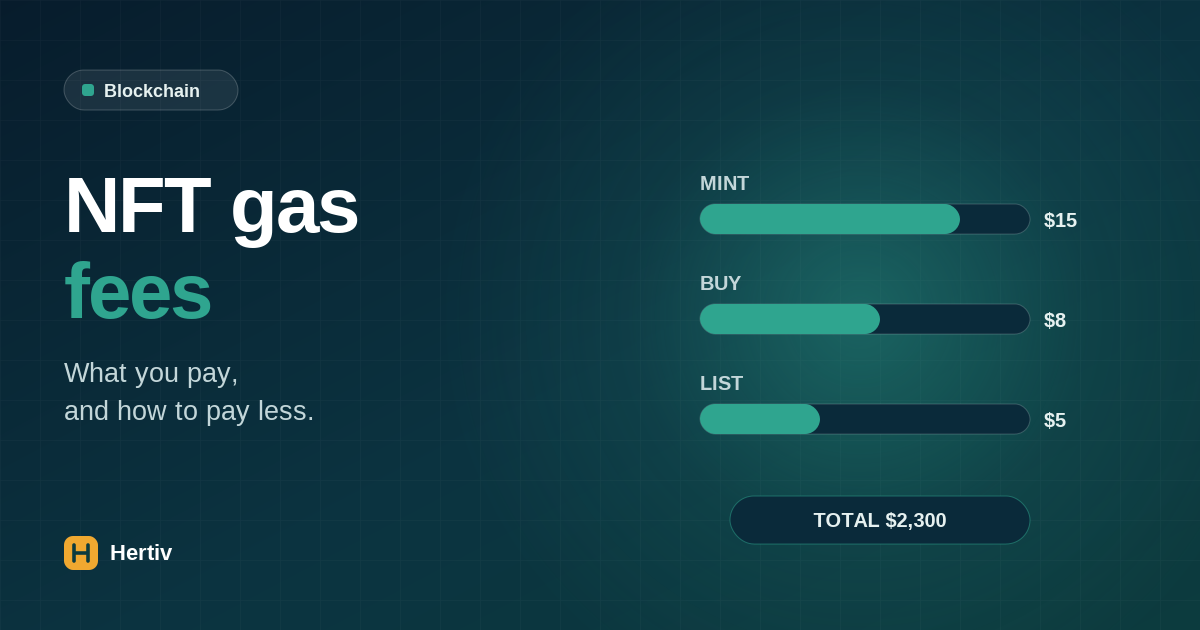
Example (hypothetical): an artist plans a 100-piece collection on Ethereum. On a busy evening the mint fee is $15 per piece and the listing approval is $8 per piece. Minting all 100 costs 100 times $15, which is $1,500, and the approvals cost 100 times $8, which is $800. The total gas cost is $1,500 plus $800, which is $2,300 before a single piece sells.
The artist changes the plan. She lists the collection with lazy minting, so nothing is minted until it sells, and she mints in a quiet hour when the fee is $6 per piece. If 30 pieces sell, the mint cost is 30 times $6, which is $180, and the approvals are one per collection at $8, not one per piece. The total is $188 instead of $2,300, a saving of $2,112.
The saving comes from two choices: not minting unsold pieces, and minting at a quiet hour. The artist still pays gas, but only on pieces that sold, and only at the cheaper rate. That is the pattern to copy: pay gas on demand, not in advance.
What are the common mistakes?
The most common mistakes are minting everything up front, ignoring the approval fee and setting the gas price too low. Each one costs money or time.
- Minting the whole collection first. Unsold pieces still cost gas. List with lazy minting until you know what sells.
- Forgetting the approval fee. The first listing needs a paid approval. Budget for it before you price the NFT.
- Setting the fee too low. A transaction that never confirms wastes time and can still cost gas if it fails.
- Minting at peak time. A popular drop can triple the fee. Wait for a quiet hour unless the drop is time-limited.
- Ignoring the chain choice. The same NFT can cost $15 to mint on one chain and under $1 on another. Pick the chain before you mint.
If you want to see how NFTs reach buyers on social platforms, read NFTs in social media for the distribution side of the same story.
Key takeaways
- NFT gas fees pay for the computing work of each on-chain action
- Minting, listing, buying, transferring and bidding each carry a fee
- Fees spike when the network is busy or the contract is wasteful
- Lazy minting moves the mint cost to the buyer at the moment of sale
- Quiet hours, batching and layer 2 chains cut the cost
Frequently asked questions
How much does it cost to mint an NFT?
It depends on the chain and the hour. On Ethereum a mint can cost a few dollars on a quiet day and tens of dollars during a busy drop, while on a layer 2 chain it often costs under a dollar. Check a gas tracker before you mint, and remember the listing approval is a separate fee.
Do buyers pay gas fees too?
Yes. The buyer pays gas on the purchase transaction, and sometimes on the mint as well when the NFT is lazily minted. The seller pays gas on the listing approval and on the transfer. Both sides should check the fee before they confirm.
Can I avoid gas fees completely?
No, not on a chain that charges for transactions. You can cut them a lot with lazy minting, quiet hours and a cheaper chain, and some marketplaces cover the first mint, but every on-chain action has a cost somewhere.
What is a gas war?
A gas war happens when many buyers try to mint the same limited collection at once and each raises the fee to get into the next block. The fee climbs fast, and some buyers pay a high fee and still fail. Waiting for the rush to pass is usually cheaper.
Is gas cheaper on Polygon or Arbitrum?
Yes, usually far cheaper. These layer 2 chains settle on Ethereum but do most of the work off the main chain, so a mint that costs $15 on Ethereum can cost under $1 there. The trade-off is a smaller buyer pool on that chain.
What happens if my transaction runs out of gas?
The transaction fails and the NFT is not minted or moved, but the gas you already spent is not refunded. That is why you should set a sensible gas limit and check the estimate in your wallet before you confirm.


