What Is a Multichain Tokenization Platform?
A multichain tokenization platform issues the same real-world asset on more than one blockchain. Learn how it works and what to check before you build one.
On this page
Short answer
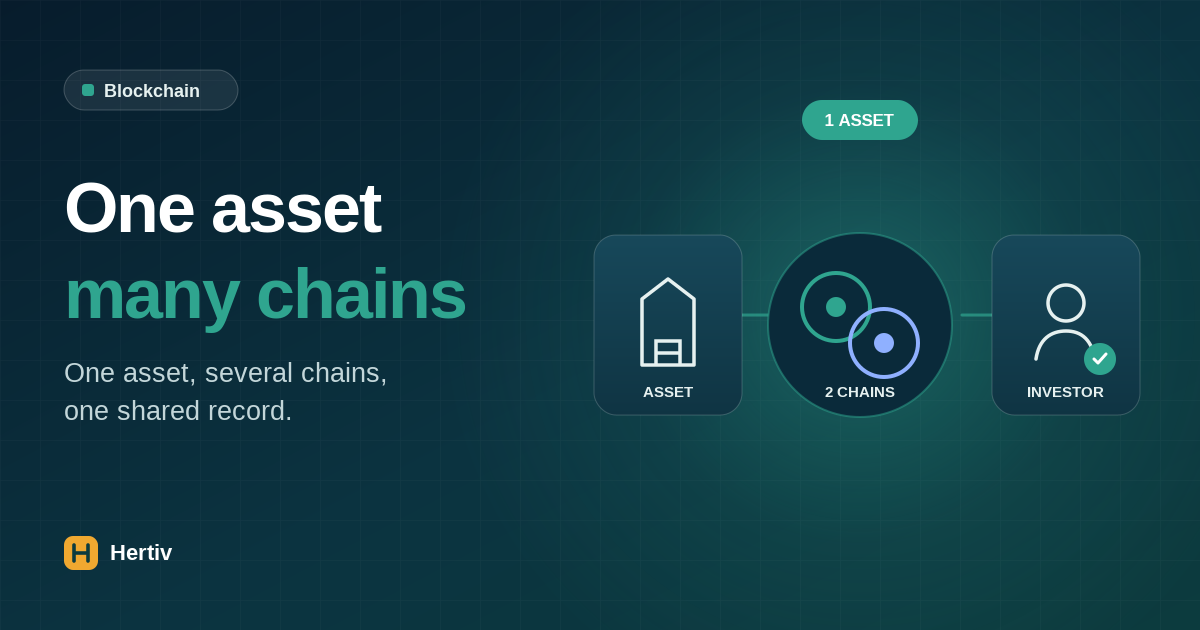
A multichain tokenization platform for Web3 issues tokens that represent the same real-world asset on more than one blockchain, so investors on different chains can hold, trade and settle the same asset. It differs from a single-chain platform because it manages issuance, bridging and a shared record across chains instead of tying the asset to one network.
What is a multichain tokenization platform?
A multichain tokenization platform is a system that turns a real-world asset, such as a fund share, a property or a bond, into digital tokens on several blockchains at once. The tokens on each chain represent the same underlying asset, and the platform keeps the record straight across all of them.
It has three jobs. First, it issues the tokens, with the legal and compliance rules attached. Second, it moves tokens between chains when an investor wants to hold the asset somewhere else. Third, it keeps one shared record of who owns what, so the total issued never exceeds the asset behind it.
The difference from a single-chain platform is reach. A single-chain platform can only serve investors who use that chain. A multichain platform can serve investors on several chains without issuing a separate asset for each one.
| Point | Single-chain platform | Multichain platform |
|---|---|---|
| Investor reach | Only users of one chain | Users of every supported chain |
| Fees | One fee level | Varies by chain, often lower on some |
| Complexity | Lower, one set of contracts | Higher, bridging and shared record |
| Risk | One chain outage stops trading | Other chains keep working |
| Compliance | One set of chain rules | Rules checked on every chain |
Teams usually choose the multichain route when their investors are spread across chains, or when fees on the main chain are too high for small trades. RWA tokenization platform development covers the single-chain starting point.
Why tokenize on more than one chain?
Teams tokenize on more than one chain for three reasons: to reach more investors, to cut costs on some trades, and to avoid depending on a single network.
Reach comes first. An investor who holds funds on one chain will not always move them to another chain to buy a token. If the token exists on the chain they already use, they can buy it without that extra step. That matters for funds and property tokens, where the buyer pool is wide and spread out.
Cost is second. Some chains charge far less per transaction than others. Small trades, such as a $100 token purchase, make sense on a low-fee chain and not on a high-fee one. A multichain platform lets the issuer put the small trades where they are cheap and keep the large trades where the liquidity is.
Dependence is third. If one chain has an outage or a fee spike, trading on the other chains continues. That does not remove risk, but it means one network problem does not stop the whole asset.
How does a token move between chains?
A token moves between chains in one of three ways, and the platform must pick one and stick to it, because mixing models is where records go wrong.
- Lock and mint. The token is locked in a contract on the first chain, and a matching token is minted on the second chain. When it moves back, the copy is burned and the original is released. The total supply stays the same.
- Burn and mint. The token is burned on the first chain and a new one is minted on the second. This works when the token is issued by one contract that controls supply on both chains.
- Native issuance. The platform issues the token on each chain from the start, with no bridging at all. Investors hold the version on their chain, and the platform tracks the total across chains in one record.
Whichever model is used, the platform must prove that the total tokens across all chains never exceeds the asset behind them. That check is the core job of the platform, and it is what an audit should test first.
What should you check before choosing chains?
Before choosing chains, check fees, settlement speed, wallet support, compliance tooling and liquidity for each chain you plan to support. A chain that looks cheap can still be the wrong choice if your investors do not use it.
| Chain | What to check | Why it matters |
|---|---|---|
| Ethereum and layer 2s | Fees, finality, wallet support | Largest investor base, highest mainnet fees |
| Low-fee chains | Fees, uptime, exchange listings | Cheap small trades, thinner liquidity |
| Permissioned chains | Access rules, audit trail | Fits regulated issuers, smaller buyer pool |
Check the compliance side too. Some chains have identity and transfer-restriction tools built in, which regulated tokens need. Others do not, which means the platform must add those checks itself. RWA tokenization platforms shows which platforms already support several chains.
How do you build or buy a multichain platform?
You build or buy a multichain platform by defining the asset and its rights first, then choosing chains, then the bridging model, and only then writing contracts.
- Define the asset and its rights. What does a token holder own, what can they transfer, and who is allowed to hold it?
- Pick the chains. Choose two or three to start, based on where your investors already are.
- Choose the bridging model. Lock and mint, burn and mint, or native issuance — one model for the whole platform.
- Write and audit the contracts. Include the supply check across chains and get an independent audit before launch.
- Add compliance checks. Identity checks and transfer restrictions must work on every chain, not just the first one.
- Launch on one chain, then add the rest. Prove the record-keeping on a single chain before bridging adds a second one.
Buying a white-label platform is faster than building, but the same questions apply: which chains it supports, which bridging model it uses, and how it proves the total supply. How much a tokenization platform costs gives a starting point for the budget.
Example (hypothetical): a fund tokenizes on two chains
Example (hypothetical): a $10 million fund tokenizes for 2,000 investors and issues on two chains. On chain A, minting costs $0.40 per investor, which is 2,000 × $0.40 = $800. On chain B, minting costs $0.05 per investor, which is 2,000 × $0.05 = $100.
Later, 500 investors move their tokens from chain A to chain B. Bridging costs $2 per token, which is 500 × $2 = $1,000. The total issuance cost is $800 + $100 + $1,000 = $1,900.
The point of the arithmetic is the split: minting on the low-fee chain is cheap, but bridging is the expensive part. If most investors stay on the chain where they first bought, the platform spends little on bridging. If they move often, bridging costs more than minting. That is why the platform should track how often tokens move before adding a third chain.
What are the common mistakes?
The most common mistakes are launching on too many chains at once, trusting a bridge without an audit, and forgetting that compliance checks must work on every chain.
- Too many chains at launch. Each extra chain adds contracts, audits and support work. Start with two or three.
- An unaudited bridge. The bridge holds the locked tokens, so a flaw there puts the whole asset at risk. Audit it before launch.
- Assuming a wrapped token is the asset. A wrapped token is a claim on the locked original, not the asset itself. Investors should know the difference.
- Compliance on one chain only. If transfer rules apply on chain A but not chain B, restricted holders can buy on chain B.
- No plan for a chain outage. If one chain stops, the platform should still show holdings and settle on the others.
Teams that already run a single-chain platform often add a second chain first and learn from it, rather than rebuilding for five chains at once. How to build a multi-asset tokenization platform covers the single-platform starting point.
Key takeaways
- A multichain platform issues the same asset on several chains, with one shared record of ownership
- Reach, cost and independence from one network are the three reasons teams go multichain
- Lock and mint, burn and mint, or native issuance — pick one bridging model and stick to it
- Total tokens across all chains must never exceed the asset behind them
- Launch on one chain first, then add chains once the record-keeping is proven
Frequently asked questions
What is the difference between multichain and multi-asset tokenization?
Multichain means one asset issued on several blockchains. Multi-asset means one platform handling several asset types, such as funds, property and bonds, which may all sit on one chain. A platform can be both, but the two ideas solve different problems.
Does a multichain token cost more to issue than a single-chain token?
Issuing on each extra chain adds minting and audit costs, and bridging adds a fee every time a token moves. The total is usually higher than a single-chain issue. Teams accept that cost when their investors are spread across chains or when small trades are too expensive on the main chain.
Is a wrapped token the same as the original token?
No. A wrapped token is a claim on a token locked in a contract on another chain. It tracks the same asset, but its value depends on the lock holding and the bridge working. Investors should know they hold a claim, not the original token, before they buy.
Which chains should a multichain platform support first?
Start with the chains your investors already use, usually two or three. Check fees, settlement speed, wallet support and compliance tooling for each. Adding a chain is easy; removing one after investors hold tokens on it is hard, so choose the first set carefully.
Do compliance rules apply on every chain?
Yes. Identity checks and transfer restrictions must work on every chain the token exists on. If a restricted holder can buy on one chain while the rules only apply on another, the platform has a gap. Test the rules on each chain before launch.
What happens if one chain in a multichain platform goes down?
Trading and settlement on that chain stop, but the other chains keep working. The platform should still show every holding in one place and let investors act on the chains that are running. That is one reason teams choose multichain: one outage does not stop the whole asset.


