How to Build a Multi-Asset Tokenization Platform
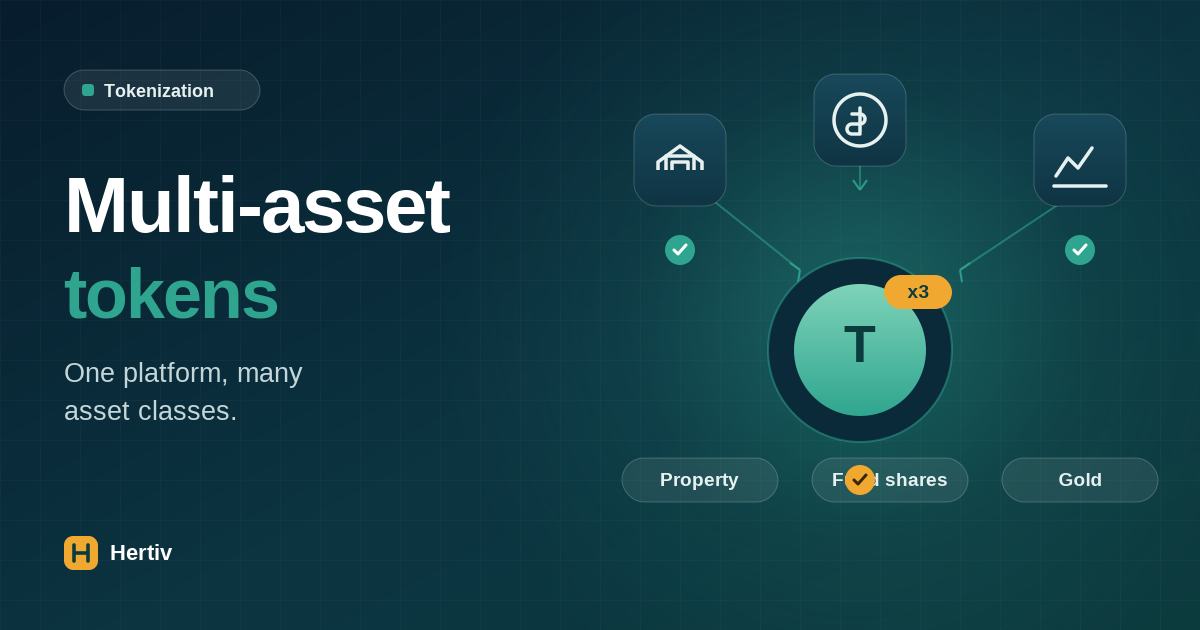
A multi-asset tokenization platform turns several asset classes into tokens on one system, with a shared compliance engine and separate rules per asset.
On this page
Short answer
A multi-asset tokenization platform is a system that issues, manages and settles tokens backed by several asset classes — such as real estate, funds, bonds and commodities — on one platform instead of one per asset. Each class keeps its own legal and compliance rules, while the platform shares the token factory, investor onboarding and settlement rails.
What is a multi-asset tokenization platform?
A multi-asset tokenization platform is a platform that lets an issuer tokenize more than one kind of asset — property, fund shares, bonds, gold or carbon credits — and lets investors hold, trade and settle those tokens in one place. The platform issues a token for each asset, records who owns it, and enforces the transfer rules that apply to that asset.
The difference from a single-asset platform is the asset layer. A single-asset platform hard-codes one asset type into its contracts and its compliance checks. A multi-asset platform adds an adapter per asset class: the adapter knows how that asset is valued, what documents prove ownership, and which investors may hold it. The token, the wallet and the settlement flow stay the same across classes.
That design is what makes the platform worth building. Without it, an issuer ends up running one platform per asset, with separate onboarding, separate wallets and separate settlement — which is the same cost as running several businesses. The general single-asset build is covered in how to build an asset tokenization platform.
Which asset classes can one platform handle?
A multi-asset platform can handle any asset class that has a clear legal owner, a defensible valuation and a transfer process that can be written down. The table below shows the classes issuers start with most often, and what changes per class.
| Asset class | What backs the token | What differs per class |
|---|---|---|
| Real estate | Property or a property fund share | Title records and local property law |
| Funds | Shares in a managed fund | Fund rules and investor limits |
| Bonds and debt | A loan or bond contract | Coupon schedule and maturity |
| Commodities | Stored gold or another commodity | Custody audits and vault records |
| Carbon credits | A verified credit in a registry | Registry rules and retirement |
| Private equity | Shares in a private company | Shareholder agreements and lock-ups |
Start with two classes, not six. Each new class adds legal work, valuation work and a new adapter, and the platform earns its keep only when the shared parts — onboarding, wallets, settlement — actually get reused. The fund angle is covered in fund tokenization.
How does the platform architecture work?
The platform architecture works as a shared core with one adapter per asset class. The core holds the parts that do not change: investor onboarding and identity checks, the token factory, the wallet and custody layer, the secondary market and the settlement engine. The adapter holds the parts that do change: valuation, legal documents, transfer rules and reporting.
That split keeps the contracts auditable. The token contract for each asset is a simple, standard token with a transfer hook that asks the compliance engine whether the transfer is allowed. The compliance engine checks the adapter's rules for that asset: is the buyer eligible, is the holding period over, is the investor limit respected. If any check fails, the transfer is blocked before it happens.
Settlement is shared across classes. A buyer pays in a stablecoin or fiat rail, the payment clears, and the token moves in the same transaction or in a linked one. Sharing settlement is where the platform saves money: one payment integration serves every asset class. The cost picture for a tokenization build is in how much a tokenization platform costs.
What are the build steps for a multi-asset platform?
Building a multi-asset platform follows the same order as a single-asset build, with one extra step: designing the adapter layer before the first asset is tokenized. Skipping that step is how teams end up with a platform that works for one asset and cannot take a second.
- Pick the first two asset classes and write down what differs between them: valuation, documents, transfer rules and investor limits.
- Design the adapter layer so each class plugs into the same core without changing it.
- Build the shared core: onboarding, token factory, custody, market and settlement.
- Build the first adapter with the lawyers for that asset class, and tokenize a small pilot asset.
- Test transfers, limits and settlement on a test network with real users and real edge cases.
- Build the second adapter and prove the core did not need to change.
- Launch with one asset class live and add the next class only after the first settles cleanly.
The order matters. Teams that tokenize the first asset before designing the adapter usually rebuild the platform for the second asset, which costs more than designing the adapter up front. The legal and registry groundwork is set out in the RWA tokenization guide.
How do compliance and settlement differ per asset class?
Compliance differs per asset class because the law treats each class differently. A real estate token needs a title check and local property rules; a fund token needs the fund's own investor limits; a bond token needs a coupon and maturity schedule; a carbon credit needs a registry entry that can be retired. The platform must enforce each set of rules without mixing them up.
The practical way to handle this is one compliance engine with one rule set per asset. The engine asks the same questions for every transfer — who is the buyer, who is the seller, how long has the token been held, does the buyer pass the checks for this asset — but the answers come from the adapter for that asset.
A transfer that is fine for a gold token can be blocked for a fund token, and the engine must know why. That is the rule to test hardest: run a transfer that should pass for one class and fail for another, and check the engine treats them differently.
Settlement differs less, but it still differs. Real estate and funds usually settle against fiat or a stablecoin with a holding period; commodities settle against audited vault records; carbon credits settle when the registry confirms the credit. The platform should record the settlement proof for each class in the same place, so an auditor sees one trail rather than five.
Example: one platform, three asset classes
Example (hypothetical): an issuer builds a platform for three asset classes — a property, a fund and a gold holding — and prices every token at 100 dollars so the maths stays simple. The property is worth 1,500,000 dollars, so it becomes 15,000 tokens. The fund is worth 2,000,000 dollars, so it becomes 20,000 tokens. The gold is worth 500,000 dollars, so it becomes 5,000 tokens.
The platform holds 40,000 tokens in total, worth 4,000,000 dollars. An investor buys 200 property tokens, 100 fund tokens and 50 gold tokens — 350 tokens for 35,000 dollars — and the platform runs three different compliance checks on the one purchase: a title check for the property, a fund investor limit for the fund shares, and a custody record for the gold.
Settlement is shared: one stablecoin payment of 35,000 dollars, one fee of 0.5 percent, which is 175 dollars, and three token transfers that settle together. If the platform had been built as three separate systems, the same investor would have onboarded three times and paid three fees.
What are the common mistakes?
The most common mistakes are hard-coding the first asset into the core, adding asset classes before the first one settles, and treating compliance as one rule set for all assets.
- Hard-coding the first asset into the core, so the second asset needs a rebuild.
- Launching several asset classes at once before any of them settles cleanly.
- Using one compliance rule set for all assets, which blocks legal transfers or allows illegal ones.
- Skipping the valuation method per asset, so nobody can say what a token is worth.
- Letting settlement proofs live in five places, so an audit becomes a search.
Key takeaways
- A multi-asset platform shares onboarding, tokens and settlement across asset classes
- Each asset class keeps its own adapter for valuation, documents and transfer rules
- Build the adapter layer first, then the first asset, then the second
- Compliance is one engine with one rule set per asset, not one rule set for all
- Start with two asset classes and add the next only after the first settles cleanly
Frequently asked questions
What is a multi-asset tokenization platform?
It is a platform that issues, manages and settles tokens backed by several asset classes — such as real estate, funds, bonds and commodities — on one system. Each class keeps its own legal and compliance rules, while the platform shares onboarding, wallets and settlement.
How is it different from a single-asset platform?
A single-asset platform hard-codes one asset type into its contracts and checks. A multi-asset platform adds an adapter per asset class, so new classes plug into the same core. Without the adapter layer, each new asset needs a rebuild.
Which asset classes work best first?
Real estate and funds are the usual first two, because both have clear ownership records and known investor limits. Commodities and carbon credits work well once custody and registry checks are in place. Start with two classes, not six.
Do investors need a different wallet per asset?
No. One wallet holds tokens from every asset class on the platform, and the compliance engine checks the rules for each token at transfer time. The investor sees one balance and one settlement trail.
How much does a multi-asset platform cost to build?
It costs more than a single-asset platform because of the adapter layer and the legal work per asset class. The exact figure depends on the classes, the chain and the compliance scope, so check the cost guide for the ranges that apply to your case.
What is the biggest risk in a multi-asset build?
Mixing up compliance rules between asset classes. A transfer that is legal for one class can be illegal for another, so the compliance engine must keep one rule set per asset and block transfers that fail any check.


