How Much Does a Multi-Agent System Cost?
A multi-agent system splits a job across several AI agents that call a model, use tools and pass results to each other. Here is what the build and bill look like.
On this page
Short answer
A multi-agent system is a set of AI agents that split a job between them, each calling a model, using tools and passing results to the next agent. The cost has two parts: the build, which is mostly engineering time, and the running bill, which is mostly model calls, tool use and monitoring.
What is a multi-agent system, and what does it cost?
A multi-agent system is a set of AI agents that work together on one job. One agent might read a ticket, another might look up the answer, and a third might draft the reply. Each agent calls a model, may call tools, and passes its result to the next agent.
The bill has four parts:
| Cost part | What it covers | When it grows |
|---|---|---|
| Model calls | Input and output tokens | More agents, longer tasks |
| Build | Design, code, evaluation | More agents, more tools |
| Tools and data | APIs, search, storage | More lookups per task |
| Running and watching | Logs, traces, alerts | More volume, more agents |
Model calls are usually the largest running cost, and they grow faster than people expect. Each extra agent adds at least one model call per task, and retries add more. That is why counting calls per task matters more than the price per token.
What drives the cost of the model calls?
Model call cost depends on how many agents run per task, how much each one reads and writes, and how often a task is retried. A three-agent chain that retries twice costs roughly six model calls, not three.
The biggest driver is context size. If every agent reads the full conversation and the full document set, the input tokens pile up. Give each agent only the slice it needs, and pass short summaries between agents instead of full transcripts.
Model choice is the second driver. A small, cheap model is often enough for classification and routing, while a large model is needed for reasoning and drafting. Mixing models by job keeps the bill down without hurting quality.
If you are still deciding whether several agents are the right shape at all, multi-agent vs single-agent systems compares the two patterns and when each one fits.
What does the build cost?
The build cost is mostly engineering time. A small system with two or three agents, a few tools and a simple handoff can take a few weeks. A larger system with many agents, custom tools, approval gates and an evaluation set can take a few months.
The work that takes the longest is rarely the agents themselves. It is defining what each agent may do, wiring the tools, building the evaluation set and adding the guardrails. Teams that skip evaluation pay for it later, because they cannot tell whether a change helped or hurt.
Budget for the evaluation set from the start. Twenty to fifty real cases with known good outcomes will guide design, catch regressions and give you a number to show when the system goes live.
For the design side, how to build a multi-agent system walks through the roles, the handoffs and the checks that keep the system honest.
What does it cost to run and maintain?
Running costs come from model calls, tool APIs, storage for logs and traces, and the time someone spends watching the system. For a small system handling a few hundred tasks a day, the monthly bill is usually modest. For thousands of tasks a day with long chains, it grows quickly.
Maintenance is a real cost too. Prompts drift as models change, tools change their APIs, and the data the agents read goes stale. Plan for a few hours a week of upkeep, more in the first months after launch.
Set a cost limit per task and an alert when the daily spend passes a threshold. Without a limit, a loop between two agents can run all night and produce a bill nobody expected.
Logging is not optional. Full traces of each step, prompt and tool call are what let you find a bad agent, a wasteful loop or a prompt that needs fixing. Keep traces for a few weeks at least.
How do you estimate the cost in 5 steps?
You estimate the cost by counting calls per task, pricing them, and adding the build and running time. Guessing from the token price alone will understate the bill.
- Count agents per task. List each agent that runs for one task, including routers and checkers.
- Count tokens per agent. Measure input and output tokens on a real case, not on a guess. Include the context each agent reads.
- Add retries and failures. If one task in ten is retried, add a tenth to the call count. If agents loop, add a hard step limit.
- Price the tools. Add the API, search and storage cost per task. Some tools charge per call, others per seat.
- Multiply by volume and add upkeep. Multiply the per-task cost by daily tasks and by 30, then add the weekly upkeep hours.
Run the estimate on a pilot of real tasks before you commit. The pilot will show you the retries and the context sizes that a spreadsheet cannot.
Example (hypothetical): a support-triage system
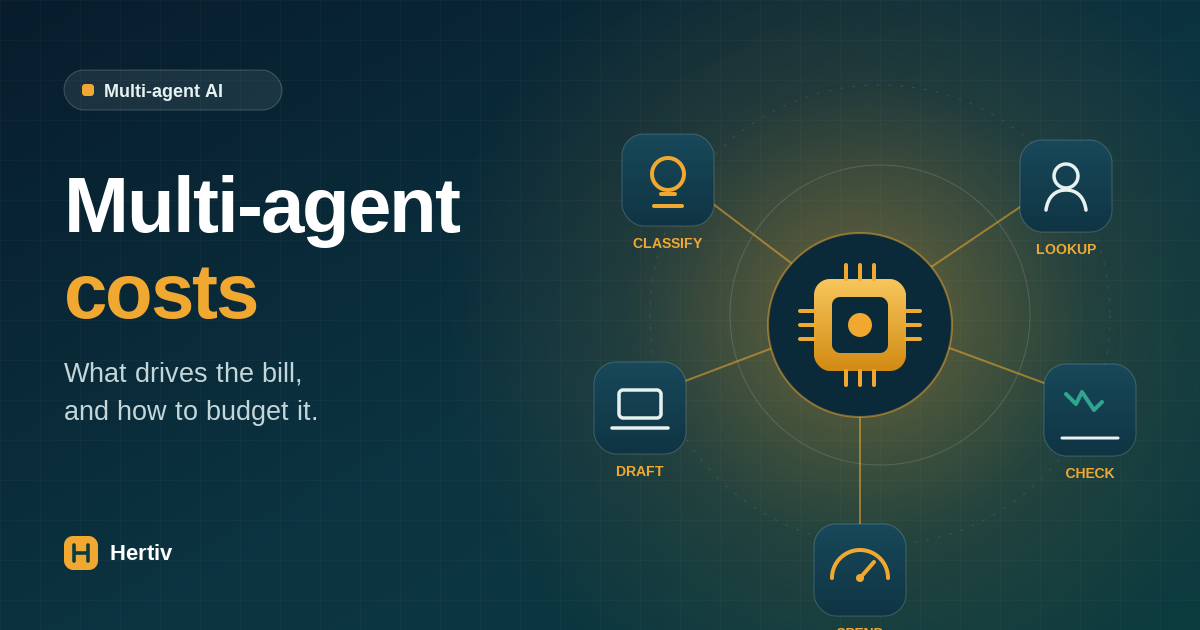
Example (hypothetical): a support team builds a three-agent system to triage incoming tickets. Agent one classifies the ticket, agent two looks up the answer in the help centre, and agent three drafts a reply for a human to send.
Each ticket takes three model calls. The classifier reads about 1,000 tokens and writes 100. The lookup agent reads about 4,000 tokens and writes 300. The drafter reads about 3,000 tokens and writes 400. That is 8,000 input tokens and 800 output tokens per ticket.
At planning rates of $2 per million input tokens and $8 per million output tokens, one ticket costs 8,000 / 1,000,000 x $2 = $0.016 for input and 800 / 1,000,000 x $8 = $0.0064 for output, about $0.022 in total. For 500 tickets a day, that is 500 x $0.022 = $11 a day, or about $330 a month.
Add a 10% retry rate and the monthly model bill rises to about $363. The build took about six weeks of engineering time, and upkeep is about four hours a week. The model bill is small; the build and the upkeep are where the money goes.
What are the common mistakes?
The most common mistakes are adding agents that add no value, letting agents read too much context, and running without a cost limit.
- Too many agents. Each extra agent adds cost and failure modes. Start with one agent, then split only when a single agent cannot do the job well.
- Full context everywhere. Passing the whole conversation to every agent multiplies the token bill. Pass short summaries instead.
- No step limit. Agents can loop. A hard limit on steps per task stops a runaway bill.
- Skipping the evaluation set. Without known good outcomes, you cannot tell whether a cheaper model or a shorter prompt hurt quality.
- Forgetting the upkeep budget. A system that nobody watches will drift, and the drift shows up as cost before it shows up as errors.
If you are starting from the basics, what a multi-agent system is explains the roles and the handoffs.
For a build partner, multi-agent systems development covers the design and guardrails.
Key takeaways
- A multi-agent system splits a job across agents that call a model and pass results on
- Model calls are usually the largest running cost, and they grow with each agent and retry
- The build cost is mostly engineering time, and evaluation is part of it
- Pass short summaries between agents instead of full context
- Set a cost limit per task and an alert for daily spend
Frequently asked questions
How many agents should a multi-agent system have?
As few as the job needs. Most working systems use two to four agents: a router, one or two workers and a checker. Adding agents adds cost and failure modes, so split an agent only when a single agent cannot do the job well or when two jobs need different models.
Is a multi-agent system cheaper than one big agent?
Not usually. Several agents mean several model calls per task, so the token bill is higher. The gain is quality and control: each agent has a narrow job, a clear input and a checkable output. You pay more per task, but you get a result you can trust and debug.
What is the cheapest way to run a multi-agent system?
Use small models for routing and classification, and reserve large models for reasoning and drafting. Pass short summaries between agents instead of full transcripts, cache repeated lookups, and add a step limit so a loop cannot run all night. Measure the cost per task each week.
How do you stop agents from looping?
Set a hard limit on steps per task, add a timeout, and require each agent to report progress in a short, fixed format. If the limit is hit, stop the task and hand it to a human. Log the loop so you can see which agent or prompt caused it.
Do multi-agent systems need human review?
Yes, for anything that reaches a customer or changes a system. A checker agent can catch simple errors, but a human should approve drafts, payments and irreversible actions. Human review is also the feedback loop that improves the prompts over time.
How do you measure whether the system is worth the cost?
Compare the cost per task with the time it saves and the error rate against a fixed evaluation set. If the system costs more per task than the manual route and does not cut errors, it is not worth running. Track both numbers monthly, not just the model bill.


