MPC Wallet Best Practices: Keep Your Keys and Funds Safe
MPC wallet best practices cover threshold choice, key-share custody, signing rules, recovery tests and audits. Follow them to keep shared signing safe.
On this page
Short answer
An MPC wallet splits a private key into shares held by different people or systems, so no single share can sign alone. The best practices are to pick a threshold that survives one lost share, store shares apart, require approval for large transfers, test recovery before funding, and audit the setup regularly.
What is an MPC wallet?
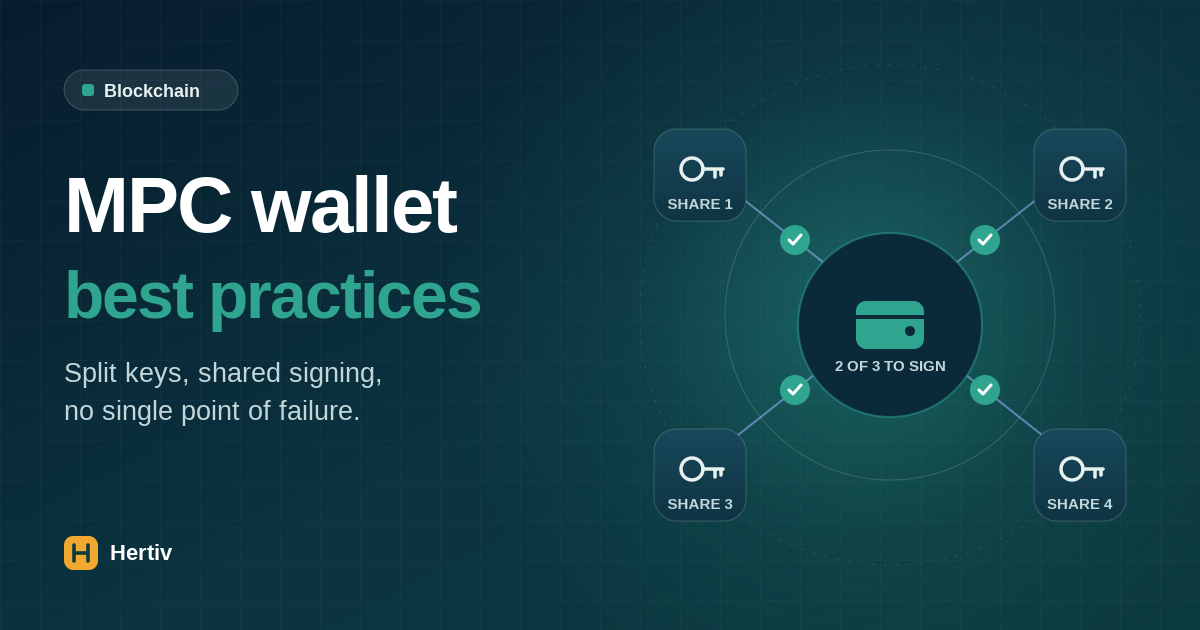
An MPC wallet is a crypto wallet that splits a private key into shares using multi-party computation, so the full key never exists in one place. When a transfer needs signing, a set number of shares combine to produce a signature without ever rebuilding the key. The shares are held by different people, devices or systems, so losing one share does not lose the funds.
The number of shares needed to sign is called the threshold. A 2-of-3 wallet signs with any two of its three shares, while a 3-of-5 wallet needs any three of five. A higher threshold is harder to attack but harder to operate, since more people must be available to sign. Most teams pick a threshold that survives one lost share and one unavailable signer.
The table below shows common setups and what each one survives.
| Setup | Shares needed | Survives |
|---|---|---|
| 2-of-3 | 2 | One lost share |
| 3-of-5 | 3 | Two lost shares |
| 3-of-3 | 3 | Nothing lost: one missing share blocks signing |
| 2-of-2 | 2 | Nothing lost |
If you are still deciding between key designs, read what an MPC wallet is first, then compare it with the multisig option before you choose a setup.
How should you choose the threshold and key holders?
Choose the threshold by asking what must still work when something goes wrong. A team that needs to sign every day should survive one person being away and one share being lost at the same time, which points to 3-of-5 rather than 2-of-3. A personal wallet with two devices can live with 2-of-3, since the owner controls all three shares.
Key holders should be people or systems that fail independently. Do not give two shares to the same person, the same laptop and the same cloud account, because one failure then takes both shares. Spread shares across roles, such as an operations lead, a finance lead and a hardware device held offline.
Write down who holds each share and what happens when a holder leaves. A share held by a person who has left the company is a share you cannot use, and finding that out during an incident is the worst time to learn it. Review the holder list every quarter and after every team change.
How do you keep key shares safe?
Store each share in a different place and under different controls. A common pattern is one share on a hardware device, one in a hardware security module, and one with a separate custodian. If one store is breached, the attacker still has only one share, which cannot sign anything on its own.
Never copy a share to a shared drive, a chat message or an email. Shares should move only through encrypted channels with a record of who sent and received them. When a share must be replaced, generate a fresh share and retire the old one, rather than copying the old share to a new device.
Rotate shares on a fixed schedule, for example once a year, and after any incident. Rotation limits how long a stolen share stays useful. Keep a written record of each rotation: the date, the shares replaced and the people who approved it.
What signing policy should you set?
A signing policy states which transfers need extra approval and who can give it. Small, routine transfers can sign with the standard threshold, while large or unusual transfers should need a second approver and a waiting period. The limits should be written down, not left to whoever is on shift.
Allow lists help too. A wallet that only sends to approved addresses is much harder to drain if a share is stolen, because the attacker cannot send funds to an address they control. Review the allow list monthly and remove addresses you no longer use.
Monitor every signing request, including ones that fail. A sudden run of failed signings, a request at an odd hour, or a transfer to a new address are all worth an alert. For the build steps behind the policy, see how to implement an MPC wallet.
How do you test recovery before you need it?
Recovery is the part most teams skip, and it is the part that matters most when a share is lost. Test it before the wallet holds real funds, and repeat the test on a schedule. A recovery plan that has never been run is a guess, not a plan.
- Write the recovery steps down: who acts, in what order, and with which shares.
- Run a drill where one share is treated as lost and the team signs with the rest.
- Run a second drill where a key holder is unavailable and a backup holder steps in.
- Time the drill and record how long each step takes, then fix the slow steps.
- Repeat the drill every six months and after any change to holders or shares.
If a drill fails, treat it as a real incident: find the cause, fix it, and run the drill again. A wallet whose recovery works in a drill is a wallet you can trust with funds.
Example (hypothetical): a payments team runs MPC wallets
Example (hypothetical): a payments team holds five key shares with a 3-of-5 threshold. One share sits on a hardware device in the office, one in a hardware security module, one with the finance lead, one with the operations lead, and one with a custodian.
In a drill, the team treats two shares as lost: the office device and the custodian share. The remaining three shares still meet the threshold, so the team can sign. The drill takes 40 minutes from start to finish, which the team records as its recovery time.
Daily transfers follow a signing policy. Transfers under 10,000 units sign with the standard threshold, while larger transfers need a second approver and a 30-minute wait. In a month with 200 transfers, about 20 are large, so the extra approval step adds roughly 10 hours of waiting across the month, which the team accepts for the added safety.
What are the common mistakes?
Most MPC wallet problems come from process, not from the cryptography. The mistakes below show up again and again, and each one is easy to avoid with a written plan.
- Choosing a threshold that blocks signing when one person is away.
- Storing two shares in the same place, so one failure takes both.
- Copying shares through email or chat instead of an encrypted channel.
- Skipping recovery drills until a share is actually lost.
- Leaving the allow list unreviewed, so old addresses stay approved.
- Giving every holder the same signing rights with no limits.
- Forgetting to update the holder list when someone leaves.
If you need help setting the wallet up for your own product, MPC wallet development covers the build and the operating model around it.
Key takeaways
- Pick a threshold that survives one lost share and one absent signer.
- Store each share apart, under different controls, and never copy shares by email or chat.
- Set signing limits, an allow list and a second approver for large transfers.
- Test recovery with drills before the wallet holds real funds, and repeat them twice a year.
- Review holders, shares and allow lists every quarter and after team changes.
Frequently asked questions
What is the safest MPC wallet threshold?
For most teams, 3-of-5 is a good balance: it survives two lost shares and still signs when one holder is away. Smaller setups like 2-of-3 work for personal wallets, while larger treasuries may use 4-of-7 or more.
Can one stolen MPC key share drain a wallet?
No. A single share cannot sign on its own, so a thief needs enough shares to reach the threshold. That is why shares must live apart: one breach should never hand over two shares.
How often should you rotate MPC key shares?
Once a year is a sensible default, plus a rotation after any incident or team change. Each rotation should be recorded with the date, the shares replaced and the people who approved it.
Do MPC wallets need a recovery plan?
Yes. Without a tested recovery plan, a lost share or an unavailable holder can freeze funds. Run drills with a share treated as lost, time each step, and repeat the drill every six months.
What is the difference between MPC and multisig wallets?
Both split control across several parties, but multisig uses several separate keys recorded on chain, while MPC splits one key into shares off chain. MPC keeps the setup private and works on chains without native multisig support.
Should small transfers need the same approval as large ones?
No. Routine small transfers can sign with the standard threshold, while large or unusual transfers should need a second approver and a waiting period. Written limits keep the rule clear for everyone on shift.


