Modular Blockchains for Web3 Projects: How They Work
A modular blockchain splits a chain's four jobs across layers. Here is how the layers fit together, when the design helps a Web3 project, and how to choose a stack.
On this page
Short answer
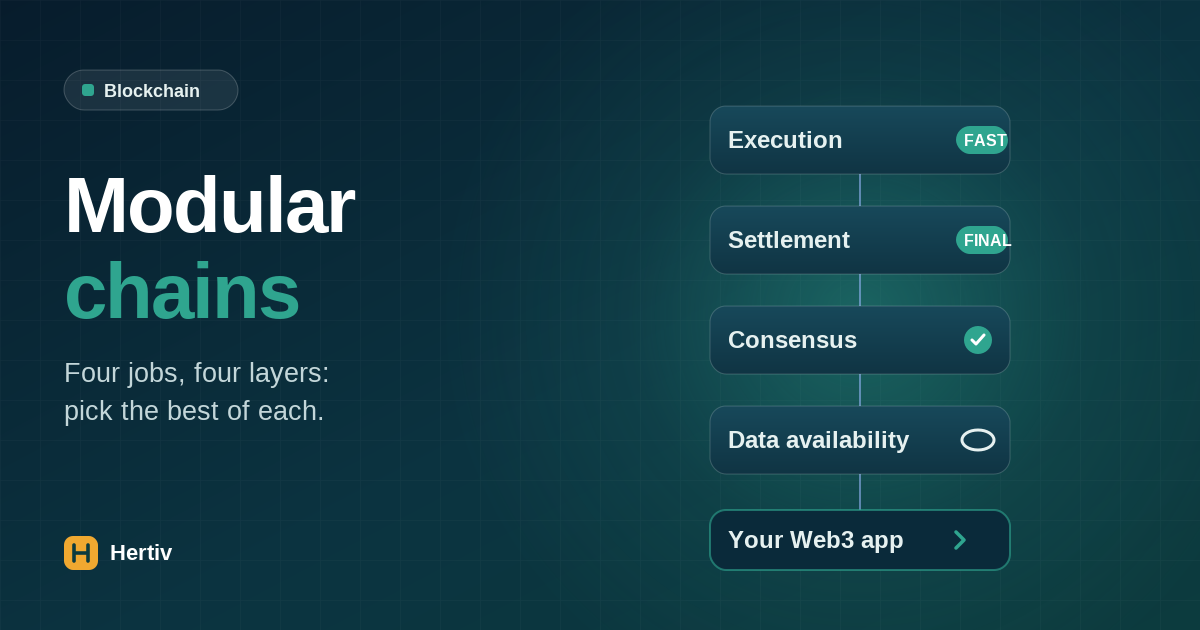
A modular blockchain splits the four jobs of a chain — execution, settlement, consensus and data availability — across layers, so a Web3 project can choose the best layer for each job. It suits apps with heavy transaction loads or plans to change layers later, but it adds complexity: more layers mean more parts to test, bridge and monitor. Choose by load, not popularity.
What is a modular blockchain?
A modular blockchain is a blockchain design that splits the work of running a chain across separate, specialised layers instead of making one chain do everything. Each layer handles one job, such as running transactions or storing data, and the layers pass results between each other. A Web3 project can then pick the strongest layer for each job rather than accepting the trade-offs of a single chain.
The idea grew out of a plain limit: one chain that does execution, settlement, consensus and data storage at once has to compromise on speed, cost or decentralisation. Splitting the jobs lets each layer optimise for one thing. A fast execution layer can process thousands of transactions per second while a separate settlement layer keeps the final record secure.
For a Web3 project, the practical question is not whether modular design is clever, but whether it fits what the project needs. A game with constant small actions has different needs from a lending app that settles large sums. The rest of this article maps the four jobs, the trade-offs, and how to choose a stack.
What are the four jobs a modular chain splits apart?
Every blockchain does four jobs, even when one chain does them all. The table below names each job, what it does, and what a project should check before trusting a layer with it.
| Job | What it does | What to check |
|---|---|---|
| Execution | Runs transactions and updates the state | Speed, fees, and how it behaves when busy |
| Settlement | Finalises results and settles disputes | How final a result is, and how disputes are proven |
| Consensus | Orders transactions and agrees on the chain state | Who runs the nodes, and how hard it is to take over |
| Data availability | Stores the data others need to check the chain | Whether the data stays public and easy to fetch |
In a modular setup, these jobs live on different layers that talk to each other. An execution layer can be a rollup that posts its results to a settlement layer, which in turn relies on a data availability layer to keep the underlying data public. If one layer is weak, the whole stack inherits that weakness, so the checks in the table matter more than the brand names.
Rollups are the most common execution layer today. Our guide to what a layer 2 is explains how they move work off the main chain.
How is a modular blockchain different from a monolithic one?
A monolithic blockchain does all four jobs on one chain. Bitcoin and the early Ethereum design work this way: the same nodes order transactions, run them, store the data and settle the result. The design is simple to reason about, and every part of the system shares the same security.
A modular chain trades that simplicity for choice. Each layer can be swapped, upgraded or replaced without rebuilding the rest. That helps a project that outgrows one layer, but it also adds moving parts: more layers mean more places where something can fail, and more teams to trust.
| Aspect | Monolithic | Modular |
|---|---|---|
| Upgrades | The whole chain changes at once | One layer can change at a time |
| Speed | Limited by what one chain can do | The execution layer can scale alone |
| Complexity | One system to learn | Several layers to join up |
| Security | Shared by everything on the chain | As strong as the weakest layer |
Neither design wins in every case. A payments app that needs one shared record may prefer a single chain, while a game that needs cheap, fast actions may prefer a modular stack. The trade-off is close to the choice in our layer 1 versus layer 2 comparison, and the choice should follow the project's load and risk, not the trend of the month.
When does a modular blockchain fit a Web3 project?
A modular stack fits best when a project has one job that is far heavier than the rest. A game that records thousands of small moves a day needs cheap execution far more than it needs fast settlement, so it can pair a fast execution layer with a slow, secure settlement layer.
It also fits projects that expect to change. A team that plans to add new features, switch data layers or support a second chain can swap one layer without moving everything. That freedom has a price in testing: every combination of layers needs its own checks before it goes live.
- High-volume apps. Games and social apps that record many small actions a day.
- App chains with custom rules. Projects that need their own fees, logic or governance.
- Projects that scale one job alone. Teams where execution load grows faster than settlement load.
- Teams that want to swap layers. Projects that expect better layers to appear and want to move.
It fits less well when a project is small or simple. A team with a few hundred users a day gains little from four layers and pays for the extra setup, monitoring and bridging. For those projects, one chain with low fees is usually the better start.
How do you pick a modular stack for your project?
Pick the stack from the project's needs, not from a list of popular layers. The steps below keep the choice grounded in what the app actually does.
- Write down the load: how many transactions a day, how fast each one must confirm, and what a failed transaction costs.
- Choose the execution layer first, since it sets speed and fees.
- Pick a settlement layer you would trust with the project's money.
- Check the data availability layer keeps data public and easy to fetch.
- Test the full stack with real traffic before launch, including a busy period.
Run the numbers before committing. A layer that looks cheap at ten transactions a day can turn costly at ten thousand, and a layer that is fast in a demo can slow down when blocks fill. A short pilot with real traffic answers both questions.
If the project is choosing between execution layers, our comparison of top layer 2 blockchains shows how the main options differ.
Example (hypothetical): a game studio picks a modular stack
Example (hypothetical): a small game studio expects 50,000 players a day, each making 4 moves. That is 200,000 transactions a day. On a single chain charging $0.02 per transaction, the daily cost would be $4,000. On a modular stack with an execution layer charging $0.001 per transaction, the same load costs $200 a day.
The studio still needs settlement it can trust, so it posts the execution layer's results to a settlement layer once an hour. That adds 24 settlement transactions a day. At $2 each, that is $48 a day, bringing the total to $248 a day against $4,000 on the single chain. The saving is real, but the studio now runs two layers, a bridge between them, and monitoring for both.
The lesson is to count the whole stack, not just the cheapest layer. Fees, settlement, bridging and monitoring all belong in the same sum before the team commits.
What are the common mistakes?
Modular stacks fail most often on the joins between layers, not on the layers themselves. The mistakes below come up again and again.
- Picking layers by popularity instead of by load and risk.
- Trusting a data availability layer without checking the data stays public.
- Forgetting the bridge: moving assets between layers is where most failures happen.
- Skipping a busy-period test and learning about limits after launch.
- Treating a modular stack as set-and-forget instead of monitoring each layer.
Key takeaways
- A modular blockchain splits execution, settlement, consensus and data availability across separate layers.
- Each layer can be swapped or upgraded without rebuilding the rest of the stack.
- The design fits apps where one job, usually execution, is far heavier than the rest.
- Security is only as strong as the weakest layer, including the bridge.
- Pick the stack from the project's load, and test the full stack before launch.
Frequently asked questions
What is the difference between a modular and a monolithic blockchain?
A monolithic blockchain does all four jobs on one chain, while a modular blockchain splits them across separate layers. Monolithic chains are simpler to reason about; modular chains let each layer be chosen, swapped and scaled on its own.
What are the four layers of a modular blockchain?
Execution runs transactions, settlement finalises results, consensus orders transactions and agrees on the state, and data availability stores the data others need to check the chain. A modular stack assigns each job to its own layer.
Is a modular blockchain cheaper than a monolithic one?
It can be, because a fast execution layer can process many transactions at low cost. The saving depends on the whole stack, though: settlement, bridging and monitoring add costs that a single chain does not have.
What is a rollup in a modular blockchain?
A rollup is an execution layer that bundles many transactions, runs them off the main chain, and posts a summary back to it. It is the most common way a modular stack handles the execution job.
When should a Web3 project avoid a modular blockchain?
Small or simple projects should usually avoid it. With a few hundred users a day, one chain with low fees is simpler, cheaper to run and easier to monitor than four layers joined by bridges.
What is the biggest risk in a modular blockchain stack?
The joins between layers carry the most risk, above all the bridge that moves assets between them. A weak data availability layer is the other common failure point, since the whole stack depends on that data staying public.


