What Does It Cost to Build a Mobile App in the UAE?
A mobile app in the UAE can cost anywhere from a small first version to a large multi-platform product. Here is what drives the price and how to budget for it.
On this page
Short answer
The cost of building a mobile app in the UAE depends on what the app does, how many platforms it covers, and how much design and testing it needs. A simple app with a few screens costs far less than a marketplace or banking app with payments, accounts and live data. This guide explains the main cost drivers and works through a realistic first-version budget.
What does a mobile app cost to build in the UAE?
Mobile app development cost in the UAE is the total spend to design, build, test and launch an app for users in the Emirates, including the team, tools and store fees. The cost varies widely because a simple booking app and a payment app are very different products, even when they look similar on a phone screen.
Most of the cost is people. A small team of a designer, two developers and a tester working for a few months will cost far more than the app store fees or the server bill.
The hourly rate depends on where the team sits. A team based in the UAE usually charges more than a remote team, but it is easier to meet, test with local users and handle support in the same time zone. Costs in other markets follow the same pattern, as a mobile app budget in Spain shows.
The rest of this guide breaks the cost into its parts, shows what each type of app usually needs, and works through a first-version budget you can adapt. All figures in the worked example are labelled hypothetical, because real quotes depend on the scope you agree with your team.
What drives the cost of a mobile app?
Five factors drive most of the cost. The feature list matters most: every account, payment step, chat or live map adds design, code and testing. The number of platforms matters next, because iOS and Android roughly double the work unless you use one shared codebase.
| Cost driver | What it changes | Typical effect |
|---|---|---|
| Features | Accounts, payments, chat, maps, notifications | More features, more build time |
| Platforms | iOS, Android, or both | Two native apps cost more than one shared app |
| Design | Screens, branding, Arabic and English layouts | Custom design adds weeks |
| Back end | Servers, databases, admin panel, integrations | A complex back end can cost as much as the app |
| Testing | Devices, languages, payment flows | More cases to test, more time |
Design deserves a closer look. An app for the UAE often needs Arabic and English layouts, which means mirrored screens and longer text in places. That is real extra work, not a copy-and-paste job, and it should be in the quote from the start.
The back end is the part buyers most often forget. The app on the phone is only the front door; the servers, database, admin panel and payment connections behind it can take as much time to build as the screens themselves.
How much does each type of app cost to build?
App types fall into a few bands, and the band tells you more about the budget than the number of screens does. A simple app that shows content and takes bookings is a very different job from a marketplace that moves money between buyers and sellers.
| App type | What it includes | Relative effort |
|---|---|---|
| Content or booking | Pages, forms, calendar, notifications | Low |
| E-commerce | Catalogue, cart, payments, orders, delivery | Medium |
| Marketplace | Two user types, chat, payouts, reviews | High |
| Fintech or banking | Accounts, KYC checks, payments, security | High |
| On-demand delivery | Live tracking, dispatch, driver app, payments | High |
These bands are about effort, not fixed prices. Two e-commerce apps can sit far apart if one sells ten products with cash on delivery and the other sells thousands with cards, wallets and same-day delivery.
Before you ask for a quote, write down the three things the app must do on day one. That short list is what turns a vague price range into a quote a team can stand behind. Validating the app idea first also stops you paying to build features nobody wants.
What is different about building an app in the UAE?
Building for the UAE adds a few local factors to the usual cost drivers. Language comes first: many apps need Arabic and English, with right-to-left layouts for Arabic. That affects every screen, every form and every error message.
Payments come next. Users in the UAE pay by card, by wallet and by cash on delivery, and each method needs its own integration and testing. If the app takes payments, it must also meet the card schemes' security rules, which adds review time.
Local rules also shape the build. The UAE has a federal data protection law, so an app that collects personal data needs clear consent, a privacy notice and limits on how long data is kept. Apps in regulated areas, such as finance or health, need extra checks before launch.
None of this makes a UAE app harder to build than one anywhere else. It means the quote should list these items openly, so you are not surprised by them halfway through the project.
Example (hypothetical): a first-version budget for a Dubai food-delivery app
Take a hypothetical first version of a food-delivery app for one city in the UAE: customers browse menus, order, pay by card and track the rider. The team is a designer, two developers and a tester working for about four months.
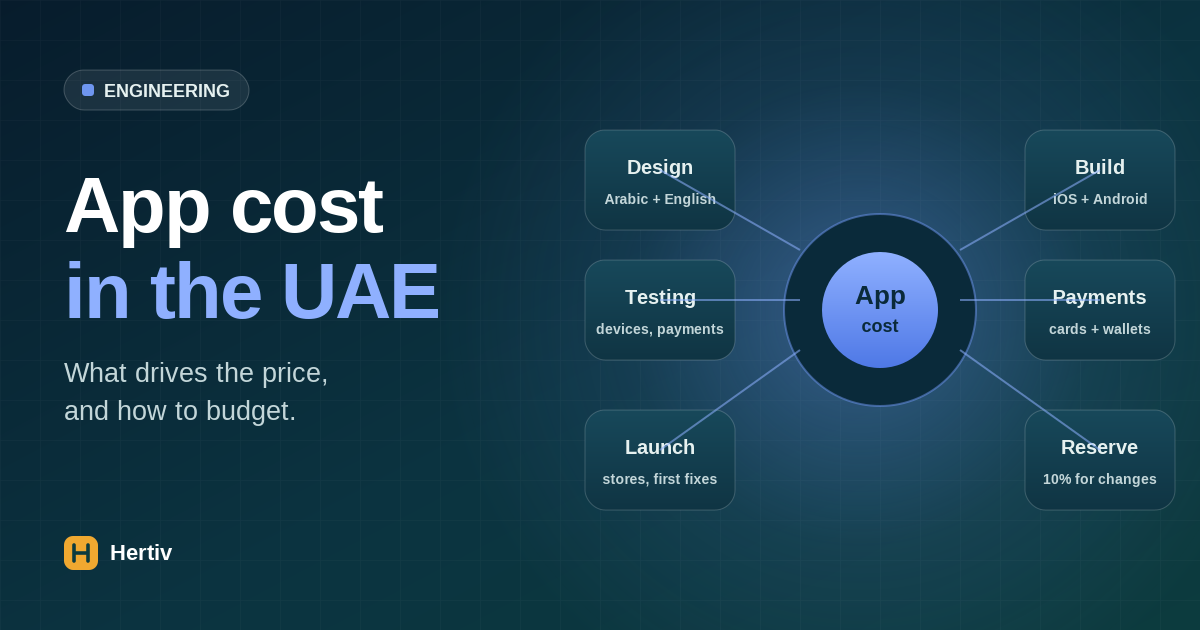
The build takes 1,600 hours at a hypothetical rate of $80 per hour, which is $128,000. Design and Arabic layout work adds $8,000, testing across devices and payment flows adds $6,000, and launch work, including store listings and the first fixes, adds $4,000. That gives $146,000 before any reserve.
Add a 10% reserve of $14,600 for the changes that always appear once real users try the app, and the total budget is $160,600. The reserve is not padding: it pays for the fixes and small changes that surface in the first weeks after launch.
Running costs sit outside that budget. Servers, push notifications, payment fees and store accounts are monthly costs, and a delivery app also pays for maps and messaging. AI app development cost follows the same split between build cost and running cost.
How to budget for your app in 5 steps
A clear budget starts with a short scope, not with a price. Follow these five steps before you ask any team for a quote.
- List the three must-have features. If the app cannot launch without it, it is in. Everything else waits for version two.
- Pick one platform first. Launch on iOS or Android, learn from real users, then add the second platform with what you learned.
- Ask for a line-by-line quote. Design, build, testing and launch should each be a separate line, so you can see where the money goes.
- Add a 10% reserve. Real users will find issues and ask for changes that no plan predicts.
- Budget the first year of running costs. Servers, fees, support and small updates continue long after launch day.
Teams that follow this order usually get quotes they can compare. Teams that skip it get quotes that describe different products, and the cheapest one is often the one that left the most out.
Common mistakes
The most common mistake is pricing the app by the number of screens. Two apps with twenty screens each can cost very different amounts if one is mostly static pages and the other moves money, tracks riders and handles refunds.
Another mistake is leaving Arabic out of the first quote and adding it later. Translating an app after it is built means reworking layouts, forms and error messages, which costs more than planning for two languages from the start.
A third mistake is forgetting the running costs. An app that costs $150,000 to build can still need thousands of dollars a month for servers, maps, payments and support. Ask for a monthly running-cost estimate alongside the build quote.
Finally, do not pick a team on price alone. A quote that is far below the others usually leaves out testing, design or the back end, and those items return later as extra charges or as bugs your users find first.
Key takeaways
- Mobile app cost in the UAE is mostly team time, not store fees.
- Features and platforms drive the price more than the number of screens.
- Plan for Arabic and English layouts from the start.
- Payments and data protection add real work to a UAE build.
- Keep a 10% reserve and budget the first year of running costs.
Frequently asked questions
How long does it take to build a mobile app in the UAE?
A simple app can take two to three months, while a marketplace or payment app often takes five to eight months. The timeline depends on the feature list, the number of platforms and how quickly you approve designs and test builds.
Do I need both iOS and Android from day one?
No. Most teams launch on one platform, learn from real users and then add the second. That cuts the first budget and gives you evidence about what to build next.
Why do UAE app quotes vary so much?
Quotes vary because teams price different scopes. One quote may include Arabic layouts, testing and the back end, while another leaves them out. Ask for a line-by-line quote so you can compare like with like.
What are the monthly running costs of an app?
Running costs cover servers, push notifications, payment fees, maps and store accounts. A small app may cost a few hundred dollars a month, while a delivery or marketplace app costs far more as usage grows.
Should I hire a team in the UAE or abroad?
A UAE team is easier to meet and test with local users, while a remote team usually costs less per hour. Many projects mix the two: local design and testing with a remote build team.
Does my app need Arabic?
It depends on your users. If you serve the general public in the UAE, Arabic is expected and should be planned from the start. If your users are a narrow group that works in English, you can launch in English first.


