How Much Does MLOps Cost to Run?
MLOps cost is the monthly spend on compute, storage, tools and people that keeps a model working in production. Learn the parts of the bill and how to estimate it.
On this page
Short answer
MLOps cost is the ongoing spend on compute, storage, tooling and people needed to keep a machine learning model running in production. For a small team with one or two models, the bill is often a few hundred dollars a month plus engineering time; large model fleets can run into tens of thousands.
What does MLOps cost?
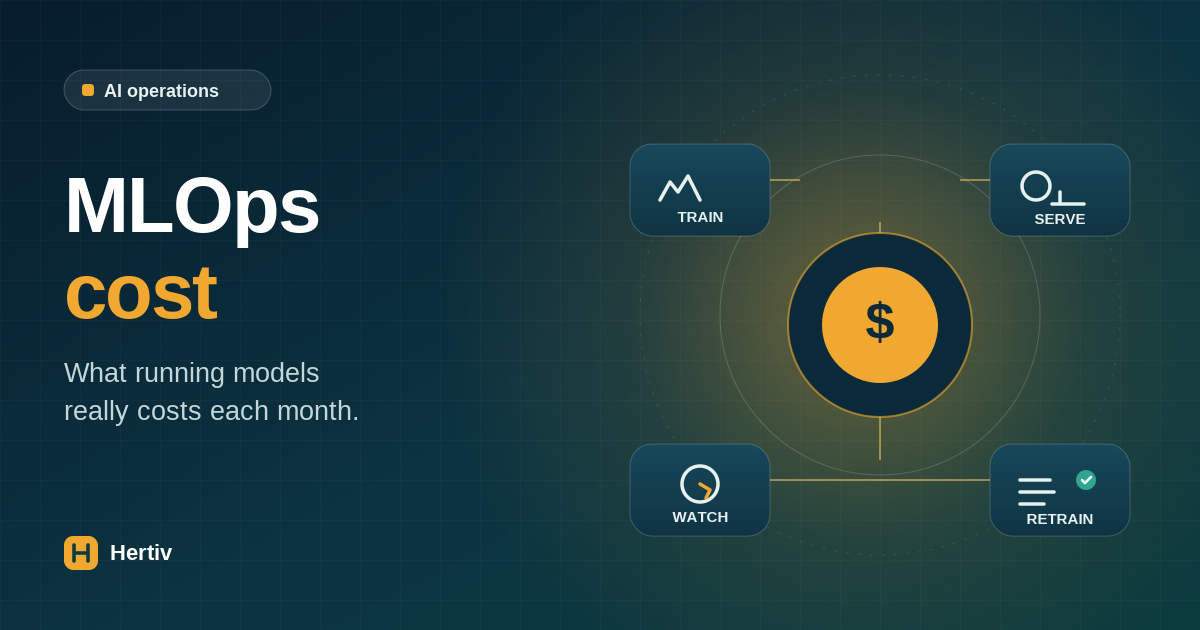
MLOps cost is the ongoing spend on compute, storage, tooling and people needed to keep a machine learning model running in production. It is not the one-off cost of building the model; it is the monthly bill for training, serving, watching and retraining it.
The bill splits into four parts. Compute pays for training runs and for serving predictions. Storage pays for training data, model files and logs. Tools pay for the platform that tracks experiments, versions models and runs pipelines. People pay for the engineers who keep the system working and fix it when a model drifts.
| Cost part | What it covers | Typical size for a small team |
|---|---|---|
| Compute | Training runs and live prediction serving | The largest line for most teams |
| Storage | Data, model files, logs and experiment records | Small at first, grows with data kept |
| Tools | Experiment tracking, registry, pipelines, monitoring | Free tier to a few hundred a month |
| People | Engineer time to run, watch and fix the system | Usually the largest real cost |
Teams often forget the people line. A model that needs an engineer to babysit it every week costs far more than its cloud bill. If you are new to the practice, what is MLOps explains the pieces that make up the bill.
What drives MLOps costs up or down?
MLOps costs rise with model size, data volume, retraining frequency and the number of models in production. Each of these multiplies the compute and the engineering attention a system needs.
Model size matters most. A small text classifier trains in minutes on a CPU and serves cheaply. A large language model needs GPU time for every training run and every prediction, so both the training bill and the serving bill grow with the model.
Data volume matters next: more training data means longer training runs and more storage, and a pipeline that reprocesses a full dataset every night costs more than one that processes only new rows.
Retraining frequency is the lever teams control most directly. Retraining weekly costs roughly four times as much as retraining monthly, before you count the engineer time to check each new version. Many teams retrain on a schedule tied to how fast their data changes, not on a fixed calendar.
The number of models matters too: ten small models cost more to watch than one large one, because each needs its own checks, alerts and rollback plan.
One cost that stays flat is the platform itself. Whether you use an open-source stack or a managed service, the tooling bill changes slowly, while compute and people scale with use. That is why the first estimate should start from the models, not the tools.
What do managed MLOps platforms cost?
Managed MLOps platforms charge for the resources a model uses, plus a platform fee in many cases. Prices are quoted by the vendor, so treat any figure here as a planning range and check the vendor site before budgeting.
Most managed platforms bill compute by the hour for training and by the hour or the request for serving. A training job on a single GPU for a few hours costs a small amount; a multi-GPU job running for days costs far more. Serving is often billed per hour of endpoint time, with some vendors adding a per-request charge on top.
Platform fees vary widely. Some vendors include experiment tracking, model registry and pipeline runs in the base price, while others charge per user, per workspace or per pipeline run. Storage is usually billed per gigabyte per month at the cloud provider's standard rate.
The honest way to compare vendors is to price one real workload on each: the same model, the same data, the same retraining schedule. A vendor that looks cheap on a price page can be dear once your workload runs daily.
Free tiers exist for most platforms and are useful for a first model, but they usually cap compute, storage or the number of models. Plan the move off the free tier before the cap forces a rushed change.
What does it cost to build MLOps in-house?
Building MLOps in-house costs engineering time up front and ongoing maintenance after. The cloud bill can be lower than a managed platform, but the people cost is higher.
A small in-house setup usually starts with open-source tools: an experiment tracker, a model registry, a pipeline runner and a monitoring dashboard. Setting these up and wiring them together takes an experienced engineer several weeks, and the setup is only the start. Someone must keep the pieces updated, fix breakages and answer questions from the model builders.
The running cost is mostly compute and storage at standard cloud rates, which is often cheaper than a managed platform's markup. The trade is time: every hour an engineer spends maintaining the platform is an hour not spent improving a model.
For teams with one or two models, a managed platform is usually cheaper once engineer time is counted. For teams with many models and a dedicated platform engineer, an in-house setup can pay off, because the same platform serves every model.
A useful rule is to count the maintenance load honestly. If the platform needs a day a week of engineer time, that is a fifth of a salary, and it belongs in the cost estimate next to the cloud bill. How to build an MLOps pipeline shows the pieces an in-house setup needs.
How do you estimate MLOps costs for one model?
To estimate MLOps costs for one model, price each part of the monthly bill separately, then add the engineer time. A five-step estimate takes an afternoon and is far more useful than a single guessed number.
- List the compute. Note the training hardware, how long a run takes, how often it runs, and the serving hardware and its hours. Price each at the cloud rate.
- List the storage. Add up training data, model files, logs and experiment records, and price them per gigabyte per month.
- List the tools. Add the platform fee, per-user charges and any per-run charges for pipelines and monitoring.
- List the people. Estimate the engineer hours per month for watching, retraining and fixing, and price them at the team's loaded rate.
- Add a margin. Add 20 to 30 percent for the first quarter, because first estimates miss the monitoring, the retries and the data that grows faster than planned.
Write the estimate down with its assumptions: retraining frequency, data growth and the number of models. When any of those change, the estimate can be redone in minutes instead of rebuilt from scratch. If the estimate is for a first model, compare the main platform options with best MLOps platforms for startups before choosing.
Example (hypothetical): a churn model in production
Example (hypothetical): a small subscription business runs one churn model that scores customers daily and retrains weekly. The monthly bill works out as follows.
Training runs once a week on a single GPU for 2 hours, which is 8 hours a month. At a planning rate of $2 per GPU hour, training costs $16 a month. Serving runs on a small CPU instance around the clock, at a planning rate of $0.10 per hour, which is about $73 a month.
Storage holds 200 GB of training data and logs at $0.02 per GB, which is $4 a month. The tooling is an open-source stack on the same cloud account, so there is no platform fee.
The people line is the largest. An engineer spends 4 hours a month watching the model, checking retraining results and fixing the odd failure. At a planning rate of $60 an hour, that is $240 a month. The total is $16 plus $73 plus $4 plus $240, which is $333 a month, and the people line is about 72 percent of it.
The lesson is that compute is the visible bill and people are the real one. A team that only prices the cloud misses almost three quarters of the cost of running the model.
What are common MLOps cost mistakes?
Common MLOps cost mistakes are pricing only the cloud bill, retraining on a fixed schedule, and keeping data and models that nobody uses. Each one quietly grows the monthly spend.
The first mistake is leaving the people cost out of the estimate. A model that needs weekly attention from an engineer costs more than its compute, and a model that nobody watches drifts until it fails in a visible way. Budget the watching time from the start, even if it is only a few hours a month.
The second mistake is retraining on a fixed schedule instead of on evidence. Retraining daily when the data changes monthly wastes compute and creates new versions that nobody checks. Set a retraining trigger based on data drift or a drop in accuracy, and review it every quarter.
The third mistake is keeping everything. Old training data, old model versions and old experiment logs all cost storage, and a pipeline that reprocesses the full dataset every night costs compute. Archive what is no longer needed and process only new data where the pipeline allows it. The cheapest model to run is the one whose costs someone actually reviews each month.
Key takeaways
- MLOps cost is the monthly spend on compute, storage, tools and people, not just the cloud bill
- Model size, data volume, retraining frequency and model count drive the bill
- Managed platforms bill compute by the hour plus a platform fee; price one real workload to compare them
- An in-house setup can be cheaper on cloud costs but costs more engineer time
- Estimate each part separately, add the people line, and add a 20 to 30 percent margin for the first quarter
Frequently asked questions
How much does MLOps cost for one model?
A small team with one or two models often spends a few hundred dollars a month on cloud resources plus a few engineer hours a week. Large model fleets can cost tens of thousands a month. The people line is usually the largest part of the bill.
What is the most expensive part of MLOps?
People time is usually the most expensive part, because an engineer must watch, retrain and fix each model. Compute is the largest cloud line, and it grows with model size and retraining frequency.
Is a managed MLOps platform cheaper than building in-house?
A managed platform is usually cheaper for one or two models once engineer time is counted, because the vendor maintains the tooling. An in-house setup can pay off for teams with many models and a dedicated platform engineer.
How often should a model retrain?
Retrain when the data or the model's accuracy changes enough to matter, not on a fixed calendar. Weekly retraining costs about four times as much as monthly retraining, so tie the schedule to drift or accuracy checks.
Does MLOps cost grow with the number of models?
Yes. Each extra model needs its own checks, alerts, retraining runs and rollback plan, so the watching and fixing load grows with the fleet even when the models themselves are small.
Can you run MLOps on a free tier?
Most managed platforms offer a free tier that covers a first model, with caps on compute, storage or model count. Plan the move to a paid tier before the cap forces a rushed change.


