What Is MLOps, and How Does It Work in Practice?
MLOps is the set of practices that takes a machine learning model from a notebook into a product that runs every day. It covers testing, deployment and retraining.
On this page
Short answer
MLOps, short for machine learning operations, is the discipline of building, deploying and running machine learning models in production. It covers the whole life of a model: training it, testing it, shipping it, watching how it behaves, and retraining it when the data changes. Without MLOps, a model that works in a notebook often never reaches users, or reaches them and slowly goes stale.
What is MLOps?
MLOps is the set of practices and tools that turns a machine learning model into a reliable part of a product. A data scientist can train a good model in a notebook, but a product needs more than that: the model must run on real data, answer quickly, be tested before each release, and be watched after it ships.
The name comes from DevOps, the practice of shipping software reliably, applied to machine learning. Software teams already know how to test code, deploy it and roll it back. MLOps adds the parts that are special to models: training data, model versions, evaluation scores, and the fact that a model can get worse over time as the world changes.
In short, MLOps is what makes a model a product instead of an experiment. It is less about any one tool and more about a repeatable path from an idea to a model that users can rely on, day after day.
How is MLOps different from DevOps?
MLOps builds on DevOps but adds problems that plain software does not have. Code either works or it does not; a model can work today and fail next month because the data it sees has changed. That difference shapes every part of the practice.
| Area | DevOps | MLOps |
|---|---|---|
| What is versioned | Code | Code, data and model weights |
| What is tested | Unit and integration tests | Tests plus model accuracy and fairness checks |
| What is deployed | An app or service | An app plus a model and its data pipeline |
| What is monitored | Uptime, errors, latency | Uptime and errors plus prediction quality and drift |
| When it is retrained | Never | When data or performance changes |
The practical result is that MLOps teams track more things. A release is not just a code version: it is a code version, a data snapshot, a training run and a set of scores. If any of those is missing, the team cannot reproduce what is running or explain why it behaves the way it does.
What does the MLOps lifecycle look like?
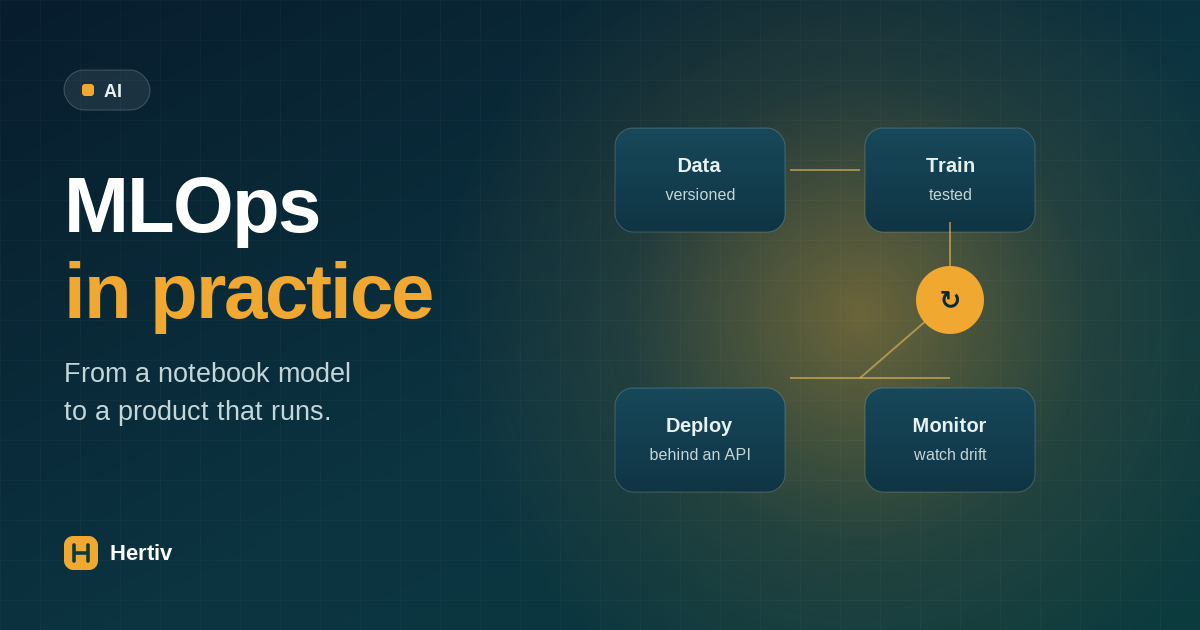
The lifecycle has five stages, and most teams move through them in a loop. First comes data: collecting, cleaning and labelling the data the model will learn from, and keeping a record of where each dataset came from. Bad data at this stage shows up later as a model that looks good in testing and fails in use.
Second comes training: choosing a model, training it, and recording the settings, the data version and the scores. Third comes evaluation: testing the model on data it has never seen, checking accuracy and also checking for mistakes that matter, such as errors on a particular group of users.
Fourth comes deployment: packaging the model with the code that serves it, testing the whole package, and releasing it slowly so problems are caught early. Fifth comes monitoring: watching predictions, checking for drift, and retraining when the scores fall. Then the loop starts again with new data.
Who does MLOps, and what tools do they use?
MLOps is a team job. Data scientists build and evaluate models, data engineers build the pipelines that feed them, and platform or DevOps engineers run the systems that serve them. In small teams one person may do all three, but the jobs are still different, and confusing them is how models get stuck in notebooks.
The tooling follows the lifecycle. Teams use a feature store or a data warehouse for data, an experiment tracker for training runs, a model registry for versions, a CI system for tests, and a serving layer that runs the model behind an API. No single tool does all of it, and the exact stack matters less than whether the pieces connect.
A common starting point is to keep it boring: one registry, one pipeline, one way to deploy. Teams that buy five tools before shipping one model usually spend more time wiring tools together than shipping models. For a step-by-step build, see how to build an MLOps pipeline.
Example (hypothetical): cutting deploy time from days to minutes
Example (hypothetical): a support team retrains a ticket-routing model every month. Before MLOps, each release took a data scientist about 12 hours of manual work: exporting data, retraining, copying files to a server, and checking the result by hand. Over a year that is 12 x 12 = 144 hours, or about 18 working days, spent on releases.
The team then builds a simple pipeline: data is versioned, training runs on a schedule, tests run automatically, and a good model deploys itself behind the same API. Each release now takes about 1 hour of review, because the pipeline does the rest. Over a year that is 12 x 1 = 12 hours, saving 144 - 12 = 132 hours, or about 16 working days.
The saving is not the main win. The main win is that releases stop being scary, so the team ships a better model every month instead of every quarter. The model stays fresh, and the team spends its time on the model, not on the release.
How do you start with MLOps?
Teams start with MLOps by fixing the most painful step first, not by buying a platform. The steps below work for a team shipping its first model.
- Version everything. Record the code, the data snapshot and the training settings for every model you ship, so any release can be reproduced.
- Automate the test. Run the same evaluation on every new model before it ships, and block the release if the score drops.
- Deploy behind an API. Serve the model as a service with a version number, so you can roll back to the previous model in minutes.
- Watch it in production. Log predictions and check them against real outcomes, so you know when the model starts to drift.
- Retrain on a schedule. Decide in advance when to retrain, and make retraining a normal job, not an emergency.
These five steps cover most of what a small team needs. Bigger teams add feature stores, online evaluation and automated retraining, but only after the basics work. For choosing the tools, see the best MLOps platforms for startups.
What are the common mistakes?
The most common mistake is treating the model as finished once it is trained. A model is a living part of the product: data changes, users change, and the model needs retraining and watching. Teams that ship a model and forget it usually find out months later that it has quietly stopped working.
Another mistake is skipping versioning. When a model misbehaves, the first question is which data and code produced it. If the team cannot answer that, they cannot fix it. Version the data and the training run, not just the code.
Teams also monitor the wrong things. Uptime and latency matter, but they do not tell you whether the model is still right. Watch prediction quality too: the share of answers that turn out correct, the error rate on new data, and any drift in the inputs.
Finally, do not buy a platform before you have a pipeline: tools cannot fix a process that does not exist yet. For help scoping the work, see MLOps consulting.
Key takeaways
- MLOps turns a trained model into a product that runs reliably every day.
- Version code, data and model weights together, so any release can be reproduced.
- Test every model before it ships, and block the release if the score drops.
- Monitor prediction quality, not just uptime, and retrain on a schedule.
- Start with the basics: versioning, tests, an API, monitoring and retraining.
Frequently asked questions
What does MLOps stand for?
MLOps stands for machine learning operations. It is the set of practices that takes a machine learning model from a notebook into a product: training, testing, deploying, monitoring and retraining. The name comes from DevOps, applied to the parts of machine learning that plain software does not have.
Is MLOps just DevOps for models?
Partly. MLOps uses DevOps ideas such as automated tests, versioning and staged releases, but it adds model-specific work: versioning training data, evaluating accuracy, watching for data drift, and retraining. A team that treats a model like ordinary code will miss those parts and ship a model that slowly goes stale.
Do small teams need MLOps?
Yes, but a light version. A small team needs versioned data, an automated test before each release, a way to roll back, and basic monitoring of prediction quality. That can be a few scripts and a checklist. A full platform only makes sense once the team ships models often enough to feel the pain.
What is model drift?
Model drift is when a model's predictions get worse because the real world changed. New words appear, customer behaviour shifts, or a data source changes format. The model was trained on old data, so its answers stop matching reality. Monitoring prediction quality is how teams notice drift and decide when to retrain.
How is MLOps different from LLMOps?
LLMOps is MLOps for large language models, with extra work around prompts, retrieval, token costs and evaluation of open-ended answers. The core ideas are the same: versioning, testing, deployment and monitoring. A team that already does MLOps has most of what it needs to add LLMOps on top.
What tools do I need to start?
Start with what you already have: version control for code, a tracker for training runs, a registry for model versions, and a simple serving API. Add a feature store and automated retraining later, once the basics work. The goal is a repeatable path from data to a running model, not a collection of tools.


